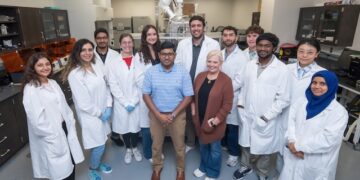






























Students and faculty watched and discussed the critically acclaimed 2016 film, “Moonlight,” at the Luckyday Residential College’s dining hall on the evening of Thursday, Feb. 19. A panel of three faculty members with expertise in theater, film and queer studies led the post-screening discussion.
The screening was the second in the African American Studies Program’s event series, “Lights, Legacy, Action.” The English, Theatre, & Film Department, the Luckyday Residential college, the Sarah Isom Center and Ole Miss Dining Services also partnered to make the event possible.
Program Manager for African American Studies, Tracion Flood, came up with the series last semester.
“We thought this would be great to get students to come out, watch Black films and then have a discussion afterwards,” Flood said.
The first screening was hosted in October and featured the film “Sinners,” which is nominated for Best Picture at the upcoming 98th Academy Awards.. Flood hopes students will gain a deeper understanding of different cultures by participating in the screenings and subsequent discussions.
“Many of the students at the university haven’t had the opportunity to really fully engage and have understanding (of different cultures),” Flood said. “But to be able to go deep with the professors. . . I think that kind of brings the students together on another level and I think it’s beautiful.”
“Moonlight” is a film adaptation of Tarell Alvin McCraney’s unreleased play, “Moonlight Black Boys Look Blue.” In three acts, the film follows the childhood, adolescence and young adulthood of Chiron, a Black, gay man navigating life in Miami during the 1990s crack epidemic. The film made history as the first with an all-Black cast to win the Academy Award for Best Picture.
Casey Craymer, a senior English major, said the representation of the Black community, racial minorities and the LGBTQ+ community were very needed on campus.
“Ole Miss is kind of a campus that’s known for the frat bros and sorority girls,” Craymer said, “And it’s important to have more diversity, you know?”
Students watched the film, which lasted around two hours, while snacking on complimentary pop corn, fountain drinks and Crumbl cookies. Afterwards, UM instructors Keith Davis, Teri Incampo and Pip Gordon led a discussion on the film’s themes, cinematography and character development. The three members of faculty said they had all used “Moonlight” in their syllabi at one point in time.
Davis, an instructional and assistant professor of film production, brought his real-world experience in acting and directing to the panel. He specifically highlighted the importance of lighting when shooting actors of color.
“The whole process of how film developed was primarily based around (the) skin tone of lighter people, white people,” Davis said. “So how much light was needed, how much exposure the film could tolerate was based on — gauged on — just white people because those were the people who were shot.”
“Moonlight,” Davis said, used the opportunity of an all-black cast to experiment with exposures and lighting that complimented darker skin tones. Specifically, the film takes advantage of how darker skin tones interact with and reflect surrounding colors.
“Dark skin . . . you’re not only your color but also all those other colors,” Davis said. “The film demonstrates that over and over. It’s part of this sort of palette of the cinematography and, look, it’s beautiful to see.”
Director Barry Jenkins also uniquely manages to incorporate marginalized backgrounds and identities without letting them dominate the film’s narrative or purpose. Davis said this was something he hoped his film students could take away from watching “Moonlight.”
“It’s like, yeah, to suddenly have a story where black people (and) gay people just get to be in a movie, and, sure, maybe those things are a part of it, but it’s not the point,” Davis said. “So you get richer, richer stories where suddenly I don’t have to spend the whole movie literally justifying the fact that I’m here.”