











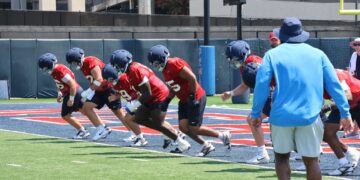












The University of Mississippi School of Journalism and New Media hosted a special screening of the short film “The Story of Ben Williams” followed by a panel discussion on Tuesday, March 31. The 15-minute film followed the life of beloved Ole Miss sports figure Ben Williams — the first African American student to play varsity football at the university — through lenses of race, public health and sports history.
Hailing from Yazoo City, Miss., “Gentle Ben,” as he was affectionately known, was recruited in 1971 as the first Black athlete on the Ole Miss varsity football team. This was only 10 years after James Meredith’s enrollment integrated UM. Williams follows basketball player Coolidge Ball, the university’s first Black athlete.
The discussion panelists following the film included producer and director of the film Fred Nettles, faculty fellow and writer-in-residence Ralph Eubanks, professor of history and African American studies Charles Ross and James Reed. Reed was recruited along with Williams to play as a running back on the junior varsity football team before joining Williams as the second Black football player on the Ole Miss varsity team.
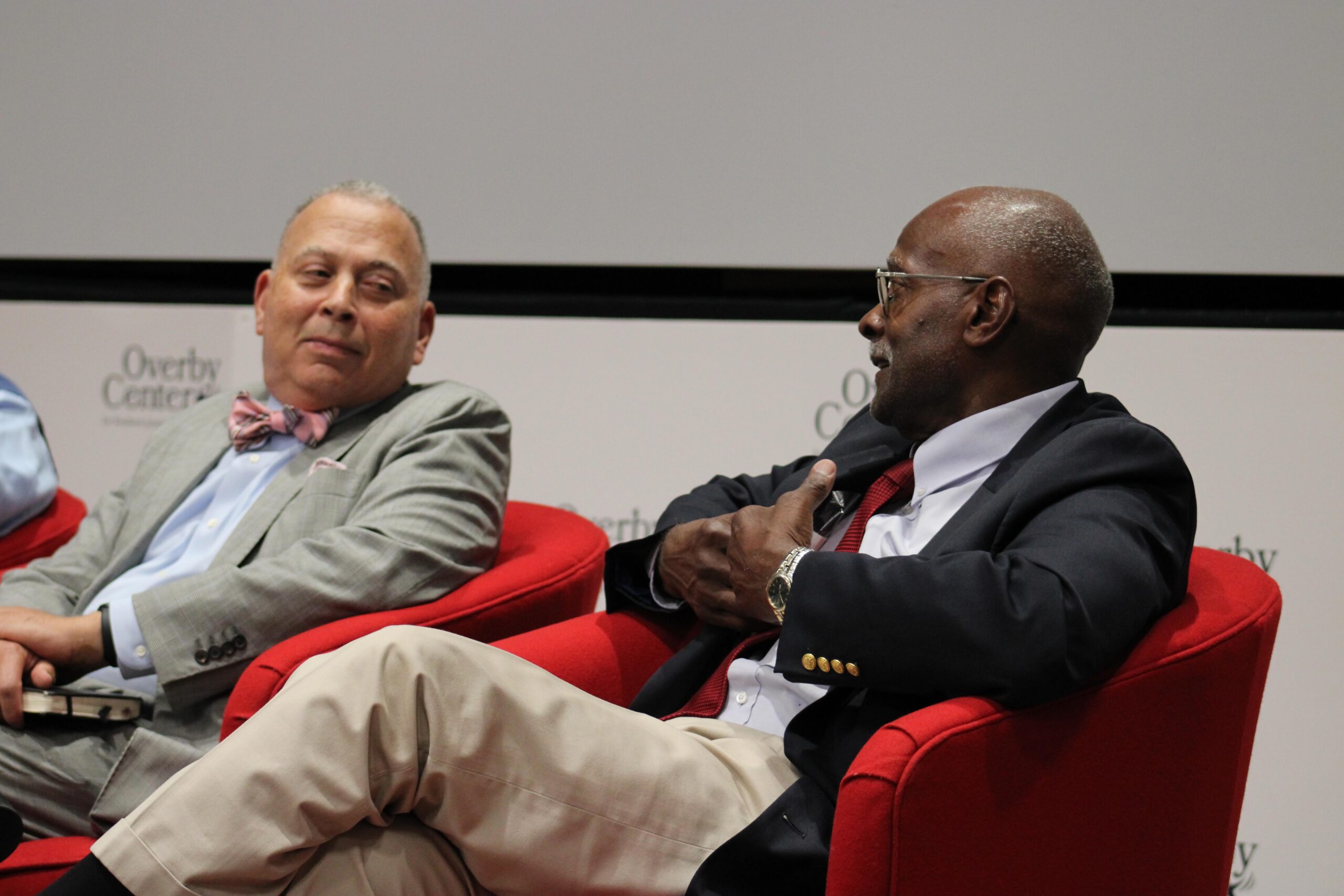
Reed reflected on his and Williams’ experience and thought process when first joining the team.
“Did we really know and understand from a political standpoint what we were doing at the time?” Reed said. “Maybe a little bit — but maybe not. We were 18 and 19 years old, and our only goal was to play.”
Williams holds the university’s record for career sacks with 37 and a single-season record of 18 sacks in 1973. After graduating in 1976, Williams was the first Black student from UM to be selected in the NFL draft. He went on to play for the Buffalo Bills before retiring in 1986. Williams died in 2020 after suffering from stage three chronic traumatic encephalopathy (CTE).
Using footage from the university’s archives, interviews with family members, historians and neuroscientists, the film detailed Williams’ impressive football career and later decline due to CTE symptoms.
According to the Mayo Clinic, CTE is a degenerative brain disease typically caused by repetitive head impacts. It often appears years after injuries with symptoms of memory loss, worsening motor functions and mental health decline. There is no cure, and it can only be definitively diagnosed postmortem.
Reed spoke of Williams’s CTE study that raised questions about his own health.
“When Ben Williams’ CTE study was done, I was given access to it, and (CTE) began forming when he was in high school,” Reed said. “We started playing at the same time and I wondered what my brain looked like on the inside. What’s going on inside my head in terms of CTE?”
Nettles spoke of the increased attention on CTE in recent years and his approach in documenting the disease.
“CTE has become a toxic buzz phrase and is considered ‘the end,’” Nettles said. “I’d like to focus on the steps before you get to that.”
The film was written, produced and filmed by Nettles, a UM alumnus. Originally from Conway, Miss., he received his bachelor’s in general studies with a focus in journalism, English and public relations in 2019. Nettles went on to earn his master’s at the Center for the Study of Southern Culture with a focus in documentary expression and sports history in 2024. Nettles began creating the film in 2021 for his master’s thesis.
During the discussion panel, Nettles described his initial interest in telling Williams’ story and the significance of Williams’ contributions to sports history.
“I went into this story as a curious sports fan from Mississippi,” Nettles said. “I always loved the stories of athletes that come from Mississippi, and another layer of that is the historical landscape. Although Ben Williams was not the first Black athlete at Ole Miss, he was one of the most significant because he integrated the sport that is most ingrained in American society.”
Much of the panel discussion included conversations and questions about race, public health and the future of football.
The film is the first installment of a three-part series by Nettles focusing on athletes and public health. Nettles is currently working on the next film in the series while pursuing a master’s degree from Harvard University in media, medicine and health. The second film will focus on youth concussions in tackle football. This project does not have a release date yet.
Nettles spoke of his experience as a self-taught filmmaker and expressed hope for future generations to follow their passions.
“I’ve been able to battle my own imposter syndrome and gather the courage to dive deeper into significant and life changing stories,” Nettles said. “I hope for the next generation to see that filmmaking is possible, and to not be afraid to pursue their passion.”
Henry Hyneman, a junior integrated marketing communications major from Oxford, spoke of his interest about the aspects of CTE brought up in the film and panel discussion.
“I thought the CTE discussion was very interesting, seeing how it’s sort of unknown and how dangerous it could be,” Hyneman said.
“The Story of Ben Williams” is available on YouTube under the account Front Porch Stories.