




























Oxford residents’ most recent push against the construction of hot mix asphalt plant Magnolia Materials, owned by local developer JW McCurdy, failed on Monday, March 23 when the Lafayette County Planning Commission unanimously voted against the residents’ petition to rezone a parcel of the Max D. Hipp Industrial Park from I-2 heavy industrial to I-1 light industrial where the plant’s proposed site currently sits.
The rezoning would have essentially quashed the plan to construct the Magnolia Materials plant at the current site.
This decision was the latest development in an ongoing controversy over the plant’s construction.
After strong public opposition, McCurdy abandoned his plans to construct the Magnolia Materials plant on Mississippi Highway 328 across from Falkner Farms near Taylor, Miss. McCurdy withdrew his petition in October 2025 to rezone the land on Highway 328 and moved his plans for construction to the industrial park.
McCurdy said the location change to the industrial park fell in line with the public’s requests to abandon the first proposed Highway 328 site.
“The city and county badly need an additional asphalt option, and almost every single person who spoke up during our first proposal said, ‘Go to the industrial park,’” McCurdy said in an interview with The Daily Mississippian. “So, we listened. We will build the exact same, a state-of-the-art, relatively small production plant.”
The Lafayette County Board of Supervisors approved the location change for the site plan in a November 2025 executive session. They approved the site plan on Jan. 5.
McCurdy must obtain a construction stormwater permit and hot mix asphalt general permit from the Mississippi Department of Environmental Quality (MDEQ) to begin construction.
“As part of the process, a public hearing is anticipated to allow for public input,” Jan Schaefer, communications director for MDEQ, said. “Following that, the matter (asphalt plant) would be presented to the Mississippi Environmental Quality Permit Board for consideration and final action.”
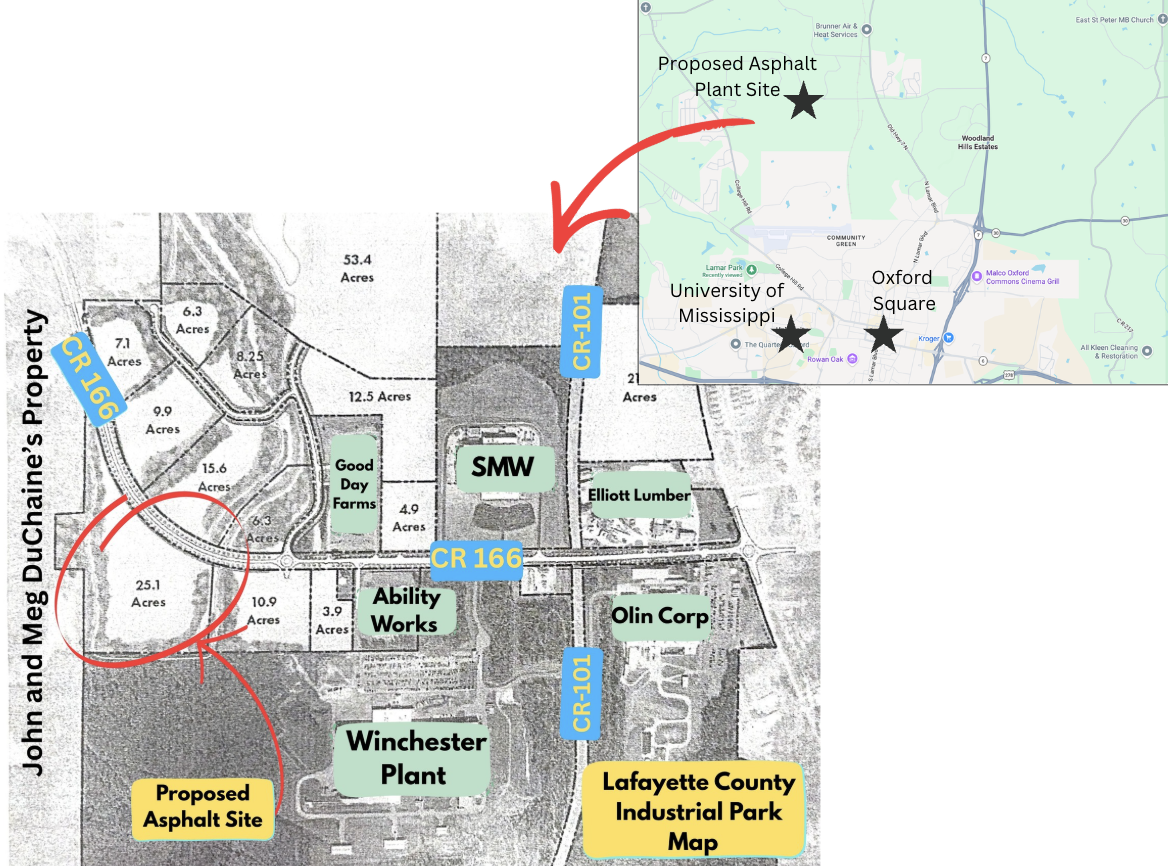
Currently, the entire 165-acre industrial park is zoned I-2 heavy industrial. The industrial park is located north of Oxford along the newly built County Road 166 that connects West Oxford Loop to Highway 7.
According to descriptions in the Lafayette County Zoning Ordinance, the Magnolia Materials asphalt plant requires construction in an I-2 heavy industrial zone.
“These (I-2 heavy) industrial uses generally have extensive space requirements and/or generate substantial amounts of noise, vibration, odors or possess other objectionable characteristics,” Article XVII of the Lafayette County Zoning Ordinance says.
Oxford resident Meg Faulkner DuChaine attended the planning commission’s meeting. She described locals’ pleas to rezone part of the industrial park to I-1 light industrial as significant.
“It was deep, it was meaningful, and people poured their hearts out — and some people got blunt,” Faulkner DuChaine said. “After all was said and done, (the planning commission) still unanimously voted to not rezone. It took them about five seconds.”
The Lehman-Roberts Company currently operates a hot mix asphalt plant on County Road 101 in Oxford, approximately 2.1 miles from the proposed Magnolia Material plant site.
According to Kate Victor, Lafayette County Administrator, the industrial park is currently home to Olin Winchester Rim Fire, Olin Winchester Center Fire, Good Day Farm, SMW Manufacturing, Ability Works, Elliott Lumber, B&B Concrete, Innovative Construction Management, Lafayette County Animal Shelter and Lafayette County Road Department storage facility and laydown area.
“When I heard they were going to put it in the industrial park, I thought, ‘Absolutely not, they cannot put an asphalt plant there. There are way too many people that live close to it,’” Oxford resident Glynna McKendree said, who attended the March 23 planning commission meeting.
Residents in neighborhoods near the site of the proposed plant — Tara Estates, Quail Creek Estates and Whitetail Landing — formed “Save Oxford: Asphalt Plant Edition,” a Facebook group with almost 400 members. McKendree is a member of the group.
Approximately 335 homes are located in a one-mile radius of the proposed asphalt plant site, according to CalcMaps and U.S. Census data.
McKendree said local residents sent letters to the board of supervisors on March 12, stating that the board had not followed Lafayette County’s Zoning Ordinance and that the lease of the property between the county and Magnolia Materials puts the county in legal jeopardy.
The zoning ordinance
The Lafayette County Zoning Ordinance was adopted in 2018, outlining zoned areas in the county such as agricultural, residential, commercial, light-industrial and heavy-industrial.
“We went to the (board of supervisors) meeting on Dec. 15, 2025, and we asked them to please table the issue until such time as the public could be notified, and then (District 2 Supervisor) John Morgan slammed his hand down on the table and said, ‘What more do you want? It’s going in the industrial park,’” McKendree said.
Morgan and fellow supervisors Brent Larson, Tim Gordon, Scott Allen and Greg Bynum did not respond to requests for comment for this article.
The difference between light and heavy industrial zones are defined by Lafayette County’s Comprehensive Plan. Both types of zones need “buffer zones” and are described as being away from residential areas.
“Industrial uses should be located away from, or well buffered from, residential uses,” the Lafayette County Comprehensive Plan said.
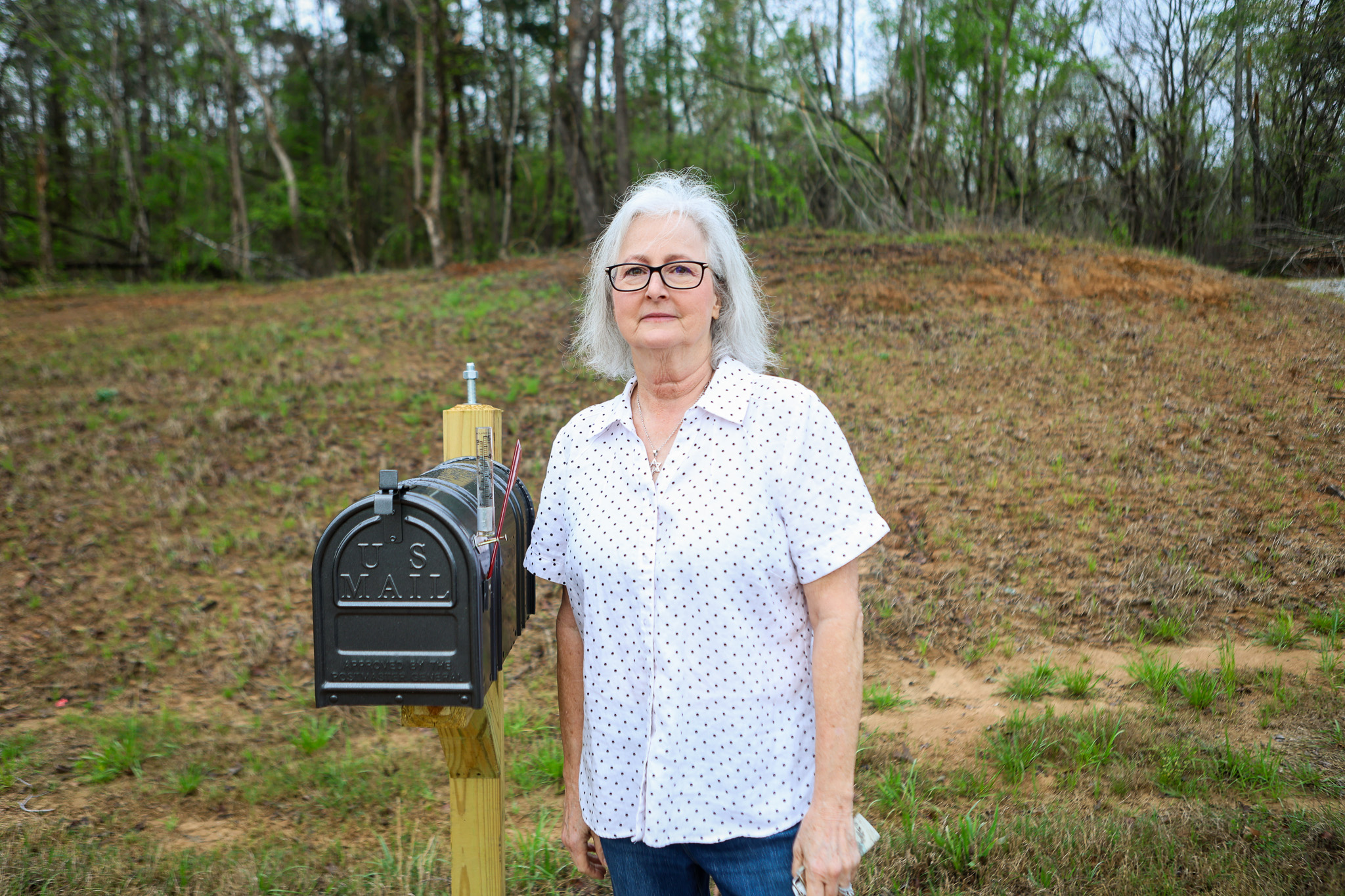
A buffer zone for the plant does not exist, according to site plans.
McCurdy did not respond to comment whether or not Magnolia Materials would build a buffer.
John and Meg Faulkner DuChaine’s 240-acre property, zoned an A-1 rural district, in Tara Estates has been in her family for generations. Meg Faulker DuChaine is the great niece of author William Faulkner, and the DuChaine family’s home is almost 200 years old. The DuChaines’ home would be only 150 feet away from the proposed asphalt plant site.
During the planning commission’s meeting on March 23, Joel Hollowell, the Lafayette County director of developmental services, said that a A-1 rural district property adjacent to the asphalt plant — the property owned by the DuChaines — would act as the buffer between the I-2 heavy-industrial-zoned asphalt plant and the residential-zoned neighborhoods.
“Joel Hollowell had the audacity to say during the meeting, that the land around the asphalt plant zoned A-1 (rural district), which is ours, will serve as a buffer,” John DuChaine, a licensed realtor, said.
Hollowell did not comment on DuChaine’s response. After initially agreeing to answer questions about the site from The Daily Mississippian, Hollowell did not respond before the time of this story’s publication.
The zoning ordinance includes no language that would imply an A-1 rural district property can act as a buffer zone for an I-2 heavy industrial site like the proposed asphalt plant.
“It is the intent of this ordinance that such ‘heavy’ industrial districts be located insofar as possible adjacent only to C-3 (Commercial High Density) or I-1 (light industrial) districts, which shall serve as transitional zones (buffers) between I-2 (heavy industrial) districts and residential uses and lower-intensity commercial uses,” Article XVII of the Lafayette County Zoning Ordinance says.
The language of the ordinance does not specify that the DuChaines’ land can be a buffer or transitional zone.
Lisa Chandler and her husband Mike Bennett’s property in Quail Creek is approximately 739 feet from the proposed plant’s driveway, according to a complaint filed by Chandler to the MDEQ on March 20.
Chandler is opposed to the plant’s location near the property she has owned for 30 years. She said she will be able to see the plant from her kitchen window, living room and back porch.
“We worked hard for this land,” Chandler said. “This used to be my piece of paradise until this happened.”
Chandler and the DuChaines thought a light-industrial area would look nice and attract visitors.
“We believed it would be this tech center, and there would be trails and paths for people to walk on,” Meg Faulkner DuChaine said.
John DuChaine asked the question: “Who is going to want to walk through an asphalt plant?”
In November 2025, when the asphalt plant was originally going to be located on Highway 328, McCurdy issued a press release explaining why the industrial park would not be a good place for the asphalt plant. The press release stated that the area surrounding the industrial park was too populated for an asphalt plant. This press release has since been deleted from the Magnolia Materials website.
The lease
McKendree, a former federal defense contractor of over 20 years, drafted many multi-million dollar contracts between the U.S. Department of Energy and Department of Defense. When she saw the lease signed between Lafayette County and McCurdy’s Magnolia Materials, she was shocked.
“It looks like a 6-year-old wrote it,” McKendree said. “I was mortified … that the board would sign this lease that gives no protections for the people of Lafayette County. Even the format of the lease is just appalling to be a government document.”
Lafayette County Attorney David O’Donnell declined The Daily Mississippian’s request for comment about the lease.
The board of supervisors signed a lease agreement with Magnolia Materials on Dec. 15, 2025, then executed the lease three days later. Mississippi Code § 57-3-9 indicates a site plan has to be approved by the board of supervisors in a public hearing before a lease can be signed.
On Dec. 22, 2025, the planning commission approved Magnolia Materials’ preliminary site plan.
“How can you sign a lease when you don’t have a site plan?” McKendree said. “I asked (District 1 Supervisor) Brent Larson, ‘Why did you do this and bind the people of Lafayette County for 35 years?’ He looked at me and said, ‘Because I can.’”
Larson did not respond to The Daily Mississippian’s requests for comment.
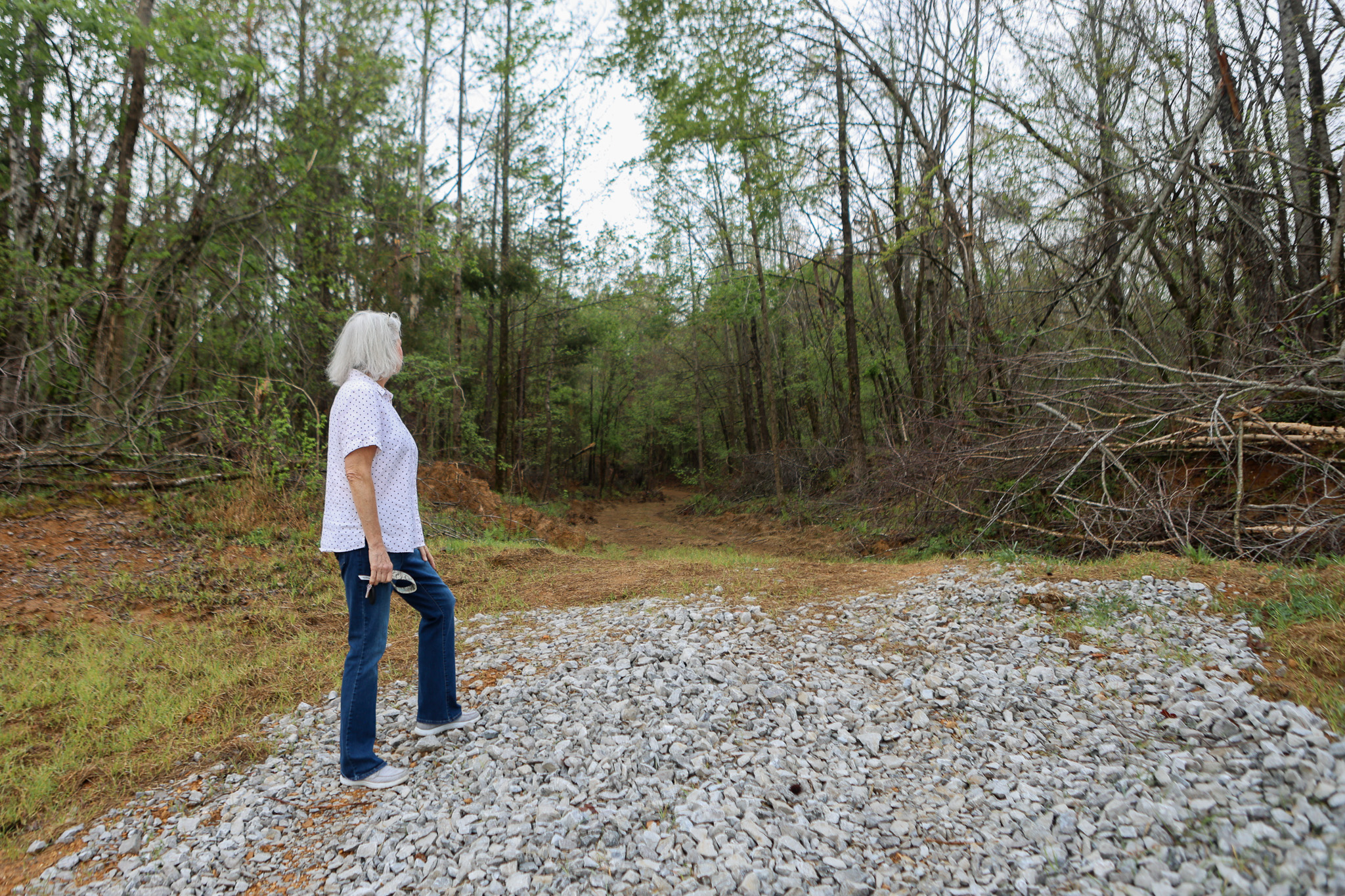
Magnolia Materials is to pay Lafayette County $5,000 a year for 35 years for the site in the industrial park, according to the lease signed.
According to a lease implemented in 2004 by the board of supervisors between Lafayette County and Olin Corporation, who owns the Winchester Ammunition plant at the industrial park, Winchester has paid $5,000 a year for rent, as well.
“I can go downtown and open a dress shop and pay the same amount for rent a month,” McKendree said. “Why would you lease land to an asphalt plant for that much when the people of Lafayette County could be getting a lot more for a toxic facility that is going to ruin their health?”
With regard to the environmental effects of the plant, McCurdy noted that the U.S. Environmental Protection Agency delisted hot mix asphalt plants as major sources of air pollution in 2002. He said that asphalt plants have reached over a 90% containment factor after 23 years of advancements in containment technologies.
Section 1.2.18 of the lease allows Magnolia Materials to assign the lease to another entity with the board of supervisors’ approval.
Exhibit B of the lease also states that permitted hazardous substances include asphalt cement, aggregate materials, diesel fuel, gasoline, motor oil and lubricants, hydraulic fluid, antifreeze, cleaning solvents, paints and coating.
“Any other materials commonly used in the operation and maintenance of an asphalt plant, provided that such materials are used, stored and disposed of in compliance with all environmental laws and quantities reasonable for tenant’s permitted use, ” Exhibit B of the lease said.
McKendree claims that the language of “other materials commonly used” in the lease is too vague and does not provide parameters for other potentially toxic materials.
According to Section 4 of the lease, the leased land will promote economic development in the county, generate tax revenue and offer employment opportunities. It also said that the asphalt plant is necessary in the fast-growing community.
The “Save Oxford: Asphalt Plant” Edition Facebook group has raised other objections to the asphalt plant’s location for reasons of economics, health and safety.
Economic impact
McCurdy believes that Lafayette County needs an asphalt plant to improve the growing Lafayette-Oxford community’s infrastructure.
“With or without us, Lafayette County and the city are spending millions on asphalt with one local producer,” McCurdy said in an interview with The Daily Mississippian. “You don’t need me to tell you how bad of a situation that is for our local government, and it is imperative that we add another option for our governments and our schools.”
Magnolia Materials is required to retain five full-time employees for the duration of the lease.
“(McCurdy’s) number one thing in the beginning was, ‘We need more asphalt.’ Of course he said his number one client was going to be the county, but the county has to bid their asphalt for the entire year in advance,” John DuChaine said. “I think (the board of supervisors is) just saying what people want to hear and not fact-based information.”
On Chandler’s back porch, the proposed plant will be visible, as well as the asphalt trucks passing by on County Road 166.
“I will see, hear and smell the constant production of asphalt and the heavy asphalt truck traffic proposed to run 12 hours per day, filling and releasing numerous trucks per hour,” Chandler said in her complaint filed to MDEQ.
The DuChaines are concerned that their sprawling property that extends over 200 acres will diminish in value due to something that they believe the county does not really need.
The impact of hot mix asphalt plants on nearby property values is inconclusive.
Safety concerns
The asphalt plant would require 20-25 asphalt trucks leaving and coming to the facility every hour, according to McKendree.
Because Regents School and Magnolia Montessori School are located close to the plant site, the “Save Oxford: Asphalt Plant Edition” members are concerned about potential safety hazards caused by the number of asphalt trucks that would be entering and exiting the Magnolia Materials facility.
“There are numerous gravel pits, concrete plants and an asphalt plant in our community, and they are strictly regulated and monitored,” McCurdy said in an interview with The Daily Mississippian. “Those regulations work, and we will be subject to the exact same ones. So, in a way, don’t take our word for it — look at the results. Lafayette County, the sheriff’s department and (Oxford Police Department) have made our roadways safe.”
Environmental and health risks
Residents are concerned about health risks as a result from long-term exposure to the asphalt plant’s emissions. McKendree cites a study conducted by Lafayette County resident Betsy Johnston, which was corroborated by a University of Mississippi professor with background in environmental toxicity, as well as the Center for Environmental Justice’s findings on asphalt production. The professor was unnamed by Johnson due to privacy concerns.
McCurdy countered those claims about health risks.
“We have addressed and will address those concerns with, first, filtration systems, which eliminate this possibility 100%,” McCurdy said. “Complemented by regular, unannounced environmental official visits … if they find that we haven’t eliminated this concern to their standards, we’ll stop work that instant. It’s fail-safe.”
MDEQ communications director Schaefer said it is the department’s responsibility to ensure compliance for all regulated Mississippi facilities. MDEQ uses periodic, unannounced inspections to do so, Schaefer said.
While MDEQ will ensure Magnolia Materials’ compliance with the agency’s standards, there are still concerns about the proposed plant’s environmental toll.
Robert DeVries, instructional assistant professor of biology at UM, agreed, said that asphalt production can emit byproducts like hexavalent chromium — a human carcinogen that can cause lung cancer when inhaled. DeVries said if the chemical is involved in laying asphalt, hexavalent chromium has to be produced in the asphalt plant itself and would be released unless contained by the plant.
“A lot of the things that leach out from asphalt are carcinogens and can cause the turning off of tumor suppressor genes,” DeVries said. “It’s hard to see a scenario that doesn’t relate to some contamination at some level.”
McCurdy outlined plans for containing emissions in a Magnolia Materials flyer distributed at the District 5 Town Hall meeting on Oct. 2.
“This plant will have entire buildings that are nothing but filters (baghouses), and the final emission will be water vapor. In fact, the total annual emissions created by the two residential fireplaces over an average year of usage,” the flyer said. “An industry like this doesn’t go through eight years of Barack Obama and four years of Joe Biden without coming out on the other end as one of the most highly regulated industries in the nation.”
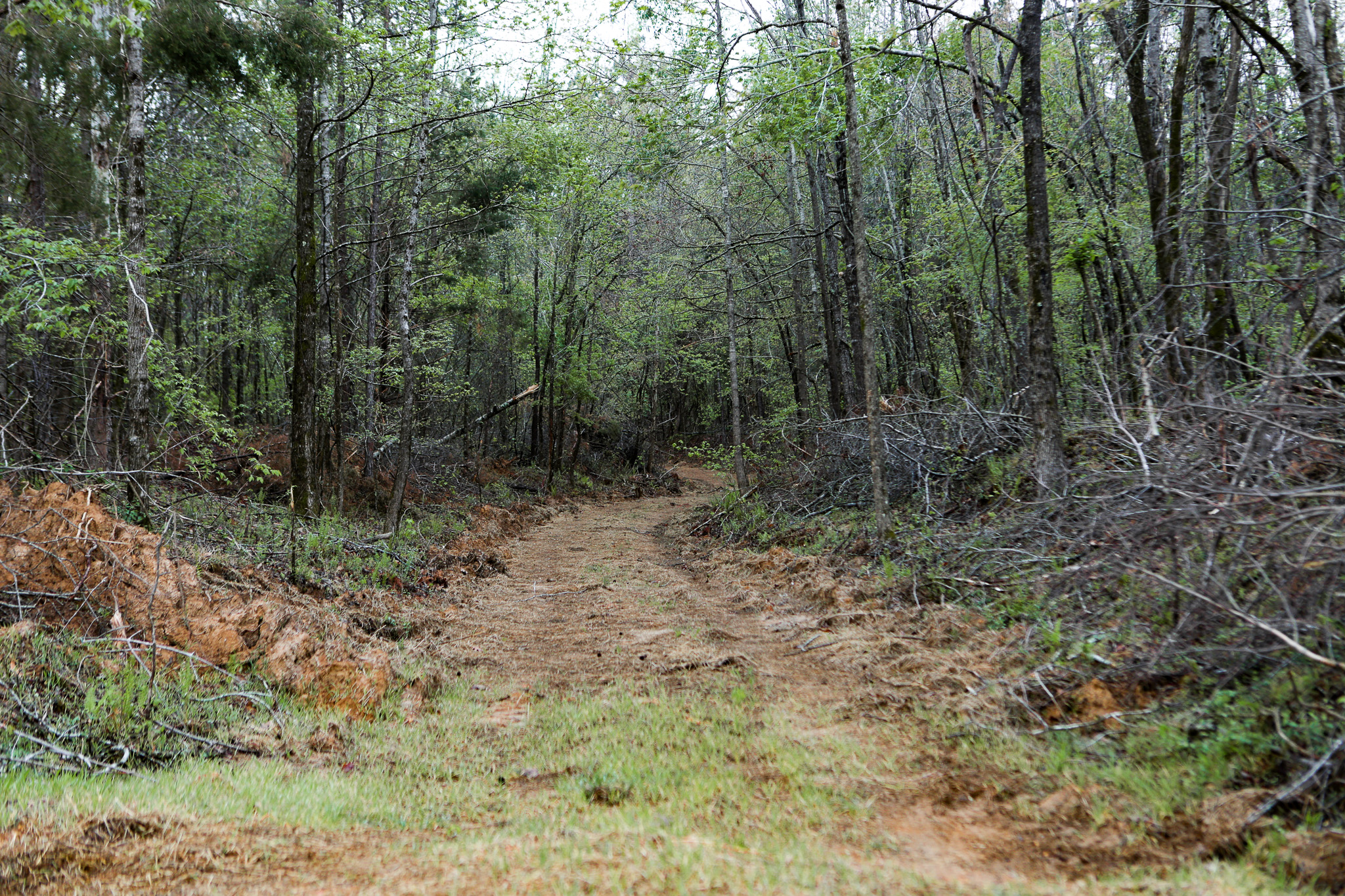
Potential contamination of the Berry Branch Creek that runs near the asphalt plant is a large concern of many local residents because it ties into Toby Tubby Creek, which flows into Sardis Lake.
Although opponents of the asphalt plant lost their bid to have the industrial property rezoned, they say they will mount additional efforts to stop construction of the Magnolia Materials facility near their homes.