



























For sophomore allied health studies major Aaron Cabriana, the TransLoc app said the OUT bus was five minutes away. Then, it said 10. A few minutes later, the bus disappeared from the app entirely.
“I honestly didn’t know if I would still get to campus on time,” Cabriana said in an interview on April 16.
Oxford-University Transit (OUT) is switching to a new tracking system, leaving students uncertain regarding bus arrival times and active bus locations. Many students believe their only solutions are to leave earlier or find another mode of transportation to campus.
OUT is the joint public transportation system for the City of Oxford and the University of Mississippi. OUT buses carry approximately 1.5 million passengers annually, making it the most-utilized transit system in Mississippi, according to OUT’s website. The OUT system serves as the primary transportation option for many students, with more than 20 routes across Oxford connecting student housing locations to campus and major Oxford locations such as Walmart and the Square.
While OUT’s tracking system update is intended to improve the system long-term, riders have found that the gap between what OUT is meant to offer and what it actually delivers is becoming difficult to ignore.
Invisible buses
The most common complaint among students is tracking buses along their routes.
Caden Bridges, a sophomore pharmaceutical sciences major who rides the bus every day, said that only one of the two buses on his route appears on the app.
“They only ever have one on the tracker, and that tracker is usually accurate,” Bridges said. “I can follow it, but the other one is just invisible. It’s 50/50.”
Senior psychology major Makenzie Tate described similar struggles waiting for buses without being able to track them using the app.
“The bus is going to come, but they’re not on the app,” Tate said. “If you’re not out there, you might have to wait another 30 minutes or an hour.”
Donna Zampella, general manager of OUT, is aware of this issue and explained that it has a specific cause: OUT is currently switching tracking platforms and has chosen not to install the current hardware, which would enable accurate tracking, on its newest buses.
“We are in the process of switching our tracking system, which is why the new buses do not yet have trackers installed,” Zampella said. “We will not invest in equipment that will be obsolete in two months.”
Sophomore exercise science major Haley Milsap said that the “ghost buses” cost her one morning after she waited more than 30 minutes for the Brown route. Since a bus never appeared at the stop, or on her screen, she ended up driving to class.
“It’s not on the app, so you kind of just have to sit at the stop and wait for one to come,” Milsap said.
Milsap now carves out an extra 20 minutes every morning to wait at the bus stop.
“I don’t feel like I can rely on the bus system to get where I need to be on time because of all of the issues,” Milsap said.
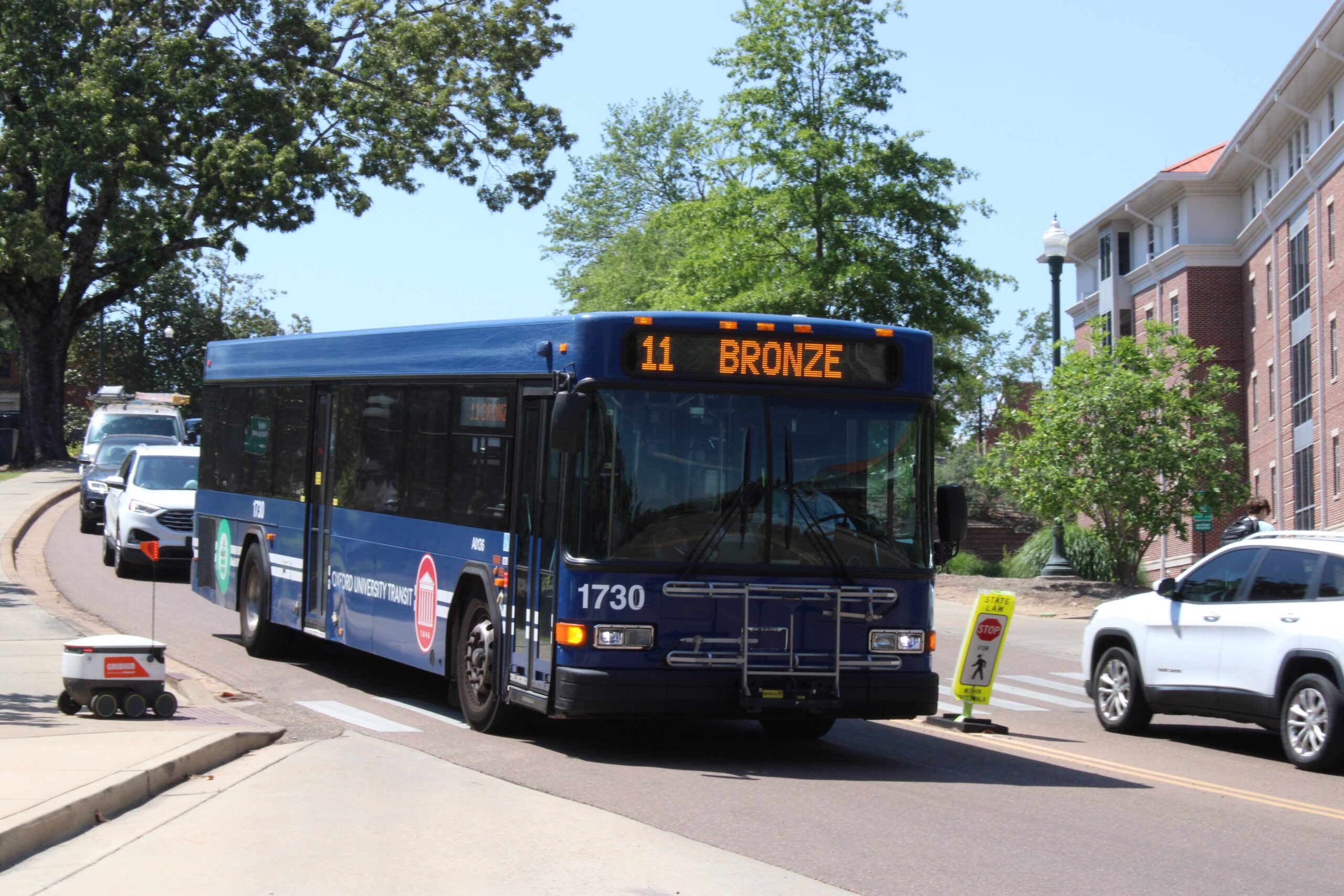
Driver shortage
Inconsistent tracking is not the only factor affecting delays. According to Zampella, a driver shortage is another challenge OUT faces, resulting in longer bus routes — both in terms of physical distance and time.
An OUT driver, who asked not to be named, said that a lack of driver availability has led to the need for combining full routes to meet the shortages.
“I’m doing Blue-Gray, which means Blue East and Gray … combined,” the driver said. “People are having to wait longer. They’re asking, ‘Where’s Gray?’ And I’m trying to get there, but I’m having to do two routes.”
The Gray route, which takes riders to the eastern edge of Oxford, is one of the longer routes on its own. Combined with another route, the delay has grown longer for those waiting.
“Both routes are really long by themselves, so some people end up waiting and don’t really know why,” the driver said.
For students who do not have an alternative mode of transportation, OUT’s unpredictability necessitates heavy planning. Jelecia Hopper, a senior integrated marketing communications major who depends entirely on the bus system to get around town, has to leave her apartment an hour before class starts.
“I will get to class like 30 minutes before, 20 minutes before, sometimes just five minutes,” Hopper said. “I just keep traffic in mind. I feel like I can rely on the bus, but I have to plan around it.”
Although OUT is aiming to cut down on wait times, Zampella acknowledged that some delays will always be a part of the transit system.
“Certain factors are beyond our control, such as traffic volume, detours, accidents, driver breaks and absences,” she said.
To address these issues, OUT is increasing hiring efforts for qualified drivers and providing Commercial Driver’s License (CDL) training for applicants at its facility. The unnamed driver and Zampella agreed that the bus system has shown improvement by more clearly establishing where the bus stops are.
“We have more stops and people actually know where to stand,” the driver said. “That part has gotten much better.”
Funding uncertainty
Despite OUT’s efforts to tackle tracking and staffing issues, the company’s financial structure depends heavily on the federal government. The City of Oxford holds the grant that supports OUT, but the system operates under federal Section 5311 funds — Formula Grants for Rural Areas. Thus, cuts to the transportation budget at the federal level directly impact OUT’s budget.
“The federal government is implementing budget cuts across various sectors, including transportation,” Zampella said. “Budget reductions could impact our ability to procure new buses, invest in technology systems and complete necessary repairs and maintenance.”
According to the American Public Transportation Association (APTA), the Trump administration recently requested a $4.8 billion cut in public transit spending for the 2027 fiscal year, a decrease of 23% from the FY 2026 enacted level.
Zampella remains hopeful that OUT will avoid disruptions to its 2026-27 budget but could not rule out the possibility of cuts. In addition to an 18-month production delay for heavy-duty buses — which is a lingering effect of the COVID-19 pandemic — budget concerns only compound the challenges OUT faces in improving its services.
Even so, OUT has added 30 buses to its fleet in recent months.
What can riders expect this fall?
In the face of driver shortages and funding pressures, upgrades to the rider experience are on the way. Regarding the specific changes students can expect for the fall semester, Zampella pointed to replacing the current TransLoc tracking system with Swiftly.
The switch to Swiftly would allow users to track buses through Google Maps, receive updates on route delays and detours in real time and experience fewer overall interruptions.
Additionally, OUT is considering the implementation of a communication application that all riders could download to receive information in real time. For those who may not have access to the internet, the agency is actively equipping bus stops with maps, route details and additional useful information for riders to stay informed on bus routes and schedules.
Overall, OUT continues to make targeted changes to bus routes with the goal of improving turnaround times.
“We regularly evaluate routes to ensure efficiency, especially as the city adds more apartment complexes,” she said.
For Milsap and many other students, however, an improved experience would not require much.
“If the app worked, honestly, it’d be fine,” Milsap said. “That’s really all it is.”