































For a university in the Western half of the world, the University of Mississippi is very Greek. In 2025, nearly 11,000 students participated in Greek life organizations — just under 50% of the undergraduate student body. While less than half of the students here are involved in sorority and fraternity life, it seems as though these organizations are all we can talk about.
Although we are years beyond high school and should have outgrown our teenage tendencies by now, the reality is that we, as college students, have not matured all that much in one aspect: We still gossip. It is time we leave behind this childish habit, contributing to negative stereotypes and bullying when it comes to members of Greek organizations.
Students on and off campus spread their opinions and post them on YikYak, an anonymous platform where anyone can join a community and, with a school email, join their college’s page. On the app, posts range from traffic complaints and football drama to all sorts of other nonsense, but its primary discourse often revolves around sororities and fraternities.
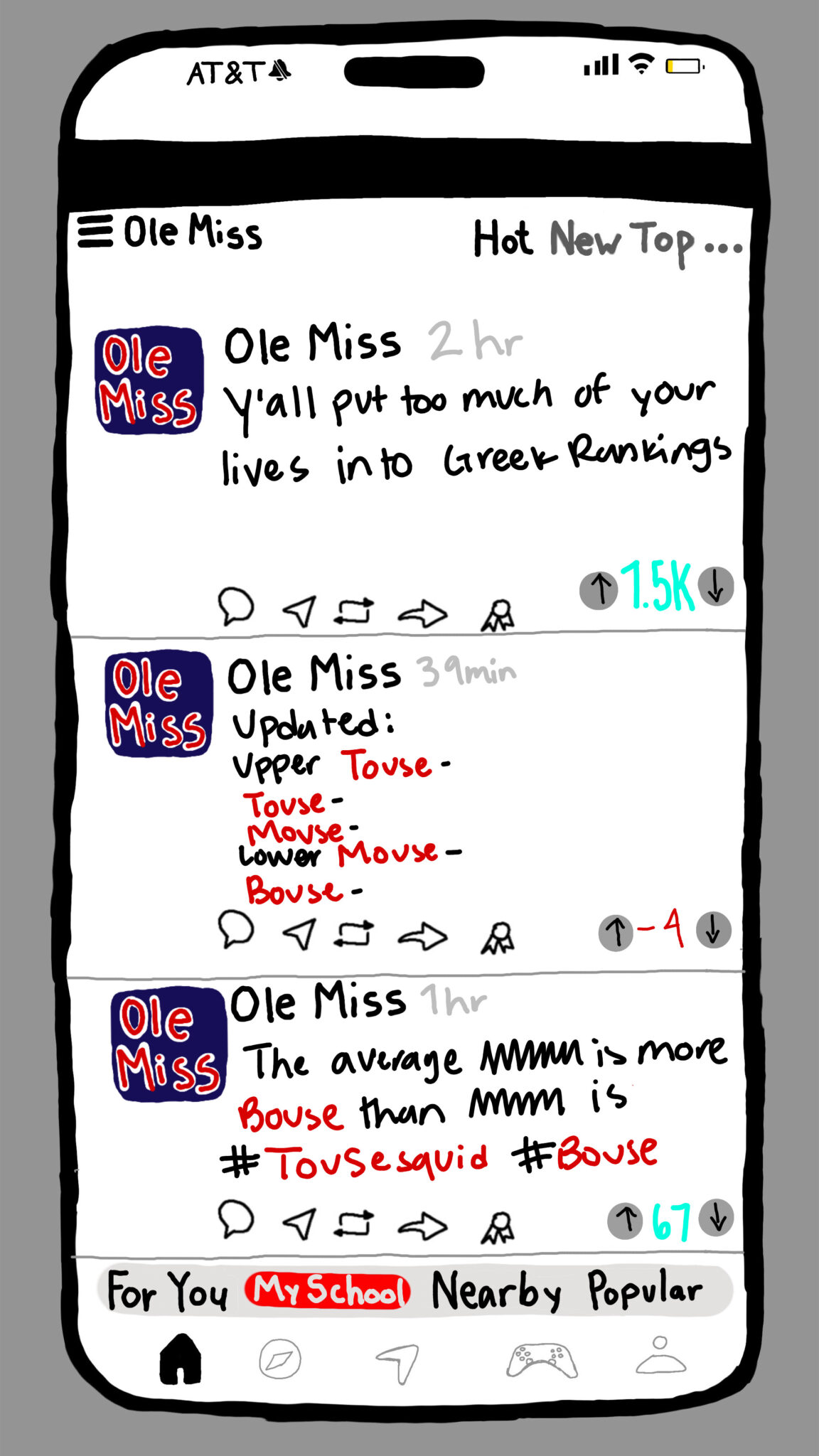
The cliques that most coming-of-age movies display are starkly similar to the sorority and fraternity stereotypes here, with the names “touse,” “mouse” and “bouse” being given to varying houses. These clever monikers are combinations of the word “house” with three levels of ranking — top, middle and bottom.
Non-Greek students are not immune to arbitrary labeling. Many students apply the term “Geed” to those who are not Greek affiliated, stemming from the acronym GDI, which stands for “g—–n independent.” Are we back to code names and passing notes like middle schoolers?
There are 11 sororities under the College Panhellenic Council and 17 fraternities within the Interfraternity Council at the University of Mississippi. According to YikYak users, each house has found its ranking of “bouse,” “mouse” or “touse.”
If you ask five people on the Ole Miss campus, you will likely find five different answers to what determines these rankings. If we can’t come to a consensus on what separates a good house from a bad one, why do we pay attention to these rankings at all?
Darlyn Bustillo, a junior political science major from Ridgeland, Miss., is not in a Panhellenic sorority, but rather, she is a member of Alpha Kappa Alpha Sorority Inc., a chapter within the National Pan-Hellenic Council.
“To an extent, I think the ranking is fair,” Bustillo said. “I think (the ranking) is determined by the person judging. Everyone’s opinions are different, and they may favor or dislike different houses.”
Junior journalism major and member of the Delta Psi fraternity Jack Trittler, from Naples, Fla., agrees that the ranking for each house is valid, though for a different reason. Trittler said rankings are determined by the behavior and character of a chapter’s members.
“(Girls in) touse are, overall, good people, someone you can count on and trust. Bouse is the complete opposite,” Trittler said.
Bustillo and Trittler said that the rankings have stronger social implications for sororities.
“It matters more for the girls’ reputations,” Bustillo said.
For Trittler, the priorities of an organization’s members factor into the rankings students assign to sororities and fraternities.
“(The ranking) is 100% different for sororities; they care more about their image and likeness, while frats are more social,” Trittler said.
Both students remarked that while members of “bad” or “bottom” chapters could still be good people — which brings into question the validity of the ranking system in totality.
“Someone can be in touse and be bouse as a person, and vice versa,” Trittler said.
Bustillo agreed with this sentiment.
“I don’t think (the rankings) apply to everyone, because I’ve met great and not-so-great people in both touse and bouse, so it depends on who the individual is,” Bustillo said.
If an individual’s worth is determined by the reputation of his or her chapter without accounting for whether he or she fits that narrative, the rankings and names he or she is given cannot be taken as legitimate and should instead be dismissed.
Ranking and name-calling others is adolescent and harmful to those in sororities, fraternities and non-Greek students alike. If arbitrary names are determining these young men and women’s reputations and social statuses, using them should be treated as defamatory. People’s worth and status should not be up for debate, regardless of their letters or lack thereof.
It might be fitting to say that demeaning others is bouse behavior.
Nataly Tello is a sophomore English and journalism major from Hernando, Miss.