





























The American Kratom Association (AKA) denounced local law enforcement in Oxford for misrepresenting the drug kratom following the deaths of two University of Mississippi students. The conference took place outside the Lafayette County Detention Center on Wednesday, Sept. 30.
“We wanted to correct the false claim that was provided in a pre-investigation report by the police chief and the county sheriff where they indicated that there was found at the scene a packaged kratom product,” Mac Haddow, senior fellow of public policy for the American Kratom Association (AKA), said. “We now know that that is inaccurate and should never have been put up.”
The Lafayette County Metro Narcotics Unit released a statement on Sept. 22 following the deaths of Aidan Hamilton and Robert Strang, stating that packaged kratom was found at both investigation sites. The specific product was not disclosed, and the statement said that there was no confirmation that kratom was a contributing factor in either death. However, the statement warned the public to avoid kratom altogether.
Oxford Police arrested Yahya Mohamed Mosleh and Islam Mohamed on Sept. 24 for possession of Schedule I substances with the intent to distribute. The arrests were made after OPD obtained a search warrant at Puffs Vape, Tobacco & Beer Store.
Following the arrests, police disclosed on Sept. 28 that the drug found at both student death sites was marketed as Smax Psuedo-DHM.
Smax Psuedo-DHM is a synthetic drug containing opioid compounds named MGM-15 (scientific name dihydro-7-hydroxymitragynin) and mitragynine pseudoindoxyl. Both compounds have been temporarily federally classified as Schedule I narcotics as of Aug. 26, 2026.
This classification does not apply to traditional botanical kratom, although both have been banned in Oxford since 2019.
Smax Psuedo-DHM and related products synthetically alter the chemical compound of kratom to create the opioid-like high that users experience. Haddow said the synthetic drugs are different from natural kratom. Local law enforcement misrepresented the issue by announcing kratom as a potential danger, Haddow said.
Natural kratom derives from the leaves of a tree native to Southeast Asia and is used as a natural pain reliever and energy booster. Crushed leaves can be drunk in tea, smoked or swallowed in pills.
Haddow said that the drugs found on the scene were mislabeled; these drugs were not, in fact, packaged kratom but, rather, Smax Psuedo-DHM.
“We are here to hold Sheriff (Joey) East and Police Chief (Jeff) McCutchen to account,” Haddow said. “(We want to) have them explain to the families and the Ole Miss community why (East and McCutchen) would not have identified properly — with pictures — the products in the scene so there would be clarity, and no one could doubt what the product was.”
OPD’s failure to release photographs of the drugs found on the scenes, combined with the mislabeling of the drugs as packaged kratom in the Lafayette Country Metro Narcotics statement, meant that students who might have been in possession of SMAX Pseudo-DHM would not have realized this was the drug found at both scenes.
“What happens if an Ole Miss student sitting in a dorm room or off-campus housing has the very product that was identified at the scenes, but not disclosed, sitting there?” Haddow said. “And it’s not packaged as kratom … because it isn’t kratom. They would think that product is safe.”
Haddow said this lapse in judgement caused significant harm and led to the increase in media attention surrounding Oxford.
“The idea that the law enforcement officials here in Oxford would allow that misinformation to occur is unforgivable because it misled everyone and, of course, it also misled the media,” Haddow said. “We’ve heard this media frenzy for the past two weeks about kratom being associated with these tragic deaths here at Ole Miss, and we find out now it’s not.”
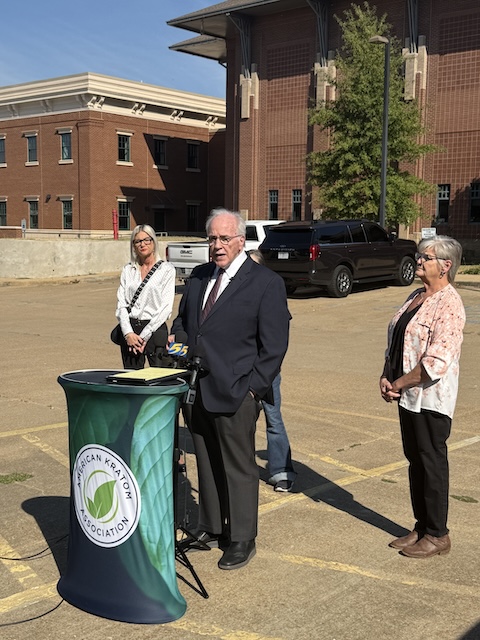
Mac Haddow speaks during the American Kratom Association Press Conference at the Lafayette County Detention Center on Sept. 30. Photo by Chance Marlowe
Lafayette County Metro Narcotics released a statement on Sept. 30 shortly after AKA’s conference which explained the initial press release did not cite kratom as the cause of death. Its warning against kratom use was issued out of an abundance of caution.
“That warning was not a declaration that kratom or any specific substance caused either death,” the statement said. “It was a proactive effort to inform the public of a potential danger while investigators worked to determine the facts.”
In an interview after the press conference, Haddow disclosed to The Daily Mississippian that the toxicology screens of Hamilton and Strang are complete but not yet released.
The Lafayette County Metro Narcotics statement maintains that the full report is still being assembled.
“We are awaiting the official autopsy and toxicology findings from the Mississippi State Medical Examiner’s Office and associated forensic testing to help determine the cause and manner of each death,” the statement read.
Haddow believes the investigation process from law enforcement should be reviewed.
“I think it is fair now to test the methodology of the police chiefs and sheriff department, and I hope the state takes a hard look at this,” Haddow said.
AKA is in favor of furthering the ban on these synthetic substances and argues that these synthetic substances create false narratives surrounding natural kratom.
“We want, as the American Kratom Association, to get the bad actors not only in this synthetic opioid space, but we want the natural kratom leaf product manufacturers who are violating federal standards that require that the entry of their product must have a reasonable basis for safety (to be removed, as well),” Haddow said. “We have reported over 140 companies who are making illegal therapeutic claims whose product formulations are suspect to the FDA.”
Haddow also expressed concerns that the toxicology report will not be done adequately. He said that if an extensive toxicology screening is not performed, kratom could be falsely attributed as the cause of death due to the manipulated chemical makeup of the synthetic drug.
“The manipulations that are made by bad actors in the kratom space is equally complex, and it requires a full and complete (toxicology) screen before anyone should come out there,” Haddow said. “I, frankly, have doubts when you have this kind of law enforcement investigation that did what the sheriff and the police chief did, that didn’t properly warn people in the Mississippi area and throughout the country. That’s irresponsible.”
Haddow cites National Medical Services Labs, an internationally accredited independent laboratory that provides specialized toxicology services, for this warning.
“They’ve informed coroners, medical examiners and law enforcement officials that you cannot rely upon simply the detection of mitragynine, the principal alkaloid in the kratom plant, as a basis for saying (kratom) is attributed to or in any way caused the death,” Haddow said.