






























Sometimes the most beneficial thing a player can do is stop playing. Plenty of players try to push through injuries or do not let their bodies fully heal, which can lead to severe consequences. For Kewan Lacy, that time may be now.
Lacy entered the season with expectations of being one of the most important pieces on the Rebel offense. His explosiveness, physicality and ability to turn an ordinary rushing attempt into a game-changing play made him a focal point of the offense last year. When healthy, there is little question that Lacy is the most dangerous running back on the team, perhaps even the entire country.
However, the best ability is availability. As the season has progressed, Lacy has dealt with a series of blows to his left shoulder, an injury to his thigh and a hamstring injury. He will now miss the game against Auburn on Halloween, as well, because of his shoulder.
At some point, Ole Miss has to recognize that continually trying to push Lacy back onto the field may not be the best decision for the player or the program.
Instead, Ole Miss should seriously consider shutting Lacy down for several weeks to allow him to fully recover while handing the reins of the backfield to Makhi Frazier, along with other names.
“Makhi (Frazier has) come in and played well. With Kewan (Lacy) being out this week, Shekai (Mills-Knight)’s going to have a real opportunity this week,” head coach Pete Golding said in a press conference on Oct. 26. “Obviously, JT (Lindsey) is still in the room. Now, we have to find some things for him to do.”
The Rebels have good depth at the running back position that must be utilized going forward. The other backs will get more reps against Auburn with Lacy out for the second time this season.
“We’re going to need all those guys moving forward to be honest with you and do a good job in that room creating roles for them, and allow them to execute throughout the week,” Golding said.
This is not meant to disparage Lacy’s toughness or willingness to compete. If anything, his determination to keep playing despite the physical setbacks demonstrates how much he wants to contribute to the program.
There is a difference between being healthy enough to play and being healthy enough to perform at the level a team needs and keep yourself safe from future injuries.
Football offenses thrive on repetition. Offensive linemen develop familiarity with how running backs attack certain gaps. Quarterbacks become comfortable with their teammates’ tendencies in pass protection and the passing game. Coordinators establish an identity around the personnel they know will be available.
That process becomes considerably more difficult when the team’s primary running back is constantly moving among the field, the injury report and the sideline.
The Rebels cannot afford to enter every week wondering whether their offensive game plan will revolve around Lacy, whether his workload will need to be restricted or whether someone else will be forced into a larger role.
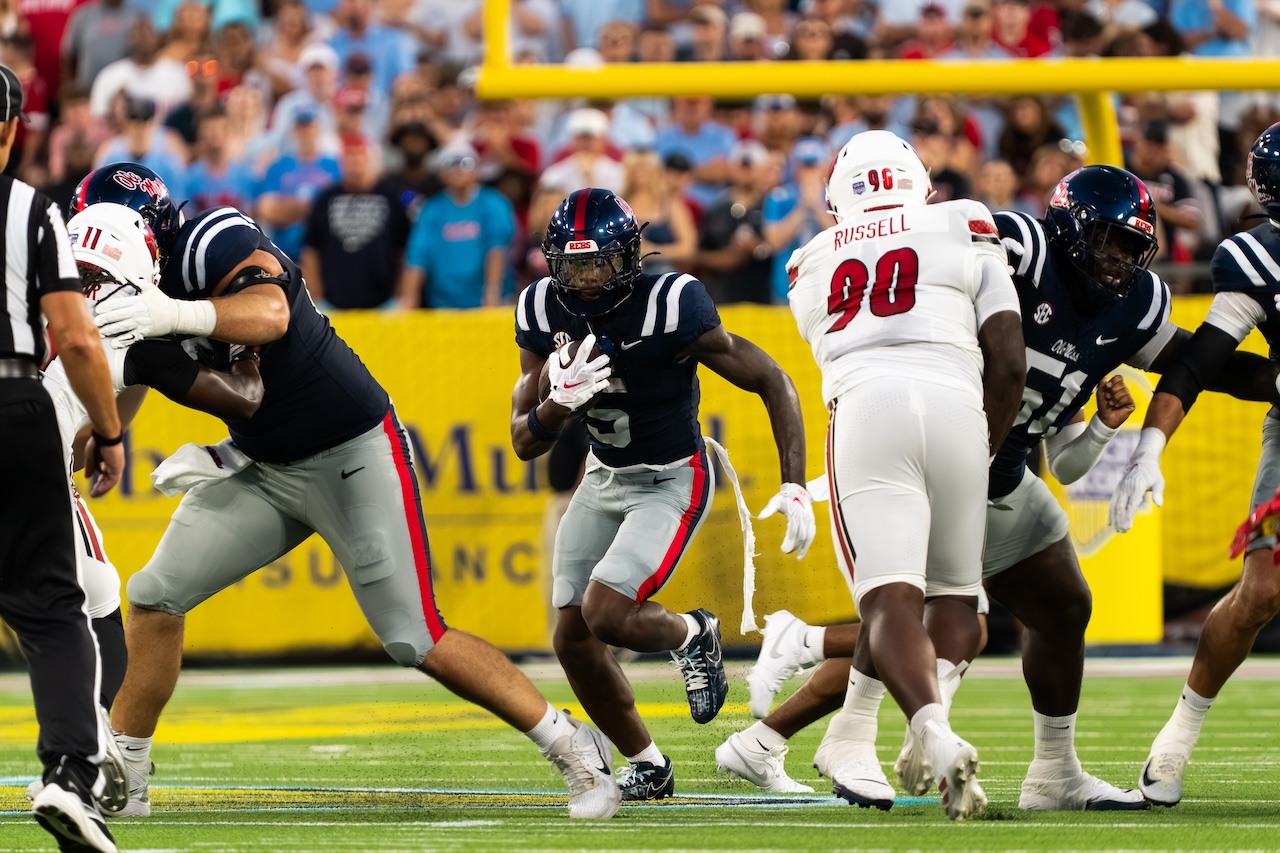
While Golding is confident in his backfield, Lacy’s continued uncertainty can affect the offense’s production.
Should the coaching staff limit his carries? Should it avoid certain plays? Should it rotate running backs more frequently to keep him fresh?
Those are reasonable questions individually, but collectively, they make establishing an offensive rhythm much more complicated than necessary. The solution is not necessarily finding a more talented player — it is finding a dependable one. That is where Frazier enters the conversation.
There is value in knowing who will carry the football on first down, who will be trusted in short-yardage situations and who will remain on the field when the offense needs to sustain a drive.
For Frazier, a consistent workload would provide the opportunity to develop a rhythm that is difficult to establish through sporadic appearances. Running backs often become more comfortable as games progress. They begin to recognize how opposing defenders react to certain blocking schemes, where cutback lanes might develop and which defenders are overcommitting to particular gaps.
There is also a larger question that Ole Miss must consider when evaluating Lacy’s future. What does the program actually gain by continuing to put him on the field before he has fully recovered?
Especially in a season like this where Ole Miss is already at two losses with a much bleaker outlook on the College Football Playoff — and, as fans, we must admit we could not care less about a regular bowl matchup — it is playoffs or bust in today’s era.
If Lacy returns and produces a handful of explosive plays, that might provide an immediate boost, but if the physical problems persist, the Rebels could find themselves in the same situation a week later.
The decision to shut Lacy down should ultimately be guided by the medical staff and the player himself. Outsiders cannot determine the severity of his injuries or whether continued participation would create additional medical risks.
From a roster-management perspective, Ole Miss has every reason to prioritize his recovery rather than rush him back simply because he is its most talented option.
Lacy’s future should matter more than squeezing a few additional carries out of him this season.