

















I do the same thing every morning in almost the exact same order. I wake up, brush my teeth, put my contacts in and make my bed.
I do not like it if my routine is messed up.
I hate when my toothbrush falls on the opposite side of the cup, when the toothpaste coats my teeth in what feels like the wrong way and when my mouthwash does not coat my entire mouth. This is life with obsessive-compulsive disorder — or OCD.
OCD is your worst fear all the time. It is unpleasant thoughts that stick with you for weeks on end. OCD can eat at you until there is nothing left. The World Health Organization listed OCD as one of the most disabling mental illnesses in the world.
October is OCD Awareness Month, a time dedicated to challenging the stereotypes cycled through mainstream media: incessant neatness, excessive germaphobia and impenetrable organization. The battle those with OCD face is nothing like the tidy, trivial, sometimes hidden super power characters like Monica Geller, Melvin Udall and Adrian Monk possess.

Lucy Claire Waring, a sophomore general business major from Texas, started the OCD Awareness Club this summer to fight these perceptions after her recent diagnosis with the disorder.
Waring didn’t get diagnosed until later in life, like many people suffering with OCD. Stanford Medicine reports that most individuals get diagnosed before the age of 25 while the mean hovering at around 19 years of age.
More broadly, women are 66% more likely to receive a medical misdiagnosis than men, and this disparity rings true for OCD. Men receive OCD diagnoses far earlier than their female counterparts on average.
Often, the symptoms of mental health disorders like OCD and attention-deficit hyperactivity disorder (ADHD) can overlap, obscuring the accuracy of official diagnoses. For disorders like ADHD, a delay in diagnosis can lead to serious consequences. For OCD, it can be even more debilitating.
At 2.3%, American adults suffer from OCD in comparison to the 6% of adult individuals who are diagnosed with ADHD. Not only is OCD underdiagnosed, it is misdiagnosed.
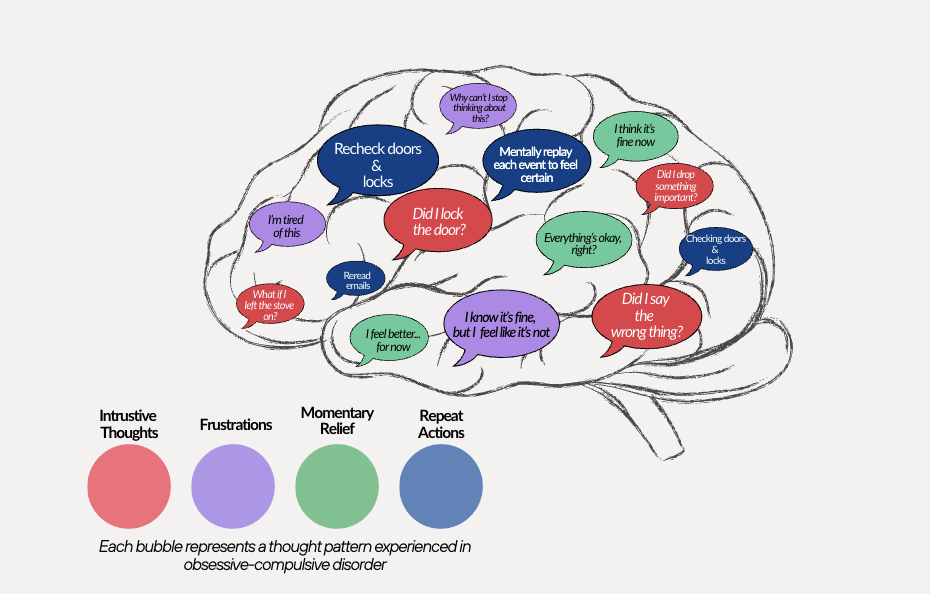
For Waring, her ADHD almost overshadowed her OCD symptoms until she couldn’t mentally handle it anymore. Her repetitive thoughts, compulsions and overthinking were about to consume her, it mirrored the anxiety and depression often seen in women with ADHD. She finally got an OCD diagnosis this summer.
Waring and I can relate on this level, having both been diagnosed with ADHD at a young age. Sometimes the symptoms get lost.
“(After the diagnosis), it clicked … you’ve had OCD your whole life and you just didn’t know it,” Waring said.
Although we continue to make advancements in the world of mental health, OCD continues to be stigmatized and misunderstood. “You see the stereotypes online that are like you know arranging things like color order, like things have to be tidy, which can be a part of it but OCD is obsessive compulsive disorder. You have mental obsessions and intrusive thoughts,” Waring said.
Unlike Waring, I received my diagnosis before I turned 16, and I went through a slew of anti-depressants, anti-anxiety medications and every other “anti” in the book before I finally got OCD slapped on my shoulder for a lifetime commitment badge. Waring calls it “the doubting disease,” and I absolutely agree. It is all-consuming.
Her story is like so many suffering from this disorder, but through the OCD Awareness Club, she hopes to create a space where people with OCD no longer feel helpless. It is an opportunity to practice mindfulness and a space to educate those who do not have OCD.
Perhaps, with some intentionality, we can build a world where individuals with OCD are understood and supported.