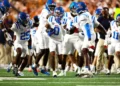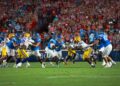













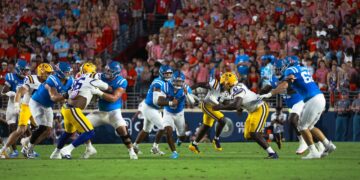

















The Rebels have been blessed with playmakers at multiple positions. Quarterback Trinidad Chambliss is a Heisman contender, running back Kewan Lacy is one of the best running backs in the country and wide receiver Deuce Alexander embraced the WR1 role after all the turnover in the receiver room. However, two games into the season, head coach Pete Golding seems to be leaning heavily on these three to run the offense — perhaps too much so.
While these playmakers are obviously solid additions to the team, the offense filtered almost exclusively through the trio in Week 2, even though Ole Miss was facing a lower-caliber team in the Charlotte 49ers.
At the end of the first half, Alexander had eight catches for 76 yards, while the next leading receivers, Traylon Ray and Horatio Fields, each had two catches for 26 yards. Lacy led the running back room with 12 carries for 82 yards and two touchdowns. Not a single other running back even registered a rush attempt or catch.
Golding discussed how the slow start in the first half led the team to not be comfortable with getting some of the backups reps in the second half, especially in the running back room where Lacy dominated.
“It’s still early in the season, and you have to create some continuity in the group,” Golding said in the postgame press conference. “Our goal was to go out there and really get rolling in the first half and have some decisions to make in the second half and we thought we were going to be able to do that. … That (our play) didn’t allow us to do some of the things earlier that we would like to.”

Throughout the offseason, Ole Miss revamped its running back room via the transfer portal. Michigan State transfer Makhi Frazier and LSU transfer JT Lindsey were both viewed as solid backups that could come into games and be serviceable to help ease the burden on Lacy.
However, against Charlotte, Frazier and Lindsey only received a handful of combined snaps in the first half and registered no stats; instead, they mainly served as pass blockers to give Lacy rest. The first rush by a tailback other than Lacy was a 3-yard rush by Lindsey in the second half.
More surprisingly, Lacy and Chambliss remained in the game well into the second half. It was not until there were only 10 minutes left in the fourth quarter that backup quarterback Deuce Knight finally replaced Chambliss, besides one play when Chambliss’ helmet came off and he was required to sub out.
The Rebels have lived and died by the explosive offense and big plays. It has been their identity for years. Yet, the 49ers’ ball control and time of possession forced both teams to slog through a slower-paced game.
Charlotte almost doubled Ole Miss in time of possession by essentially taking the full 40 seconds of play clock before snapping the ball, which gave the Rebel offense fewer opportunities to score. Even Charlotte’s two drives that both ended in three-and-outs took a combined three and a half minutes.
The Rebel defense has been less than spectacular to begin the season. If opposing teams are able to grind down the Rebels and force the game to come down to a few plays or drives, Ole Miss could be in trouble.
While Charlotte’s mastery of time of possession definitely posed an issue for the Rebels, equally problematic is the Rebels’ overreliance on Chambliss, Lacy and Alexander.
In the Rebels’ win over No. 24 Louisville in Week 1, Alexander totaled 159 receiving yards and two touchdowns as Chambliss’ main target. Deep passes to Alexander were an offensive mainstay, especially while Lacy dealt with injuries for half the game.
In Lacy’s stead, Lindsey and Frazier were each equally underwhelming. They had seven carries apiece and rushed for 25 and 27 yards, respectively.
Despite the lack of a running game, no pass catchers besides Alexander had exceptional performances. Tight end Caleb Odom and Fields both had solid games, but were not overly impressive.
While the Rebels have advanced to 2-0, this early success has come about under somewhat worrisome conditions. They beat Louisville in a last-second field goal and defeated Charlotte less handily than the score might indicate.
Last year, Lacy ended the season in the playoffs with a leg injury. With better running back depth, it was generally assumed Lacy would take a less sizable chunk of the rush attempts.
If this top-heavy offense paired with a below-mediocre defense persists, the Rebels could run into issues.
Ole Miss will welcome LSU to Vaught-Hemingway Stadium on Saturday, Sept. 19 at 6:30 p.m in what will be a season-defining matchup. The Rebels will aim to get right ahead of the matchup.