








Navigating collegiate life as a student with a physical disability brings a unique set of challenges.
Lifelong Ole Miss fans Braden Neal and Marilee Cleveland would only settle for attending the University of Mississippi, even if it meant living on a campus with fewer disability resources than other Mississippi public schools.
Students can register with the Office of Student Disability Services (SDS) to obtain disability-related accommodations. The office operates under the Division of Access, Opportunity and Community Engagement and works to remove curricular and programmatic barriers.
“Our focus is on working with each individual student to meet their needs and ensure access to higher education,” Jacob Batte, director of news and media relations at UM, said of the mission of SDS.
At the time of publication, 2,146 students were registered with SDS for the fall 2025 semester. This is not the total number of students with disabilities at UM, as registration with SDS is not required.
UM abides by all state and federal disability laws, including the Americans with Disabilities Act (ADA). The ADA is a federal law that prohibits discrimination against people with disabilities. Title II of the ADA protects students with disabilities at state and federally-funded colleges.

To abide by the ADA, the university must ensure that facilities are accessible to students with disabilities; provide services necessary to ensure such students receive effective communication, support and access; make reasonable academic and policy adjustments to ensure students with disabilities have equal opportunities; offer a level playing field by ensuring fair treatment in admissions, programs and services.
The university’s adherence to the ADA, however, does not necessarily create equal experiences across the board for students with physical disabilities.
Housing mishaps
Senior multidisciplinary studies major Braden Neal suffers from spastic quadriplegia cerebral palsy, a birth injury to the brain resulting in limited mobility and trunk control, in his case. The Middleton, Miss., native currently resides in a wheelchair-accessible room in Pittman Hall. The university assigned him a room in Campus Walk Apartments his sophomore year, resulting in 10 months of transportation difficulties.
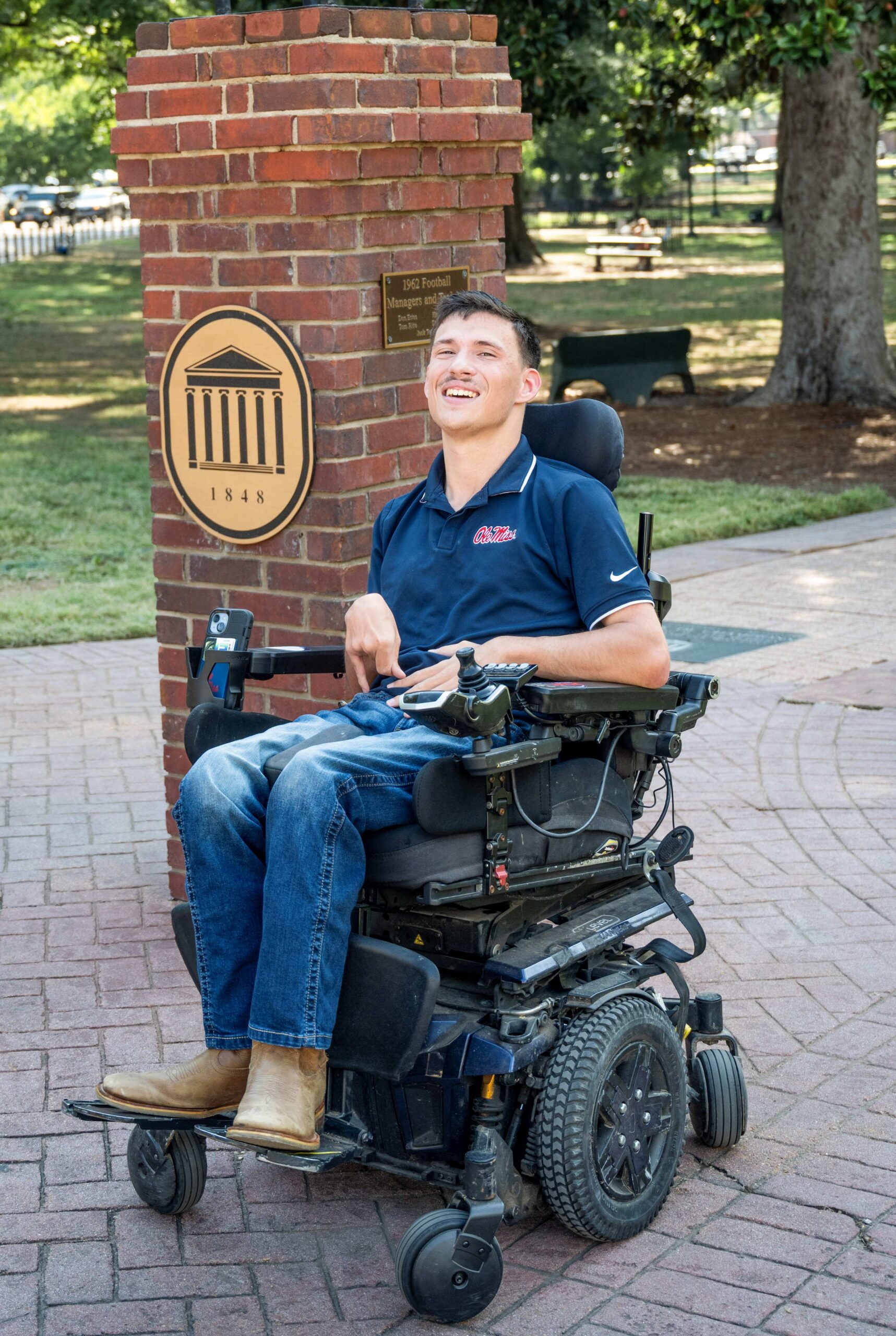
“I learned very quickly there were some massive issues, one of them being the amount of battery it took for me to get up that massive hill in the middle of the woods … once it got cold, that presented even more problems,” Neal said.
When Neal resided at Campus Walk Apartments, the nearest stop for OUT buses operating on Sundays was inaccessible to him. Campus Walk Apartments has since been added to the Brown/Hathorn Sunday route.
With no public transportation available to him on Sundays, Neal drove his wheelchair one hour each way to mass at St. John the Evangelist Catholic Church on University Avenue from his university-owned apartment.
“I had a couple times where (my wheelchair) died only because of the amount of miles I was going,” Neal said. “I had to drive super slow to get there, which took me an hour, because the faster you go, the more battery it takes.”
Neal reported two instances of his wheelchair battery dying on his long commutes and several times of the battery life reaching critically low levels.
“You call friends for help. I mean, that’s all you’ve got. And you hope to God somebody answers,” Neal said.
Securing a room in Pittman Hall, where commutes to class are shorter and flatter than from Campus Walk Apartments, took months of long processes and back-and-forth communication between Neal, UMatter, SDS and Student Housing.
UMatter assists students facing challenges by coordinating support efforts both on and off campus, promoting personal and academic success. Students are assigned case managers who intervene on their behalf to advocate for their well-being. UMatter is housed within the Division of Student Affairs.
Mandi Bloodworth is a case manager at UMatter who helped Neal secure changes to his housing situation. Bloodworth facilitates communication between students and administrative programs and offers a listening ear to students unsure whether they should ask for help and to those seeking assistance with their circumstances.
“Sometimes these processes take longer than a student would like, and I think it can be frustrating for students if it seems like there’s a delay,” Bloodworth said. “They may feel like they’ve been overlooked or forgotten about, so I also try to learn where things are in the process and share that with the student so they’re kept informed.”
ASB steps in on accessibility concerns

Senior public policy leadership major Marilee Cleveland served as principal of accessibility for the Associated Student Body the past two years. Like Neal, she has been diagnosed with cerebral palsy.
“My job is to manage whatever SDS cannot do or where there is miscommunication, which so often comes back to me,” Cleveland said. “So, if you need help like me, like having someone help you to class, you have to find it yourself. My job is to make the fallout on students easier.”
The Jackson native said her relationship with SDS has been “rocky” throughout her time as a student, noting that it has improved slightly over the past year. Cleveland said when it comes to navigating special circumstances pertaining to physical disabilities, SDS has a lack of communication.
“Sometimes the blame gets put in the wrong place,” Cleveland said. “It falls back on a student, and that’s not what the university should do. There’s often this air, or they’ll send you an email back, like ‘We did everything we could,’ ‘This is not what we handle’ or ‘You should have reached out to so and so.’ And it often just stops there.”
She explained that SDS is overworked and understaffed. Cleveland gives the office grace on some issues for this reason, but she believes improvements to their current circumstances are necessary for improving the college experiences of students with physical disabilities.
The Ole Miss vs. State debate for disabled students
Cleveland said that the difficulties many physically disabled students experience working with SDS at UM contribute to Mississippi State University’s reputation as the top choice in the state for the demographic.
Kasee Stratton-Gadke serves as the executive director of the Mississippi Institute on Disabilities at MSU. The institute houses four centers on the university’s campus: the T.K Martin Center for Technology and Disability, the ACCESS Program and Specialized College Services, the Career Horizons Center and Autism and Developmental Disabilities Clinic. Almost all services offered across the centers are available to anyone in the state of Mississippi, according to Stratton-Gadke.
“I think the university, particularly, has had a strong disability history that goes back way before my time here at Mississippi State,” Stratton-Gadke said. “Dr. Martin, who the T.K. Martin Center is named after, really kind of pushed for ADA accommodations on campus way before there was a law that required such accommodations. … So, I think he really spearheaded a movement that’s just been a solid part of the foundation at State.”
Having the Mississippi Institute on Disabilities on campus has built an awareness of services offered on the MSU campus statewide, Stratton-Gadke said. Students with physical disabilities may be more knowledgeable of the help available to them at MSU versus other public universities in Mississippi.
For patients with physical disabilities, the T.K. Martin Center at MSU offers custom-built driving technology and driving lessons, allowing patients to become mobile in a way they may never have had access to before. This program is one example of how MSU uniquely caters to the personal and professional development of students with physical disabilities.
Cleveland said she and many other UM students with physical disabilities believe SDS caters heavily to students with developmental and learning disabilities.

Batte said the university provides institutional support toward accessibility on our campus, including all federally required services.
“Funding for Student Disability Services has increased from $1.2 million last year to $1.4 million this year, an 11% increase,” Batte said. “SDS works with each student individually to identify and implement accommodations based on their needs.”
Batte did not address The Daily Mississippian’s question of what percentage of these funds go toward resources specifically for students with physical disabilities.
“The university does not separate students into broad categories such as ‘physical’ or ‘mental’ disabilities because about three-quarters of students registered with SDS have multiple diagnoses, and those diagnoses often span categories,” Batte said.
Personal care assistant troubles
Student leaders are working to establish new programs at UM to expand the number of services available to students with physical disabilities.
Cleveland and the current ASB principal of accessibility Emerson Morris worked together for the past year to implement a “buddy system” on campus, pairing student volunteers with physically disabled students to help with tasks normally reserved for personal care assistants (PCAs).
“We’re hoping to enlist students who are hoping to go into healthcare professions who need those hours doing service,” Morris said. “They’ll get this experience and help physically disabled students who are bound to wheelchairs, or maybe have crutches and need help carrying backpacks. So, we’re hoping that this will provide them with a smoother transition into college and something that’s a little bit more reliable and accessible to them to improve their experience on campus.”
Morris said the biggest obstacle to implementing this system is navigating potential liability issues for student volunteers, as well as getting SDS or another department to approve and manage the program. She said this project will be continued under ASB President Jack Jones’ administration.
Neal has experienced trouble finding and keeping PCAs, exemplifying why a program like the one Morris and Cleveland have outlined would be beneficial at UM. Between navigating payment plans, few individuals offering PCA services and the extensive administrative process to secure IDs with dorm room access for PCAs, Neal turned to alternative means to ensure he received the care he needed.
During the fall 2024 semester, Neal’s primary PCA resigned, leaving him to depend on friends and family to travel to Oxford and perform morning and nightly personal care duties. After his former PCA left, Neal did not have a PCA onboarded with completed university paperwork and a background check for multiple weeks.
There were several nights Neal would give his student ID to a friend who transferred him to bed so the friend could reenter his room in the morning, as Neal is not physically able to get out of bed on his own to let someone into his hall.
Neal received five emails, one from SDS and four from Student Housing. Each email alleged that Neal violated the Student Housing visitation and overnight guests and identification cards policies. The emails stated that future violations would result in referral to the Office of Conflict Resolution and Student Conduct for initiation of the student conduct process.
In September 2024, after receiving the first email in this series from SDS director Stacey Reycraft, Neal called and explained his predicament to then-ASB Vice President Jack Jones, who now serves as president.
Jones confirmed that he did receive a call from Neal and that he proceeded to call a university staff member to advocate on Neal’s behalf. Jones declined to identify the staff member but acknowledged that he/she was not employed in the Office of Conflict Resolution and Student Conduct.
Neal never received a disciplinary referral from the Office of Conflict Resolution and Student Conduct.
Batte declined The Daily Mississippian’s request for an interview with Reycraft on her behalf. Batte also declined for Student Housing to comment on Neal’s case due to federal student privacy laws.
Neal said he had no choice but to violate student housing policies to ensure his medical needs were met. He believes his situation demonstrates the difficulties faced by students like him, whose physical disabilities make it difficult to perfectly abide by university rules.
“The university’s personal care attendant (PCA) policy, in place since 2017, is designed to ensure the safety and security of residential communities while supporting students’ independence and choice of assistance,” Batte said. “Students are required to identify their PCA, who must complete the necessary paperwork and background check before being granted residence hall access.”
Batte said that while paperwork is being processed for a new PCA, students can check PCAs in as guests during visitation hours, and friends or family may also assist under housing policies. Neal, however, could not physically leave his bed to check PCAs in for morning visits, violating housing policy by lending his student ID to friends or unofficial assistants and not checking them in.
“Violating student housing policy can result in a warning or a referral to the Office of Conflict Resolution and Student Conduct, depending on the circumstances,” Batte said.
The slow pace of progress to improve accessibility at UM has worn heavily on Cleveland. This year, she is taking a step back from her previous position as ASB principal of accessibility to serve as special adviser to the president for accessibility. She will continue her passion for helping students like herself from a supervisory role.
“When I was choosing a school, I thought if it’s not as handicap accessible as Mississippi State University. … I’ll find a way to work around it,” Cleveland said. “It just had to be Ole Miss. That is why I do what I do. I want other students to say the same thing — it just has to be Ole Miss.”


