






















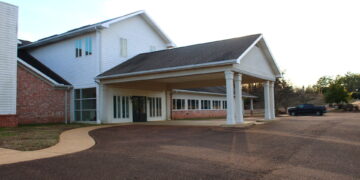




Associated Student Body senators convened in the auditorium of the Gertrude C. Ford Ole Miss Student Union to pass four pieces of legislation, including a bill which called for the adoption of ranked-choice voting in internal elections, during the final formal ASB Senate meeting of the semester on Tuesday, Dec. 2.
Senate Bill 25-01CW, motioned to revise the ASB Code to adopt the usage of ranked-choice voting for open-seat senate elections, was the first piece of legislation discussed. Presented by senators Corey Kingery, Kayt Davis, Alex Griggs, Andrew Nichols and Madison Waldrop, the bill aimed to replace the existing plurality voting system.
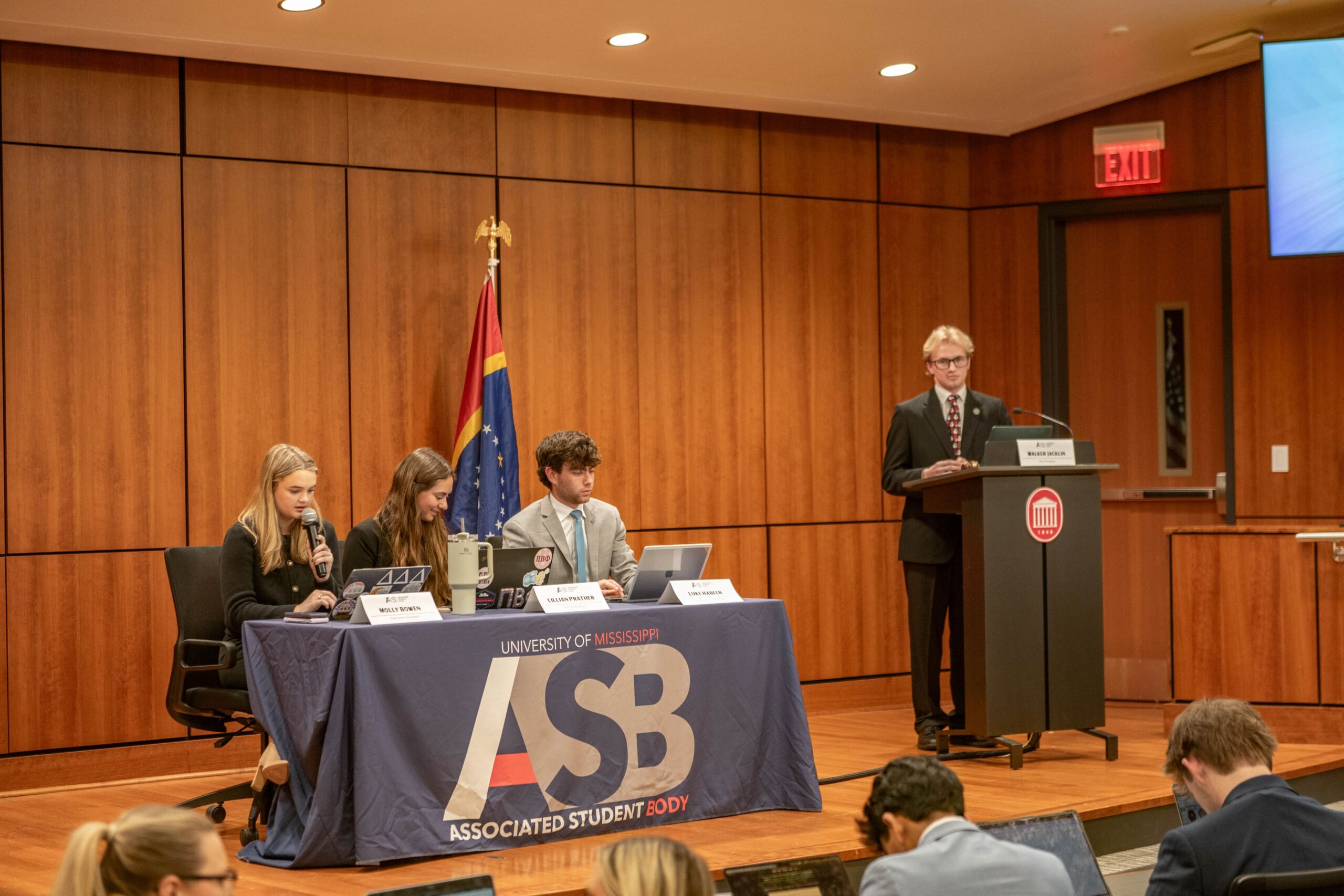
Whereas in the current system, senators cast one vote for each open seat in an election, under the new system, senators would rank each candidate in descending order. In a sequence of rounds, the candidates would initially be placed by order of first-place votes. The candidate ranked last would be eliminated, and those who voted for that person would have their second-place votes distributed to the candidates. Candidates would continue to be eliminated and votes re-applied until the number of seats were matched.
Municipalities across the country utilize ranked-choice, including the recent party primaries in New York City. Maine first used the system during its 2018 statewide elections, while Alaska used the system during its 2022 special congressional election. The bills’ presenters cited the use of ranked-choice voting in general elections at Auburn University and Louisiana State University.
The bill’s authors wrote that ranked-choice voting “promotes a more fair and democratic election process,” adding that the system “encourages senators to vote honestly and true to ideals of an ASB senator.”
In addition, the bill would give the responsibility of accepting and counting ballots to the attorney general rather than the senate clerk.
In an interview with The Daily Mississippian after the meeting, Kingery detailed the background of the bill’s drafting.
“This actually came about (during the) last open seat (election), when we were just reviewing the code policy, how we vote for the different open seats in (the) senate. And we were like, ‘How can we make this a more fair process, more equitable?’” Kingery said. “I’ve done a little research, and I was like, ‘Ranked-choice voting seems to be a really good way to go about it.’ So I brought it to our (president pro tempore), our attorney general, our (government operations chair) and our vice president and they were all pretty much on board with ranked-choice voting, except we had to figure out the logistics.”
The logistical hurdle was a significant one to overcome, Kingery said.
“The biggest hold-up with this bill is trying to figure out the logistics of how we would even go about ranked-choice voting,” Kingery said. “So we talked with Auburn, we talked with LSU about how they did it and we finally found a way.”
Members of the Auburn and Louisiana State University student governments recommended the software OpenVote, due to its ease of use and the ability to automatically tally votes.
“Once we figured that out, we were like, ‘Okay, let’s bring it before the senate,’” Kingery said. “My big thing tonight was trying to make sure everyone really fully understands ranked-choice voting, because it’s not as simple as a plurality vote.”
Concerns were raised about the “learning curve,” as the bill’s presenters put it. Questions were also raised about the need for a change in the voting method.
Ultimately, by a vote of 36-6 with one abstention, the bill was adopted by the senate, renumbered as Senate Bill 25-29.
“I think we did a really good job tonight. Everyone was very passionate. I love to hear good debate on bills, so I loved hearing everyone’s opinions and support. I’m really glad we did this,” Kingery said. “I do think this will make a more fair and equitable process and better represent our student body.”
Senator Griggs presented Senate Bill 25-26, which would revise the ASB Code to reflect current practices of ASB’s standing committees. Specifically, the bill would allow for the chairs of all standing and ad hoc committees to serve on the committee on rules, where currently only chairs of other standing committees are eligible per the code.
For Griggs, this is part of a bigger project to root out differences between existing practices and ASB Code.
“A big project of mine I took on for the semester was to make sure that everything within the legislative branch was up to date because as time changes, procedures change, but often it gets left behind in the code,” Griggs said in an interview with The Daily Mississippian following the senate meeting. “So for this project, I reached out to all of the current committee chairs. And from there, I asked them if they noticed any inconsistencies within their sections in the code. … I worked with our president pro tempore, Wesley Templet, to make those changes.”
The bill passed by a unanimous vote.
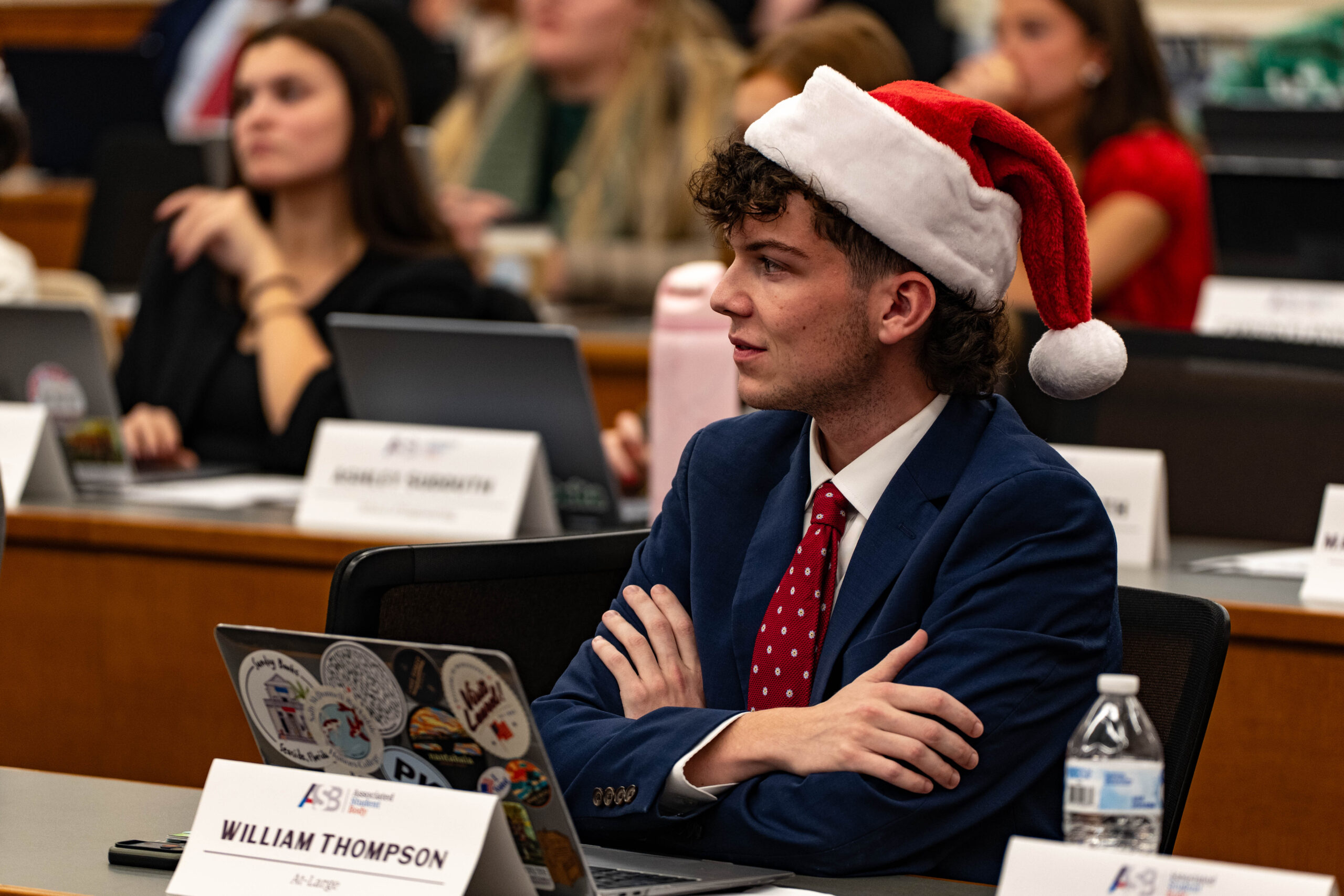
Nichols also presented Senate Bill 25-27, which would revise the ASB Code to clarify election guidelines, specifically that candidates are permitted to campaign and leave campaign materials in Greek houses during meal and chapter times with approval from chapter presidents, while candidates cannot leave campaign materials in residence halls.
The bill, Nichols argued, was designed to formally codify existing practices and to prevent cases in the ASB Department of Justice’s Election Review Board (ERB).
“It just makes it clearer for candidates. I’ve served on the past three or four ERBs, and a lot of candidates get sent to ERB not because they’re intentionally breaking the rules, but they just get confused about what the rules are,” Nichols said in an interview with The Daily Mississippian following the senate session. “We just wanted the bill to help make it clear about when people speak in Greek houses and leave materials, what is and isn’t allowed and how to do it properly.”
Templet, the president pro tempore, presented an amendment to the bill, which would remove the clause that allows candidates to leave campaign materials in Greek houses. Templet believed there would be an unfair advantage to candidates in Greek life without it.
The amendment failed by a vote of 20 to 23.
Following the rejection of the amendment, the vote on the original bill was held, with Senate Bill 25-27 passing by a vote of 26 to 17.
Prior to the vote, Zach Rifkin, executive liaison to ASB President Jack Jones, announced that Jones would consider vetoing the bill should it be passed by the senate.
Jones clarified his concern with the bill to The Daily Mississippian.
“While I believe the senators who authored SB 25-27 had good intentions, I am especially concerned about the implications the legislation will have for our non-Greek student population, Greek chapter presidents and ASB’s Department of Justice,” Jones said. “Over the coming days, I will be meeting with my team to discuss what next steps may be required on this issue.”
Nichols also presented Senate Bill 25-28, which would amend the ASB Code to include all attorneys general onto the ASB’s Election Review Board. Previously, only the Deputy Attorneys General of Elections and the Code & Constitution could stand on the board.
“That was a (Department of Justice) amendment, just helping codify some practices we already have with the Deputy Attorney General,” Nichols said.
The bill passed by unanimous vote.
While the senate is adjourned during winter break, the first ASB informal senate meeting of the next semester is scheduled for Tuesday, Jan. 27. The first formal senate of the upcoming semester is scheduled for Tuesday, Feb. 3.