





















Amy McDowell’s path to teaching was anything but traditional, shaped by unexpected turns and a passion for understanding people’s stories. The associate professor of sociology at the University of Mississippi released her latest book, “Whispers in the Pews: Evangelical Uniformity in a Divided America,” on March 10.
The book employs ethnography — the immersive study of a group’s culture — and is based on an evangelical church in Oxford that describes itself as welcoming and inclusive. McDowell set out to find out whether this was true or not.
“I spent a lot of time with the community of churchgoers that I studied,” McDowell said in an interview with The Daily Mississippian. “Ethnography really means that you have to be embedded in the community that you study.”
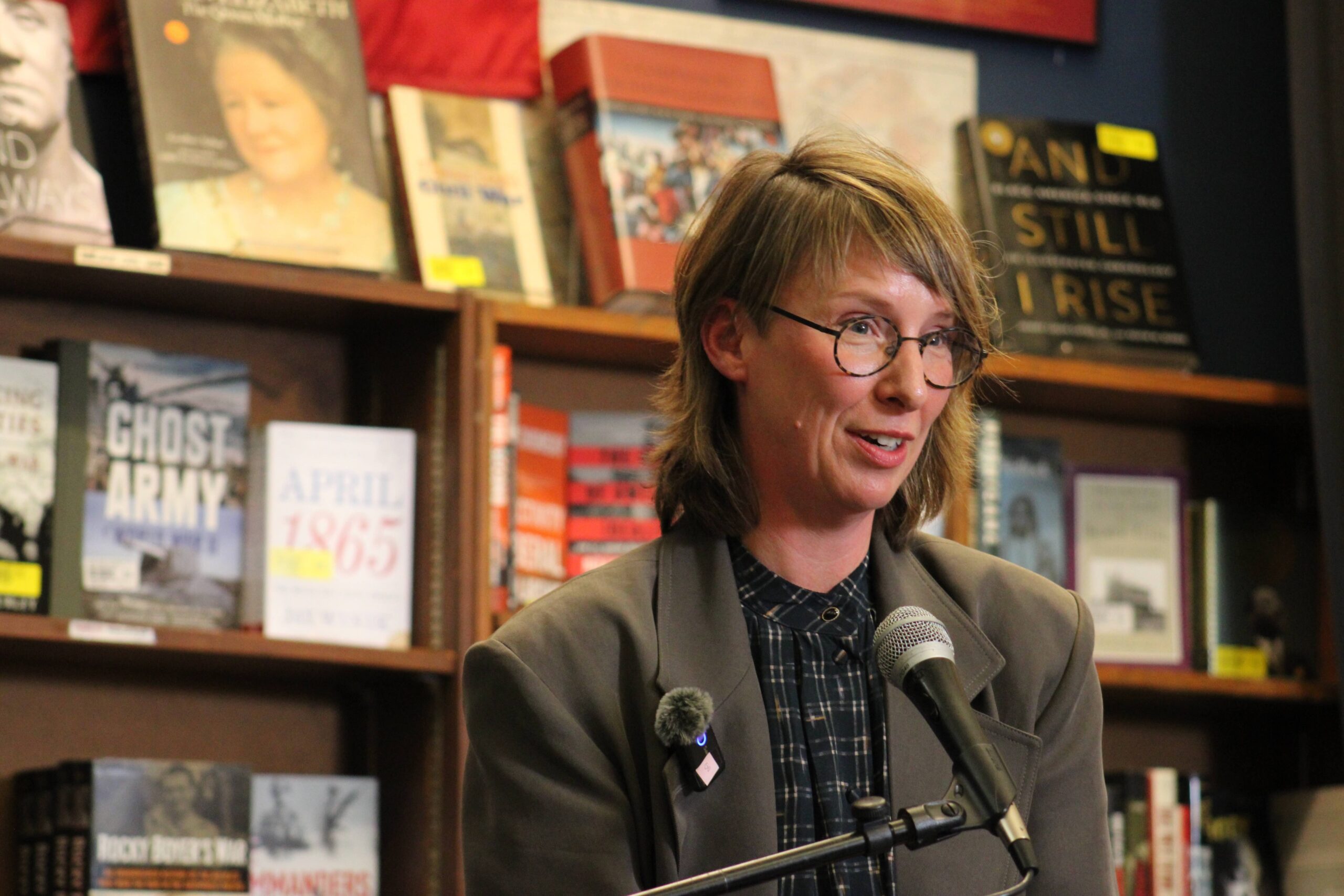
McDowell spoke about the book in conversation with UM Professor of Anthropology and Southern Studies Jodi Skipper at an event hosted by Off-Square Books on Wednesday.
While she was publishing her dissertation and working as an assistant professor, McDowell collected ethnographic research from 2016 to 2019 that created a strong foundation for the book.
“Kathleen Blee, a renowned sociologist known for her work on ideological extremism, race and social movements, was my dissertation adviser,” McDowell said. “My dissertation areas were religion, culture, race and gender.”
McDowell explained how her research helps deepen understanding of why people “believe the things they do and make the choices they make.”
Common in sociology, McDowell uses pseudonyms to cover the true locations and names of the people involved in her research. She did use the name of the city, however, to encourage thoughtfulness.
“I studied a church community in Oxford, and in the book, I don’t hide that it was in Oxford,” McDowell said. “It made me feel more accountable, and that was hard.”
McDowell observed patterns of deflection and ignoring issues in church societies through the church she studied.
“People don’t express their doubts, opinions or their disagreements in church spaces,” McDowell said. “People really try not to talk about that stuff.”
Although writing her book was challenging, it left her feeling fulfilled and confident.
“You get to help people feel like they’re in the room with you,” McDowell said.
McDowell never imagined she would become a professor. At 18 years old, she ran a small record store in Pensacola, Fla., and pictured she would end up in music rather than education.
“I didn’t take a very traditional path,” McDowell said. “I felt that I would do something in music distribution or work in some way in the music industry.”
A first-generation college student, McDowell earned master’s and doctoral degrees in sociology at the University of Pittsburgh. She started as an assistant professor at the University of Mississippi in 2014 and was promoted to associate professor in 2020.
Mary Rogers, a sociology professor at the University of West Florida who died in 2009, inspired McDowell to pursue a sociology degree. Rogers encouraged McDowell to finish her undergraduate degree at the University of Colorado, Colorado Springs.
“(Rogers) kind of helped me put together pieces of things I had been thinking about but had never heard articulated in quite that way,” McDowell said.
McDowell strives to make a difference as a college teacher like Rogers did. Kennedy Marrs, a junior Southern Studies major, has already noticed McDowell’s impact this semester.
“She’s a great listener, and she wants us to be engaged in the content,” Marrs said. “She wants us to enjoy our time with the material, which I think is inspiring.”
For McDowell, teaching courses on gender and sexuality felt like the beginning of a deeper involvement.
“I had a lot of students who were queer, some of them were from Mississippi, who were deeply sad and angry,” McDowell said. “I still think about a couple students.”
These students inspired her role as director of the Queer Mississippi Histories Project.
One of McDowell’s colleagues, Jessie Wilkerson, an associate professor of American history at the University of Tennessee, Knoxville, had oral history students who wanted to do a project on LGBTQ+ people in Mississippi. That project led to allocating funding for creating an archive supporting oral history research.
“Fairly quickly, there was a lot of attention to this archive,” McDowell said.
McDowell describes the stories that her students have recorded for the Queer Mississippi Histories Project as “inspirational and powerful.” They can be accessed online on eGrove.
McDowell went on to build a class, called “Queer Mississippi” with UM Associate Professor of History Eva Payne. The class gives undergraduate and graduate students the chance to gain experience in historical research methods.
“It was a collaborative effort. It’s never been a solo show,” McDowell said.
Graduate student Zoe Rees enrolled in McDowell’s Queer Mississippi course in fall 2024.
“I expected an engaging academic experience,” Rees said. “What I did not anticipate was how profoundly she would shape my graduate career and personal growth. I wholeheartedly recommend Dr. McDowell as a professor and mentor. Studying under her has been one of the most significant and rewarding experiences of my graduate education.”
McDowell said juggling her different roles has been enjoyable but not perfect.
“I drop the ball all the time,” McDowell said. “Actually, I find the process of writing painful, as a lot of people do, but at the same time, I like taking data and trying to make sense of what is going on.”
McDowell made a promise to herself to make more time for writing in 2026, continuing work that she knows can be difficult yet deeply meaningful.
“I miss (making sense of the data), and I want to get it back,” McDowell said. “That’s kind of my promise to myself this year — to make more time for that.”