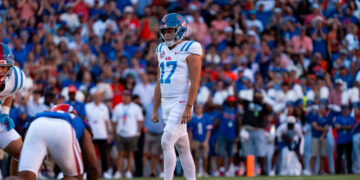













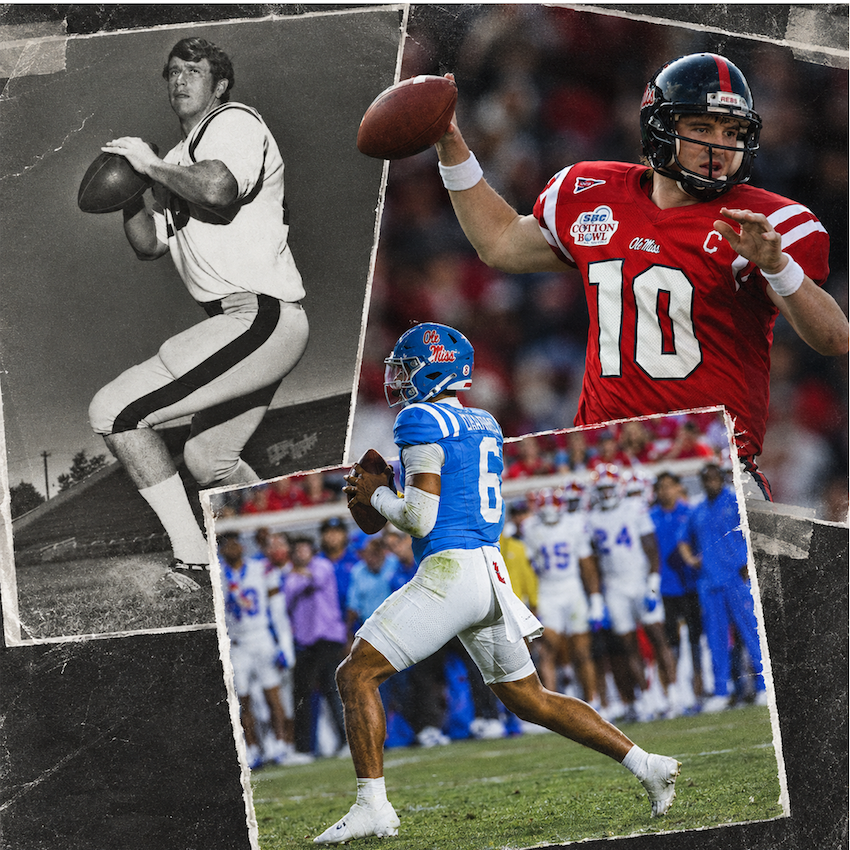
Trinidad Chambliss finished eighth in Heisman voting last year, the highest finish by an Ole Miss player since Eli Manning finished third in 2003. This year, Chambliss entered the season Top 5 in Heisman voting. After Week 4, he sits fourth, but he is still a mainstay in the Heisman conversation.
Though an Ole Miss player has never won the Heisman Trophy, the buzz surrounding Chambliss’ season is palpable. That said, it seems appropriate to walk down memory lane to highlight other Ole Miss quarterbacks who have contended for one of the sport’s most prestigious awards.
Charlie Conerly (1947)
Charlie Conerly started his career at Ole Miss in 1942, but World War II interrupted his time in Oxford. After serving in the Battle of Guam, Conerly came back to Ole Miss in 1947 ready to make a name for himself on the football field. That season at quarterback, he led the nation in completions with 133. He also threw 18 touchdown passes and added nine on the ground.
Conerly was pivotal to Ole Miss’ success that season. He led the Rebels to a 9-2 record and the SEC Championship win. The 9-2 finish was Ole Miss’ best since before World War II. For his efforts, Conerly received All-SEC and All-American recognition and finished fourth in Heisman voting.
Conerly enjoyed a successful 14-year NFL career with the New York Giants after his time at Ole Miss. He won the NFL Championship Game in 1956 and was named to two Pro Bowls in 1950 and 1956.
Named after the Ole Miss legend, the Conerly Trophy is now awarded to the best college football player in the state of Mississippi at the end of every college football season.
Jake Gibbs (1960)
Jake Gibbs started at quarterback for Ole Miss in 1959 and 1960. Gibbs led the team to consecutive Sugar Bowl victories and back-to-back AP No. 2 finishes.
In 1960, Gibbs led the SEC in passing touchdowns with 12. He threw for 970 yards on 66-of-109 passing, which was enough for No. 20 in the country. On the ground, Gibbs added 246 yards and five touchdowns.
He led Ole Miss to a 10-0-1 record. The Rebels beat Rice 14-6 in the Sugar Bowl, and he was named the Sugar Bowl MVP. Additionally, Gibbs took home unanimous All-American honors and finished third in the Heisman voting.
Gibbs was drafted by the NFL’s Cleveland Browns and the AFL’s Houston Oilers of the, but he decided to forgo both options and pursued a career in the MLB with the New York Yankees.
Archie Manning (1969 and 1970)
Archie Manning began his tenure on the Ole Miss varsity football team as a sophomore in 1968. He started immediately and led the Rebels to a 7-3 record and a Liberty Bowl victory in year one.
His junior and senior seasons, however, are why his No. 18 jersey is the honorary speed limit on Ole Miss’ campus.
In 1969, Manning threw for 1,762 yards and nine touchdowns. While these numbers seem pedestrian for a Heisman candidate, Manning also led the Rebels in rushing yards and touchdowns, rushing for 502 yards and leading the SEC with 14 rushing touchdowns.
Manning displayed his excellence to a national audience on Oct. 4, 1969 in the first college football game broadcast on television prime time. Manning threw for 436 yards and three touchdowns while rushing for 104 yards against Alabama. Even though the Rebels lost that game, 33-32, Manning became the hottest name in college football.
Ole Miss finished 1969 with an 8-3 record and a Sugar Bowl victory against Arkansas. Manning took home the MVP award in that contest. He finished fourth in the Heisman voting, but won SEC MVP and the Walter Camp Award, which is presented to the best player in the country but is less prominent than the Heisman.
Manning came into the 1970 season with immense expectations. Despite finishing higher in the Heisman voting than he did the year prior (third), Manning and the Rebels disappointed in 1970. They finished 7-4 and suffered a loss to Pat Sullivan and Auburn in the Gator Bowl. The Gator Bowl loss marked their third straight defeat to end the season.
Notably, Manning broke his arm against Houston on Nov. 7, leading to a poor ending on what could have been an all-time great season for the Rebels.
Statistically, Archie had a relatively quiet season in 1970 as well. He threw for 1,481 yards, 14 touchdowns and 14 interceptions. He rushed for 113 yards and six touchdowns.
The Saints selected Manning second overall in the 1971 NFL Draft. He had a 13-year NFL career and was selected to the Pro Bowl twice. Manning was elected to the College Football Hall of Fame in 1989, and his legacy is sacred within the city limits of Oxford.
Eli Manning (2003)
Eli Manning followed in his father’s footsteps by committing to Ole Miss ahead of the 2000 season. With enormous shoes to fill, Manning served as a three-year starter. He led the Rebels to three straight winning seasons while putting up incredible statistics.
As a senior, Eli Manning earned the Maxwell Award, a third-place Heisman finish, the Johnny Unitas Golden Arm Award and SEC Offensive Player of the Year.
He recorded 3,600 passing yards, 29 touchdown passes and three rushing touchdowns. Eli Manning led the SEC in both passing yards and touchdowns. The Rebels won 10 games and ended their season with a Cotton Bowl win.
The Cotton Bowl was Eli Manning’s last game in an Ole Miss uniform. He threw for 259 yards and two touchdown passes in the Rebels’ 31-28 victory. He earned the Cotton Bowl MVP, a fairy-tale ending to his Ole Miss career.
The San Diego Chargers selected Eli Manning with the first overall pick in the 2004 NFL Draft. Manning was traded to the New York Giants and enjoyed four Pro Bowl appearances and two Super Bowl wins in his 16-year career.
Trinidad Chambliss (2026)
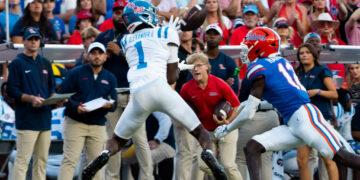
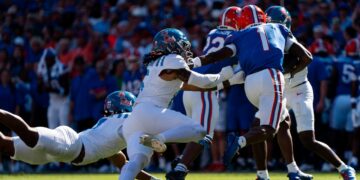
Chambliss enters Week 5 of the college football season fourth in the Heisman race. He was briefly the favorite before Ole Miss lost 52-28 to Florida. In that game, Chambliss took a big hit, which forced him to be subbed out. He also threw an interception late in the fourth quarter when the game was all but over.
He has 1,222 passing yards and eight passing touchdowns so far this season, plus 108 yards on the ground and four rushing scores.
If he can shake off the rough performance against Florida and return to the form he held for the first three games of the season, Chambliss’ Heisman stock will shoot back up.