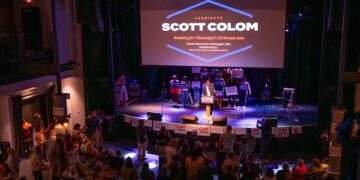
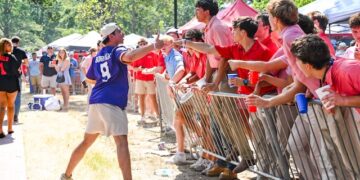

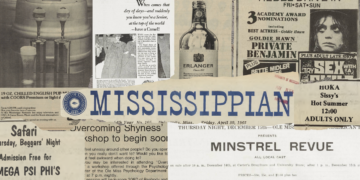





For more than a century, the University of Mississippi has hosted political figures from across the country, including vice presidents, U.S. senators and presidential candidates. Most recently, the university served as a venue for Vice President JD Vance and Erika Kirk’s Turning Point USA visit.
Curtis Wilkie, a Greenville, Miss., native and 1963 Ole Miss alumnus who became a political journalist and presidential campaign correspondent, remembers a campus where national political rallies were less common.
“Until fairly recently, there weren’t many votes on campus because you had to be 21 to vote,” Wilkie said. “So, there wasn’t much incentive for political people to have a rally on campus.”
That began to change as students became a larger part of elections and national political figures began engaging with young voters. Some of those visits carried significance beyond campaigning, particularly as the university and Mississippi continued to navigate the political and social consequences of the 1962 integration crisis.
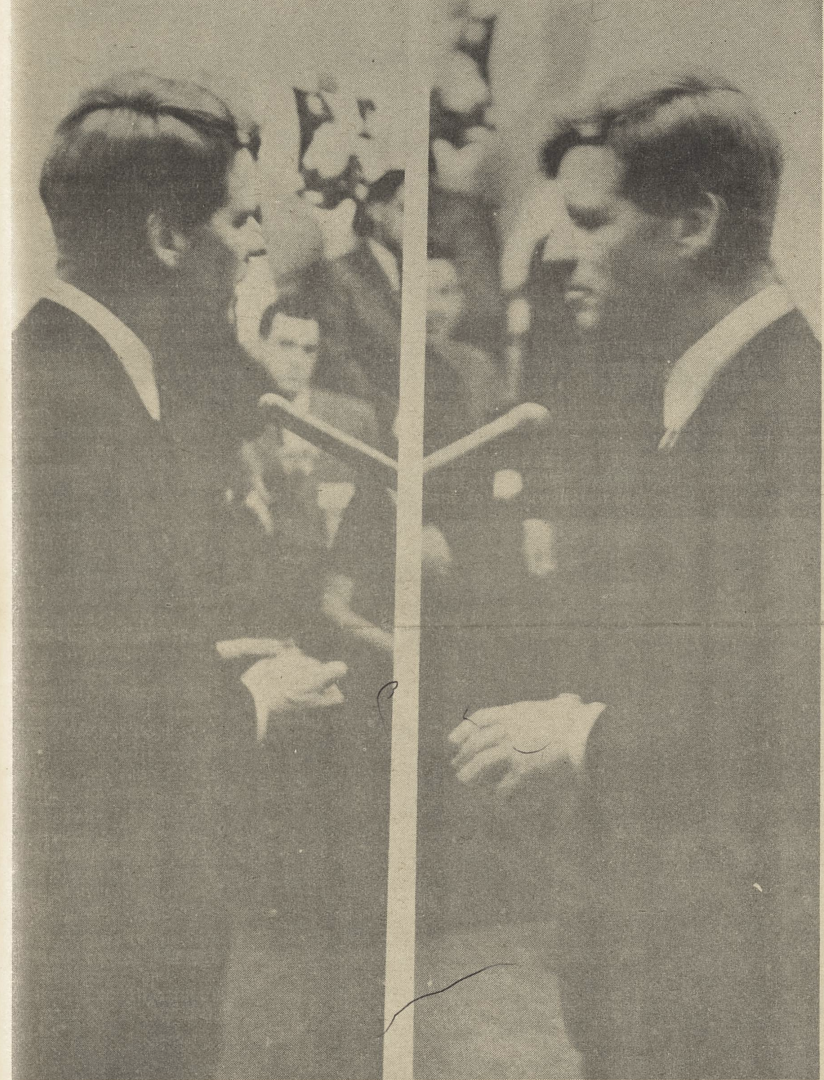
Robert “Bobby” F. Kennedy
Robert “Bobby” F. Kennedy visited the campus as a U.S. senator on March 18, 1966. Bobby Kennedy had been attorney general during the 1962 integration crisis and had directed U.S. marshals to accompany James Meredith when he enrolled at Ole Miss.
Bobby Kennedy accepted an invitation from the university’s law students to address students. The event drew about 6,000 people. According to Wilkie, Bobby Kennedy’s reception was notable. Rather than the confrontation some expected, he remembers a largely welcoming crowd.
“(Bobby Kennedy) was very popularly received,” Wilkie said. “He (was) surprised (there were) so many people, because a handful of (Ku Klux) Klan people showed up, and some people freaked out and said, ‘It’s going to be something terrible,’ but it could not have been a warmer reception.”
The students who brought Bobby Kennedy to campus also had a political objective beyond hearing from a current senator. According to Wilkie, they wanted to use the event to challenge former Mississippi Governor Ross Barnett’s political legacy after their confrontation over Meredith’s enrollment.
“The law school students wanted to do everything they could to make sure that Ross Barnett would never get elected again,” Wilkie said. “So, they essentially cut a deal with Bobby Kennedy’s office that he would come down here, but he would not talk about Barnett in his speech. However, he made it clear he would be willing to take public questions and answers after his speech.”
That arrangement left room for the audience to raise the subjects that Bobby Kennedy had avoided in his prepared speech. When the question and answer session began, the first question returned directly to the events of the riots four years prior.
“The first question was, ‘Who was responsible for the riot in (1962)?’ and Bobby Kennedy grinned and didn’t blame Barnett explicitly, but he began talking about the deals Barnett had tried to cut with the Kennedys,” Wilkie said. “People had heard rumors, and it had never been confirmed. Here, the guy who had been involved in it confirmed everything.”
Edward “Ted” Kennedy
In May 15, 1978, then-Sen. Edward “Ted” Kennedy delivered the commencement speech at the university, marking another notable appearance by a member of the Kennedy family.
Ted Kennedy spoke to the students about racial justice. His appearance was covered nationally, with reports pointing out the symbolism of Ted Kennedy delivering the commencement address at a university so closely tied to the family’s involvement in the 1962 integration crisis.
Ted Kennedy’s presence was particularly notable because his brothers, former President John F. Kennedy and former Attorney General Robert F. Kennedy, had played central roles in the federal response to Meredith’s enrollment. Sixteen years later, Ted Kennedy stood before Ole Miss graduates as their commencement speaker.
The invitation also reflected an unusual political relationship between Ted Kennedy and former Mississippi Sen. James Eastland, a prominent segregationist and powerful Senate figure. Eastland had developed a working relationship with Ted Kennedy over the years, and their relationship helped make Ted Kennedy’s appearance at Ole Miss possible.
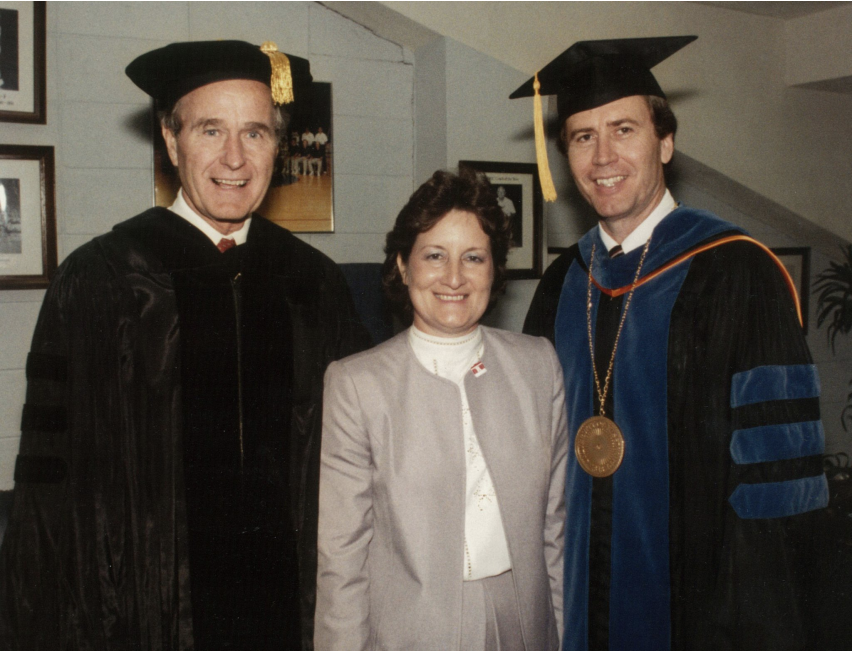
George H.W. Bush
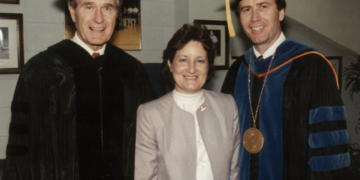
George H.W. Bush delivered the keynote address at the university’s second commencement in May 1985, during R. Gerald Turner’s first year as university chancellor. This fell during Bush’s tenure as vice president; he was elected president in 1989.
Turner later recalled that the university wanted to bring a prominent national figure to campus for the occasion. U.S. Sen. Thad Cochran and U.S. Rep. Sonny Montgomery had personal connections to Bush, making the invitation possible.
In a Dec. 4, 2018 article for the University of Mississippi News, Turner reflected on how Bush came to deliver the address.
“It was my first year as chancellor at Ole Miss, and we wanted someone of note for this occasion,” Turner said. “Through my associations with U.S. Sen. Thad Cochran and (U.S. Rep.) Sonny Montgomery, who regularly played golf with the vice president, we invited Mr. Bush to come and deliver the keynote address. He graciously accepted our invitation.”
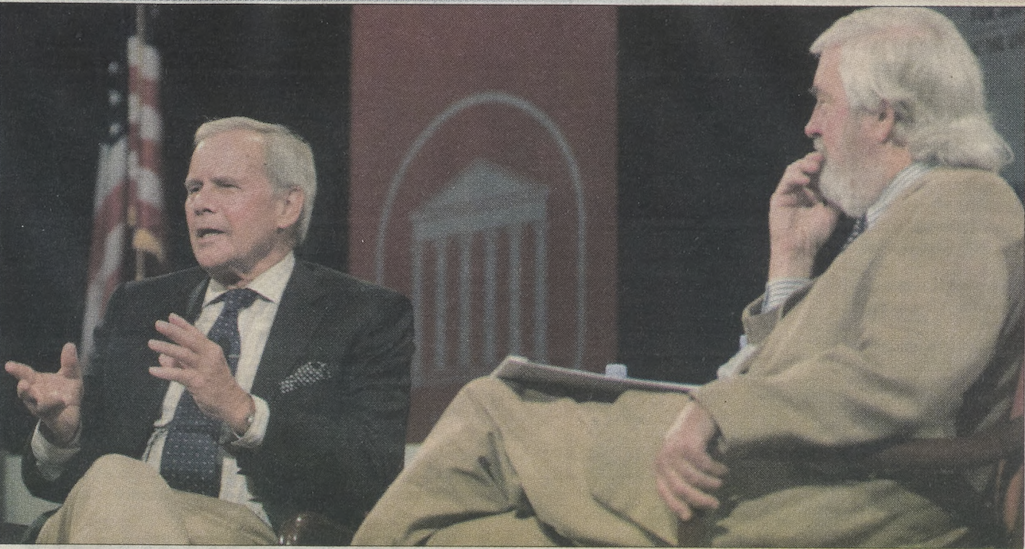
John McCain
John McCain visited the university twice, first as a senator in 2005 and again three years later as the Republican presidential nominee. His first visit came on Nov. 18, 2005, when the Trent Lott Leadership Institute hosted him for a public forum at the Ford Center for the Performing Arts. The event focused on current events and gave students and community members a chance to hear directly from a prominent national political figure.
McCain was elected to the U.S. House of Representatives in 1982, won a U.S. Senate seat in 1986 and sought the Republican presidential nomination in 2000. His 2005 appearance came years before he secured the Republican nomination and faced then-Democratic nominee Barack Obama in the 2008 presidential election.
For Wilkie, McCain’s first visit created an unexpected connection between the senator and the university. Wilkie had known McCain for years and recalled attending a small dinner at the chancellor’s house after the forum with him.
“I remember I went to dinner at the chancellor’s house that night,” Wilkie said. “He had a small dinner party, and he knew that McCain and I were friends. I remember asking McCain at the dinner, ‘Sir, how would you like to come back to Ole Miss in three years and appear at a presidential debate?’”
What began as a hypothetical suggestion at a dinner table became reality less than three years later. McCain returned to Oxford on Sept. 26, 2008, this time for a presidential debate against Obama.
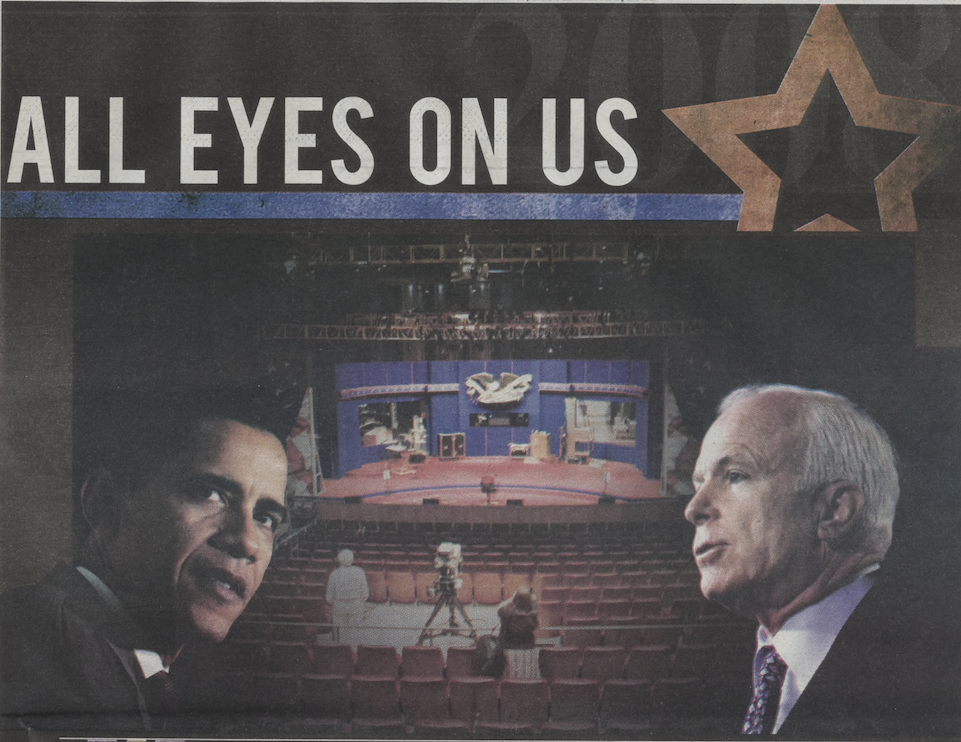
Barack Obama
In 2008, presidential candidates Barack Obama and McCain came to Ford Center to participate in a presidential debate. Students, faculty and alumni gathered to watch the historic event.
Robert Khayat, the chancellor from 1995 to 2005, remembers the debate beyond the candidates themselves. For him, the event changed the atmosphere of the university, creating a sense of anticipation that reached far beyond the Ford Center.
“The excitement that flooded the campus was really across the campus. I thought, lots of students and lots of faculty staff, plus alumni, were so thrilled about it,” Khayat said. “It was alive.”
The scale of the event also reached beyond the university. More than 3,000 additional people came to Oxford, filling not only the Ford Center but also the David Nutt Auditorium across the street. The town prepared for the influx by expanding housing and restaurant, medical and transportation services. Alumni and faculty also helped organize and fund the event, making the debate a collective effort that extended throughout the Oxford community.
For Khayat, the significance went beyond the logistics of hosting a nationally viewed event. The presence of Obama and McCain on campus also reflected the university’s changing position in the national conversation.
“It was a great statement for the university to have that diversity in those two candidates — to have one person who was African American, who has, I’d say, marginal experience with Mississippi, and John McCain, who was much more familiar with us because of his family relationship,” Khayat said.
The debate became part of a larger effort to reshape how the university saw itself and how it was viewed beyond Oxford. For Khayat, bringing the debate to campus aligned with a goal he had emphasized throughout his tenure.
“When I was first told that I would be chancellor in 1995 and I went around making talks on campus, I repeatedly said, ‘We want to be perceived as one of America’s great public universities, and we want to perceive ourselves as one of America’s great pilots,’ so that means students, faculty, staff, alumni, friends (and) elected public officials.”
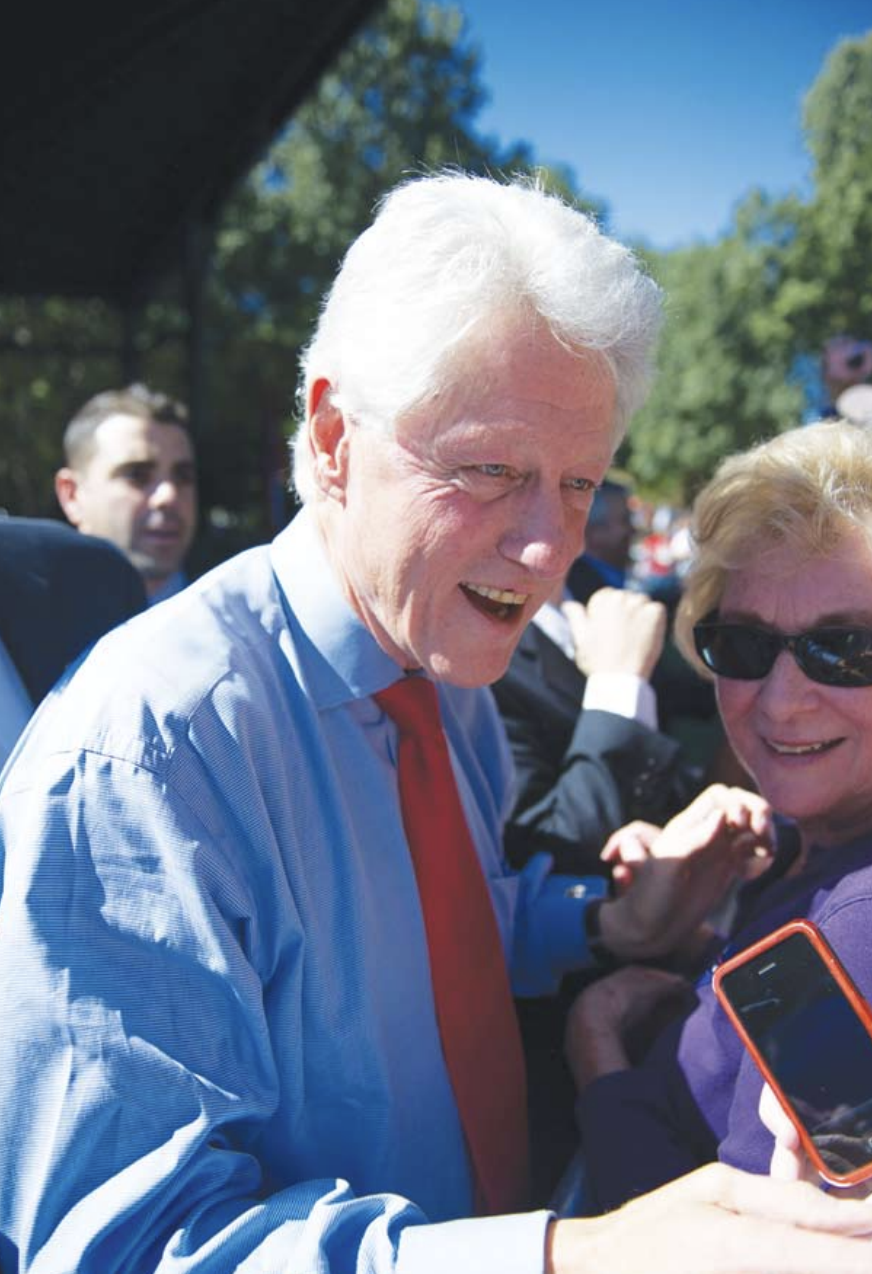
President Bill Clinton greets supporters after his speech at the Grove stage on Oct. 14, 2010.
Bill Clinton
Former President Bill Clinton visited Ole Miss on Oct. 14, 2010, joining then-U.S. Rep. Travis Childers for a “Get Out the Vote” rally to encourage young voters to participate in the upcoming midterm elections. Speaking from the Grove Stage, Clinton and Childers emphasized the importance of civic participation as students gathered to hear from the former president.
Clinton originally set out to support people who had backed Hillary Clinton during her 2008 presidential campaign, since she was unable to participate in political activities as a member of President Obama’s Cabinet.
As Clinton traveled to more campaign events, his focus shifted toward voter engagement. He said conversations with students and others along the campaign trail made him increasingly concerned about whether people would participate in the midterm election.
“The more I got out here, and the more I saw what was going on, the more upset I got,” Clinton said in his speech. “Two University of Mississippi students were interviewed saying they voted in 2008, but they just weren’t interested in voting in the midterm, so what I decided to do was see if I could find some way to get people to think about this election”
Clinton’s appeal then moved beyond simply encouraging students to vote. He challenged them to take a more deliberate approach to the political decisions they were making, arguing that frustration and instinct could easily replace consideration of the issues.
“We don’t want to think; we just make up our mind, we get mad, and we say, ‘This is what I’m going to do,’” Clinton said. “I’m telling you, on this campus, it is time to think about this election.”
Many other political figures have also made appearances on campus, including former Vice President Hubert Humphrey, former Sen. Mitt Romney, former Rep. John Lewis, former Sen. Tom Daschle and former President Joe Biden.