































Each academic department at the University of Mississippi will introduce its individual artificial intelligence policy this semester. AI policies are expected to be included in every course syllabus.
All departments were tasked by the university in May to create department-specific AI policies. The university’s AI Task Force gave departments guidance on what, specifically, each AI policy should aim to address.
The guidelines emphasized addressing student and faculty usage and the renewal of any AI policies on an annual basis to keep up with technological changes.
“Each academic department or program is responsible for developing artificial intelligence guidelines that: address student use of generative AI in course components,” the AI Guidelines for Teaching and Learning said. “Address student use of agentic AI in course components; address student use of assistive AI in course components; and hold students accountable for infractions.”
The guideline then went on to outline what’s needed for faculty to take a case of a suspected AI usage violation, and the opportunity for possible restorative opportunities.
Robert Cummings, the chair of the university’s AI Task Force, met with administrators, deans and chairs throughout the summer to ensure that all departments had a clear understanding of the principles behind their AI policies.
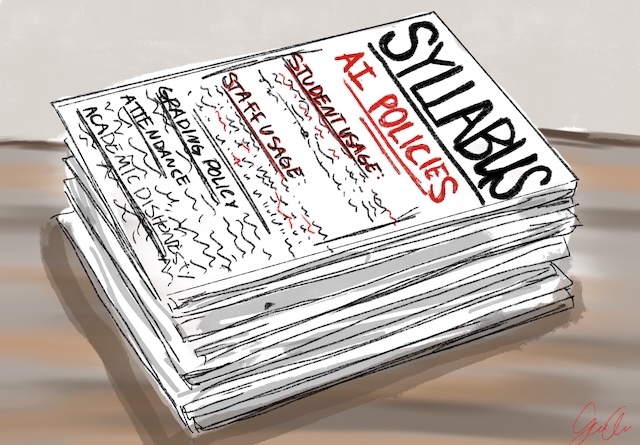
Many schools, and the departments within, are in different stages in terms of the degrees to which they have integrated AI into their courses. Some departments have fully introduced AI into their courses, while others are more hesitant and are still in conversation with faculty and staff to find the best form of implementation.
“There is a natural tension between groups of faculty who are resisting AI and groups of faculty who are embracing AI,” Cummings said. “Both of those perspectives, in my opinion, are correct, and that’s what makes this so challenging and so interesting.”
The School of Journalism and New Media has found many ways to incorporate AI, ranging from the approval of a new minor in AI in communications, which will launch this fall, to the integration of AI into preexisting courses.
Rashad Mammadov is the chair of the Media and Communications Department in the School of Journalism and New Media. He also serves as the chair of the School of Journalism and New Media’s AI Task Force.
The journalism school’s AI Task Force was created about a year and half ago with the expressed purpose of finding ways to teach students how to use AI within their chosen fields. This past summer, the task force was instrumental in bringing the departments within the School of Journalism and New Media together to create their policies.
“We started exploring the ways we can integrate AI skills into our curriculum with the understanding that AI is becoming the new workplace reality,” Mammadov said. “Our students are expected to have AI skills going into newsrooms, into advertising offices, into pretty much any kind of communications-related workplace that you can name. We approached this with an understanding that this is one of the tools that the industry is using, and we would be doing our students a disservice if we do not address that particular need.”
Other departments are coming together to create policies under a shared goal, as well. School of Education departments, for example, are united under a mission to advance teaching and learning practices.
“No matter what, the School of Education is focused on how can we enhance teaching and learning,” Rock said. “If a tool can enhance that work — not do it for us, but help us do it better — then we’re always going to explore how we can use it to strengthen teaching and learning.”
However, while the departments may be working under the same principles of bettering the teaching and learning practices and experiences for their students, each department’s policy might not be the same as other departments within the school.
“We have a Department of Higher Education preparing professionals to work in higher education, while other departments focus on areas such as teacher education and early childhood education,” Rock said. “The goal of teaching and learning is the same across those areas, but how AI is used and what guidelines or requirements are needed can be very different. I think each department will have to approach it in a way that fits its specific needs.”
It is expected that there will be variation in AI policies as departments accommodate for their respective needs and priorities. However, the university and faculty have an expressed interest in making their policies as transparent as possible for their students.
“A university is like a city, and in a city, you have different neighborhoods, and in different neighborhoods, you’ve got different approaches to solving problems and moving forward,” Cummings said. “(Students are) going to be in different departments, and they’ll have different approaches, but wherever they are, they’re owed clear guidelines in the classroom. … The university’s committed to the idea of giving them clarity.”