
























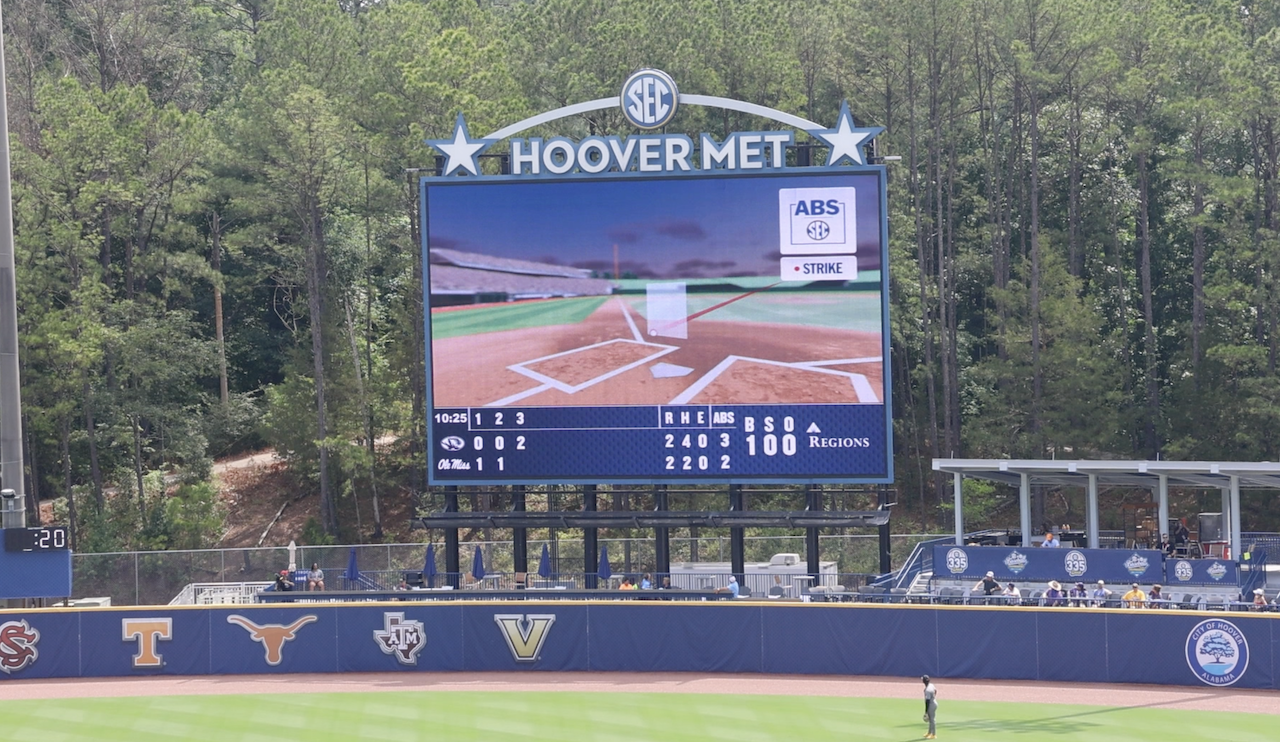
The Southeastern Conference implemented the Automated Ball-Strike System in last week’s conference baseball tournament. While the system certainly increased accuracy for ball-strike calls, it seems unlikely that it can be implemented across the NCAA as a sustainable aspect of college baseball.
ABS worked well during the SEC Tournament. On day one, it was pretty slow, taking 10-12 seconds to display the verdict on the jumbotron, but it was much faster, down to 2-3 seconds, by the next day.
The system had significant impacts throughout the tournament. In 15 games, there were 105 challenges. Fifty-six percent of challenges were overturned. Catchers initiated 69% of the challenges, batters 30% and pitchers just 1%. Catchers had a 64% overturn rate, while batters had a 41% rate.
Last week’s tournament featured a 19-inch strike zone, which equals the width of home plate plus the 1-inch black border on each side. Its upper boundary was 58% of the batter’s standing height, and its lower boundary was 23% of the standing batter’s height.
The Major League Baseball strike zone is 17 inches wide — 53.5% of the batter’s height at the top and 27% at the bottom. The top of the zone used last week was 4.5% taller and the bottom was 4% lower than MLB’s zone.
Frankly, the Rebels were unprepared to adjust to how ABS affected the game. In Ole Miss’ lone game in Hoover, Ala., against Missouri, they used the system once — an unsuccessful challenge from catcher Austin Fawley. Missouri, on the other hand, had nine challenges, and seven were overturned.
The most important challenge from the Tigers was in the bottom of the fifth with Fawley at the dish and two runners on base in a one-run game.
On a 2-2 count, the Tiger pitcher threw a slider that was about one foot from where the catcher was set up and the umpire called ball three; however, the catcher challenged it, and ABS showed the pitch clipped the top of the zone.
Fawley had already homered in the game. Had ABS not been in use, he would have had another pitch to tie the game if not take the lead.
In the past, if a pitcher missed his spot that badly, which makes the catcher have to adjust and often makes the ball look like it was out of the zone, the umpire would not call it a strike.
ABS takes that human error out of the game and eliminates some need for execution. Pitchers do not have to hit their spots in order to get a favorable call, but a strike is a strike whether executed well or not.
It is fair to say that, had the SEC used the MLB standard zone, Fawley would have not struck out on that pitch. In fact, many other calls throughout the week would have gone a different way if the MLB standard was used.
College strike zones have always been larger than MLB zones, but ABS exposed the zone as too big. It needs to be reduced; however, the zone cannot match that of MLB. Professional pitchers are professionals for a reason.
It is unreasonable for less-developed college pitchers to share the same zone as professional athletes. A balance between changing the zone to be fair to batters and giving college pitchers a slightly larger target must be found.
“The pitchers aren’t as good here as they are in MLB. I don’t want a tight zone, but it certainly seemed like the challenges were favoring strikes versus balls,” D1Baseball writer Mark Etheridge said in an interview with The Daily Mississippian on May 20.
Tracking technology Hawk-Eye makes ABS possible. The technology requires cameras to be placed around the venue. Professional tennis leagues use it to determine in or out calls. Installation costs $100,000.
The technology simply cannot be installed at every college baseball venue.
“It’s cost-prohibitive. It’s expensive. There’s some programs out there that can’t give full scholarships,” Etheridge said. “It’s really not possible to ask them to fund this technology instead of scholarships or basic travel expenses.”
ABS cannot just be used in the SEC. If one conference uses it, all of them must use it.
First, college baseball teams play more than just conference opponents. If ABS was limited to just the SEC, visiting teams would have to switch from one set of rules to another often.
Second, if only the SEC had ABS, why would its teams want to play teams in other conferences? Everyone must agree to the same set of rules for every game. Failing to do so undermines the season.
The system can drastically change the outcome of major moments; therefore, it affects the result of the game.
Third, how could non-SEC teams, who play SEC teams on the road and have no experience with ABS, utilize the system properly compared to teams who use it for the majority of the season?
Ole Miss fans already saw how unprepared the Rebels were for ABS and how their unfamiliarity with the system affected their SEC Tournament game. It would be unfair for a team with over 30 ABS games to play a team which has never used it.
The SEC, having already won six consecutive NCAA College World Series championships, has separated itself as the top baseball conference. ABS would put the SEC ahead technologically and widen its achievement gap.
ABS cannot solely be used for tournaments or the postseason, either. Teams should not go a full season without ABS and then have to adjust to the system in the postseason.
ABS must be implemented in every college baseball stadium to be effective without putting some teams at a disadvantage. It changes too much about the game to only be used in some stadiums.
Experimenting with ABS in the SEC Tournament was a grand idea, but the system’s implementation across the sport will be much more challenging.