

























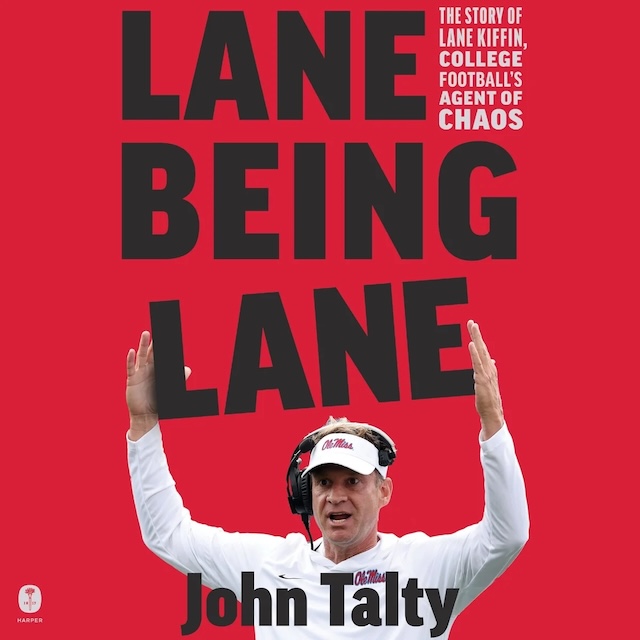
National college sports reporter John Talty’s biography of current LSU head football coach Lane Kiffin, titled “Lane Being Lane,” hits bookshelves today. Talty will participate in an interview and host a book signing for the new release at Square Books on Wednesday, Sept. 16.
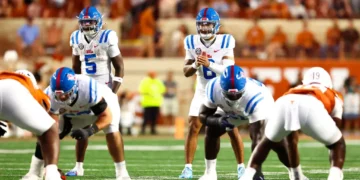
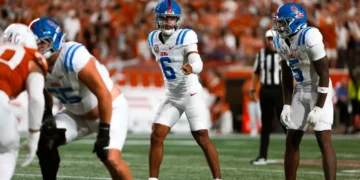
The book details Kiffin’s life from childhood to his current position at LSU, which he accepted after leaving the Ole Miss Football team on Nov. 30, 2025, right before Ole Miss’ first appearance in the College Football Playoff.
“Lane Being Lane” follows not only Kiffin’s career, but his personal life and how his struggles impacted his career.
Kiffin coached at Ole Miss from 2020-25 for a total of six seasons, all of which are featured in Talty’s biography. Talty writes in explicit detail Kiffin’s highs and lows, from wins on the field to relationship breakups off the field.
Talty also chronicles the various times Kiffin’s name was included in head coach searches by other schools when he was actively coaching the Rebels. The author alleges that Kiffin’s interest in coaching for another program began in his second season at Ole Miss when the Auburn job became available.
With this history in mind, Talty seems to present the idea that Kiffin leaving the University of Mississippi was not a matter of “if,” but “when.”
“It’s almost like the football version of the age-old question of whether it is better to have loved and lost or never loved at all,” Talty wrote. “If you knew there was an expiration date on the Lane experience, as there always was, would you still sign up for it?”
Talty also describes Kiffin’s relationship with the larger Oxford community. Specifically, the writer details Kiffin’s complicated personal relationship with John Currence, the owner of City Grocery, Big Bad Breakfast, Snackbar and Bouré.
“Currence never hesitated to keep it real with Lane. He was successful enough that he didn’t need the Ole Miss head coach to like him,” Talty wrote. “When Lane demanded a reservation for eight people one busy night only to no-show, the restaurateur had no problem letting him have it.”
Indeed, Talty does not shy away from writing about the complicated and often negative feelings that Kiffin brought about in other people. However, Talty balances this representation by speaking on Lane’s work as a strategist and his perfectionism. Talty’s book represents Kiffin as a nuanced man who thrives on chaos.
“(Kiffin) was a successful head coach, made a lot of money and yet at various times seemed to be juggling three exes and multiple new partners,” Talty wrote. “Why, the friend asked, was he still trying to balance all that as a famous SEC head coach? ‘I don’t know why,’ Lane told him, ‘but I love chaos.’”
It was this very chaos that ripped through the Oxford community when Kiffin took the LSU head coaching position. Talty described Kiffin’s reaction to not being able to coach the football team in the 2025 playoffs. The move impacted his behavior toward the university and the Oxford community after the fact.
What “Lane Being Lane” can offer Oxford readers is a better understanding of why Kiffin left in the manner that he did, from Kiffin’s calling out impact of the university’s racial history recruiting in Vanity Fair to his attempts to take Trinidad Chambliss and Kewan Lacy with him to LSU.
Talty paints a picture of Kiffin that seeks to explain and reveal the deeper facets of his character. He ends the book with a grand summarization of Kiffin’s personality and eccentricities that highlights Kiffin’s contradictions.
“Lane was brilliant and he was strange,” Talty wrote. “Lane was funny and he was awkward. Lane was brash and he was sensitive. Lane was charming and he was manipulative. Lane was evolved and yet he was stunted. Lane was unique, for better or worse, in a world full of copycats and robots. Forever and always, Lane was Lane.”