

























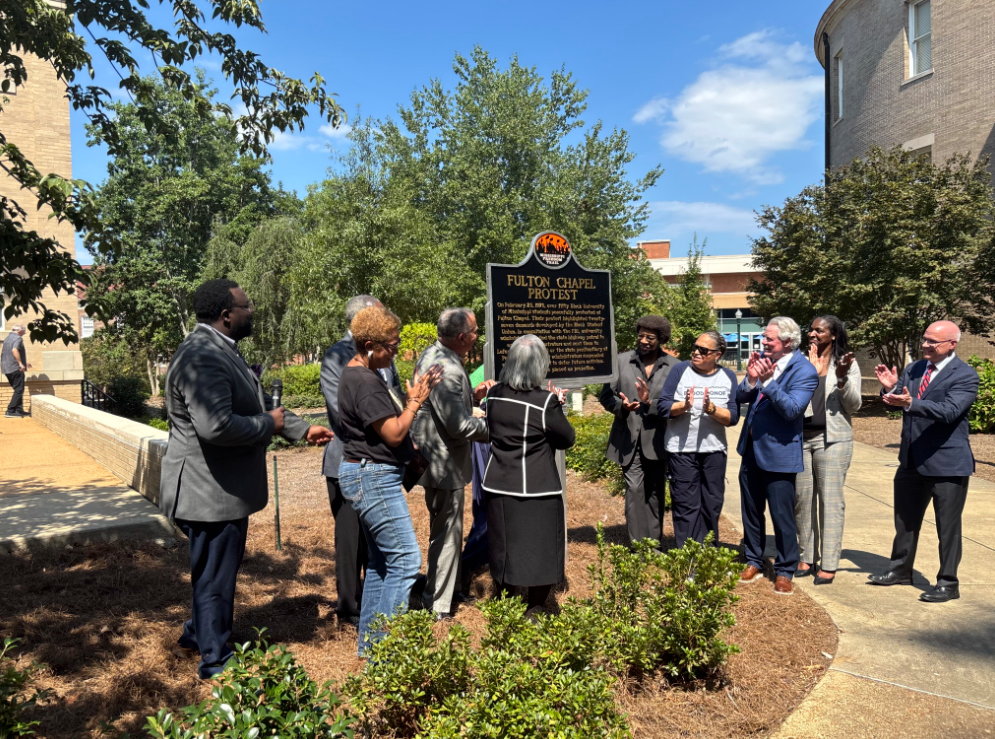
The University of Mississippi has unveiled a plaque commemorating a 1970 campus protest by Black students at Fulton Chapel. A ceremony was hosted on Tuesday, Sept. 2, outside Fulton Chapel, where the plaque stands.
The plaque honors the Ole Miss 8, who, on Feb. 24, 1970, read out the Black Student Union’s 27 demands at a peaceful protest against racial discrimination at the university. The students voiced their desires for “inclusivity on campus.”
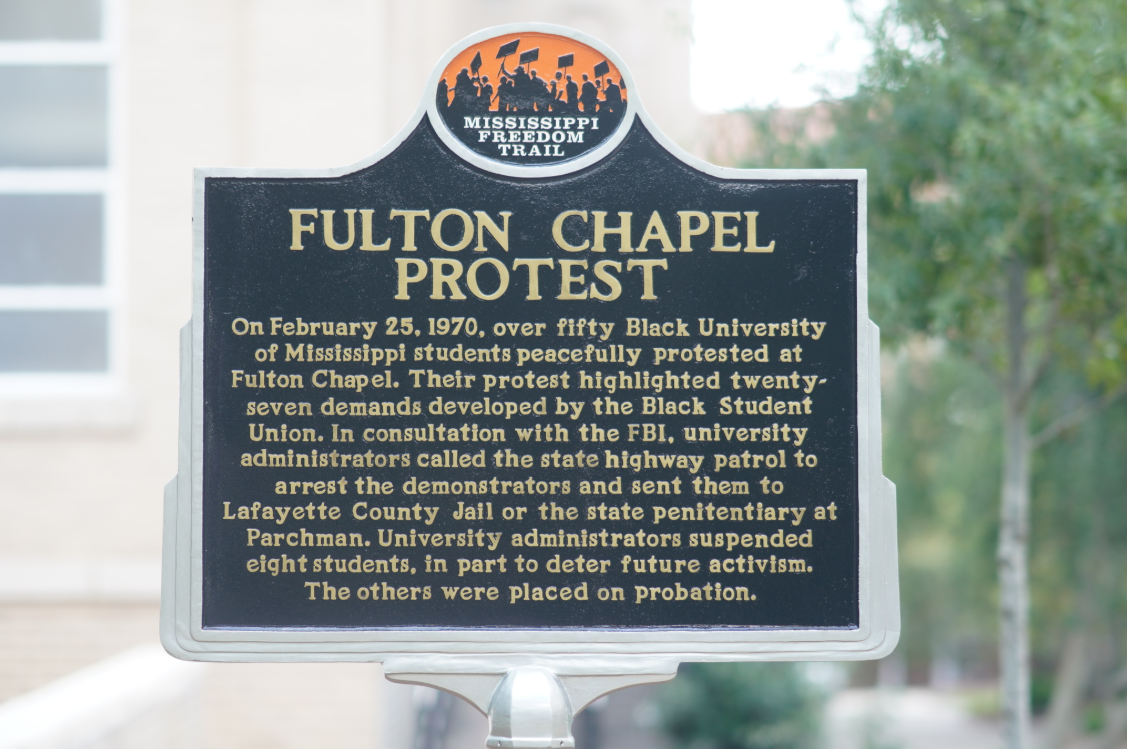
These eight students, along with several other Black students, were arrested; all eight were also “suspended from the university,” and the other students were “placed on probation,” reads the plaque.
The Ole Miss 8 finished their degrees elsewhere, but in 2020, UM offered a formal apology to the group and presented Linnie Liggins Willis with her diploma, which the university denied her in 1970 despite the fact that she had completed all her required hours.
The front of the plaque contains a short description of the Fulton Chapel protest. The back of the plaque explains in greater depth why this protest was an important step toward civil rights for Black Southerners.
Chancellor Glenn Boyce began the ceremony by introducing four members of the original Ole Miss 8 who attended the event: Linnie Liggins Willis, Donald Ray Cole, Henriese Roberts and Kenneth Mayfield.
After lauding those men and women who showed leadership and bravery in the face of racism, Boyce thanked the Mississippi Freedom Trail, the Mississippi Humanities Council and Visit Mississippi for their work in implementing the plaque and emphasized the historical importance of the Ole Miss 8 in shaping the university’s identity.
“In the life of a longstanding institution like the University of Mississippi, there are undoubtedly historical moments that forever shape who we are,” Boyce said. “The Fulton Chapel protest is one of those events, and its lessons are enduring in our history.”
Ralph Eubanks spoke next, a fellow of the Center for the Study on Southern Culture, a UM professor and author. He said he felt compelled to speak out about the event when, many decades after the protest, historian and former UM professor Garret Felber passed along the FBI’s file of the protest.
“The day Felber brought a copy of the FBI file of the Black Student Union and the Fulton Chapel protest to my office, I knew that I had to write about this event,” Eubanks said. “I immediately recognized the need to break the silence that I had been conditioned to bear for nearly 50 years.”
Eubanks’s article, “The Unhealed Wounds of a Mass Arrest of Black Students at Ole Miss, 50 Years Later,” details the events leading up to the protest, as well as the protest itself. The article was published in The New Yorker on Feb. 23, 2020, a day before the 50-year anniversary of the protest.
Eubanks described how the public perception of the event has shifted over the years: What was once a mark of shame on the university is now being recognized as a bump on the road to progress and acceptance. For many years, the protest was only spoken about in hushed tones.
“The prospect that one day the university would commemorate such a brave act of radical activism, much less speak about it openly, seemed impossible,” Eubanks said. “Today, we are officially breaking the silence about the Fulton Chapel Black Power protest.”
Donald Ray Cole was a member of the Ole Miss 8. He returned to the university to work as an assistant professor of mathematics and served as the Assistant Provost. In an interview with The Daily Mississippian, Cole echoed that the plaque serves as an important reminder of the university’s past struggles while also demonstrating UM’s commitment to improvement.
“(The Fulton Chapel protest) was hush-hush … for a number of years,” Cole said. “But the fact that the university is recognizing it publicly does represent a big change in the university and shows how far the university has advanced as an institution.”
Boyce, too, believes that this plaque helps reorient the narrative.
“It’s (good) any time you can take and bring back … even history from 40 or 50 years ago and make people realize that this university isn’t that university, and that this university wants (everyone) to be a part of who we are and what we’re about,” Boyce said in an interview with the DM. “(The Ole Miss 8) were our students, and as soon as somebody becomes one of our students, they’re our family.”
After his comments, Eubanks welcomed Willis to the stage. Willis spoke about her difficult experience transferring from Tougaloo College, a historically Black university in Jackson, Miss., to UM, where she said racism dominated the campus.
“We, the Black students, only had each other to depend on and communicate with,” Willis said.
Willis then elaborated on the steps she and others took to rectify the issues.
“By (1970), we had organized the Black Student Union, which became our voice,” Willis said. “And that voice said, ‘Enough is enough.’ We must speak up, speak out and advocate for ourselves. And more importantly, we needed to bring our concerns to the attention of the university administration.”
From there, of course, came the Black Student Union’s 27 demands at the Fulton Chapel protest.
Grace Hosemann, a junior Southern studies and public policy leadership major from Mobile, Ala., attended the event. A student in Eubanks’s Southern studies 401 class, Hosemann appreciated Willis’s short speech.
“I love that (Willis) was here to speak, because I feel like I hear, so many times, the retelling of the story, but it’s cool to see her in person,” Hosemann said.
Willis then talked about her time on the Black Power at Ole Miss Task Force, where she worked to repair the emotional and social effects of the Fulton Chapel protest.
Before the plaque was unveiled, Provost and Executive Vice Chancellor for Academic Affairs Noel Wilkin and Program and Outreach Officer for the Mississippi Humanities Council John Spann spoke.
In an interview with The Daily Mississippian, Boyce voiced his support for the ceremony.
“I thought the comments that were made were incredibly appropriate, and it was so exciting to hear some of the reconciliation and the thoughts of some of the individuals who spoke for the Ole Miss 8,” Boyce said.
Cole, too, approved of the ceremony.
“I think everyone who spoke today spoke to wisdom and spoke to the truth,” Cole said. “It’s a cultural change in the university that’s being recognized today, and I appreciate that.”
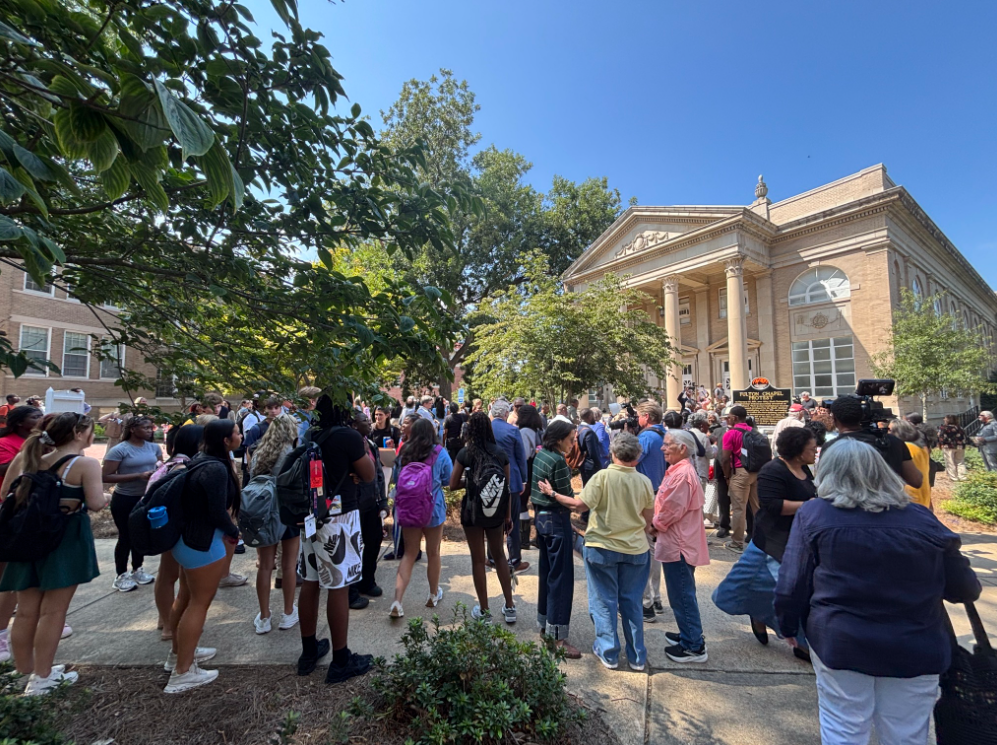
Hosemann believes that the location of the plaque is perfect.
“I remember I had (freshman) orientation in (the Fulton Chapel),” Hosemann said. “I had no idea about the history of it. I think it’ll be really important for incoming students, current students and past students to see (the plaque) now and remember. They’re seeing the physical architecture and the beautiful campus of Ole Miss … (but) they also see the past.”
Cole believes the university has come a long way since the Fulton Chapel protest.
“To acknowledge (the Fulton Chapel protest) is almost enough in its own right,” Cole said. “But to acknowledge it and then celebrate it, and celebrate those (who) are part of it, that’s going above and beyond … Those are the little things that make a good university a great university.”