


























To celebrate Hispanic Heritage Month, the Department of Sociology and Anthropology, alongside the Latin American and Caribbean Studies program, invited Dartmouth graduate and Mississippi-raised rancher, Juan Quinonez Zepeda, to speak on the complex landscape of Southern agriculture and the role of Latino farmworkers on Friday, Oct. 17.
The presentation, titled “Cattle, Cash, & Cebadilla: Latinx Farmworkers and the Future of Southern Agriculture,” explored how the agricultural industry in the Southeast relies on immigrant labor despite facing deeply rooted social, economic and legal systems.
Of the 2.9 million agricultural workers in the United States in 2022, Quinonez Zepeda noted, more than two million reported being foreign-born, making up 70% of the workforce.
Quinonez Zepeda’s research challenges the notion that farmwork constitutes “low skill or unskilled labor.” From his experience working in the cattle industry with his father when he was 14 years old, Quinonez Zepeda argues farmwork builds “tacit knowledge,” which he describes as inherent skill acquired through perception, experience and understanding.
He recalled seeing his father executing thought-out and meticulous tasks, such as negotiating best care and treatment of cattle, carrying out handling techniques and performing veterinary-level care. These tasks, Quinonez Zepeda said, made him view his father as a jack-of-all-trades.
“I would tell my dad, ‘You’re doing a lot more than just labor,’” Quinonez Zepeda said. “There’s a lot of critical thinking that goes into the work you do.”
This knowledge also includes skills like driving a tractor, building fences and caring for animals. In Quinonez Zepeda’s research, he found that agrarian workers have an average of 18 years of farm experience, demonstrating this deep knowledge. He also found that 13 out of 15 Latino cattle workers interviewed in Northern Mississippi already had previous experience working in the cattle industry in Mexico before coming to the United States.
Marcos Mendoza, a UM professor of anthropology, characterized this as having an “autoethnographic perspective,” which is a research approach where a person analyzes their personal experience to understand a broader cultural experience. This lived experience, Mendoza noted, is considered “tremendously valuable” in academia.
“Those of us who have backgrounds in agriculture and come from agricultural families can bring that wealth of knowledge,” Mendoza said. “You’re starting from a much deeper understanding of what’s happening, and you can generate knowledge, I think, much quicker and much more successfully.”
The mislabeling of this labor as unskilled, Quinonez Zepeda explained, carries two critical implications: social marginality and economic exploitation.
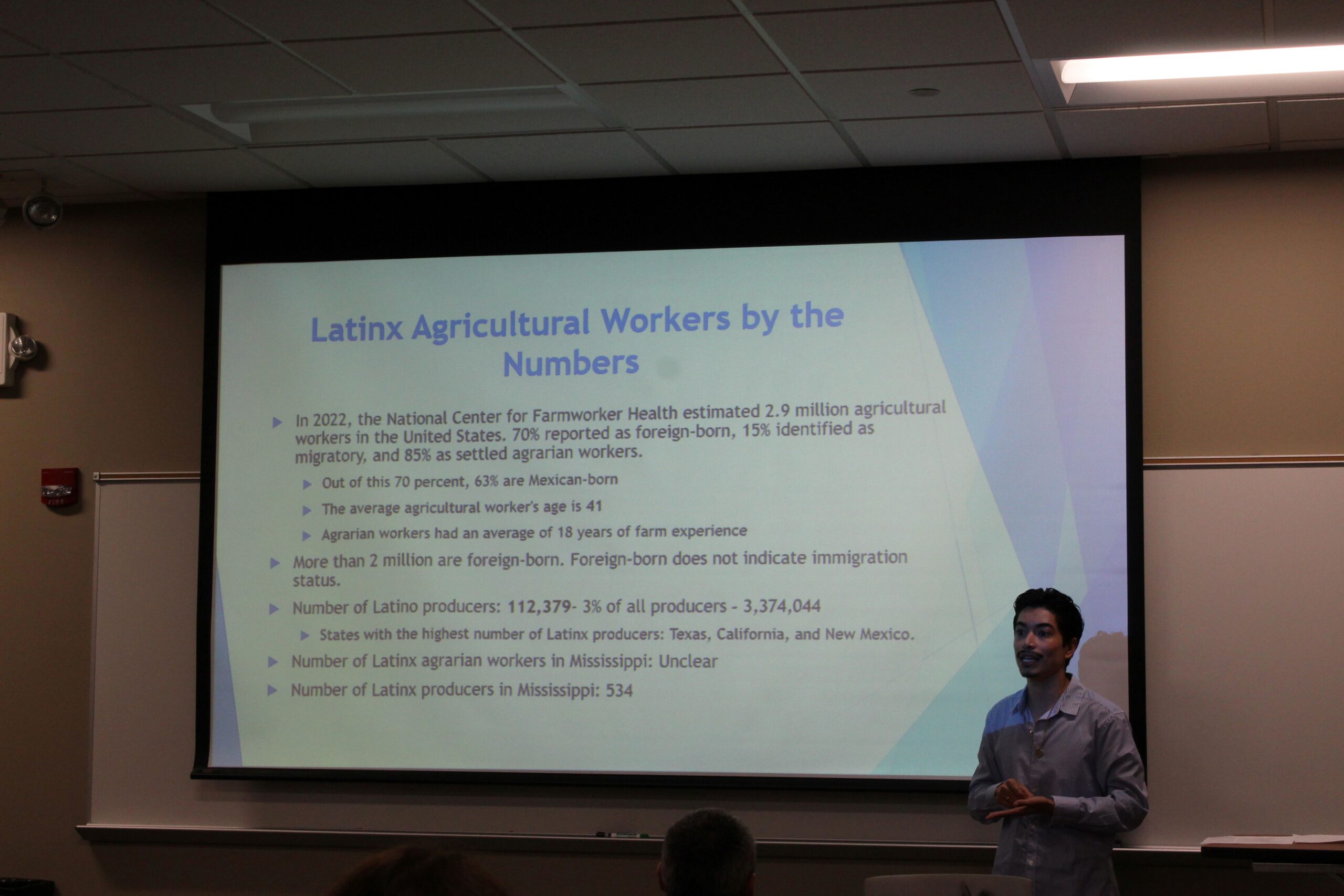
Due to labor being the third-most expensive cost of running an operation, Quinonez Zepeda also said farmworkers often don’t pay themselves or their workers adequately.
“If we continue to label (farmwork) as (unskilled), we don’t appreciate really … the richness, the complexity and the amount of experiences that go into the kind of work that they really do on a daily basis,” Mendoza said. “By labeling it as unskilled labor, then they’re going to be paid accordingly, rather than being paid for the deep amount of knowledge and experience that they really have.”
In his interviews with farm owners, Quinonez Zepeda found that several owners recognize the economic consequences of losing their Latino workforce, where one owner stated, “This would be the end of my operation.”
Xander McGarrity, a freshman law studies major, attended the event to learn more about cultural and economic trends in agriculture. He called Quinonez Zepeda’s presentation “inspirational.”
“When comparing Juan’s age to other professors, I felt like his accomplishments, roles and ability to speak as he did (were) inspiring,” McGarrity said.
Quinonez Zepeda, who is still in his 20s, offered advice for students, urging them to become agents of change to combat injustice in agriculture.
“Educating yourself about (injustice) and learning how to recognize the signs of it is how you can combat it and get involved,” Quinonez Zepeda said.
The speaker also encouraged supporting local policies and organizations that educate others on agricultural issues. He noted that most people are “really excited for young leadership” to enter these positions.
“Connect and partner with organizations who are already doing this work,” Quinonez Zepeda said. “Sometimes the research question or thesis that you’re really grappling onto is right in front of you.”