






















Graphic by Madelynn Liberto
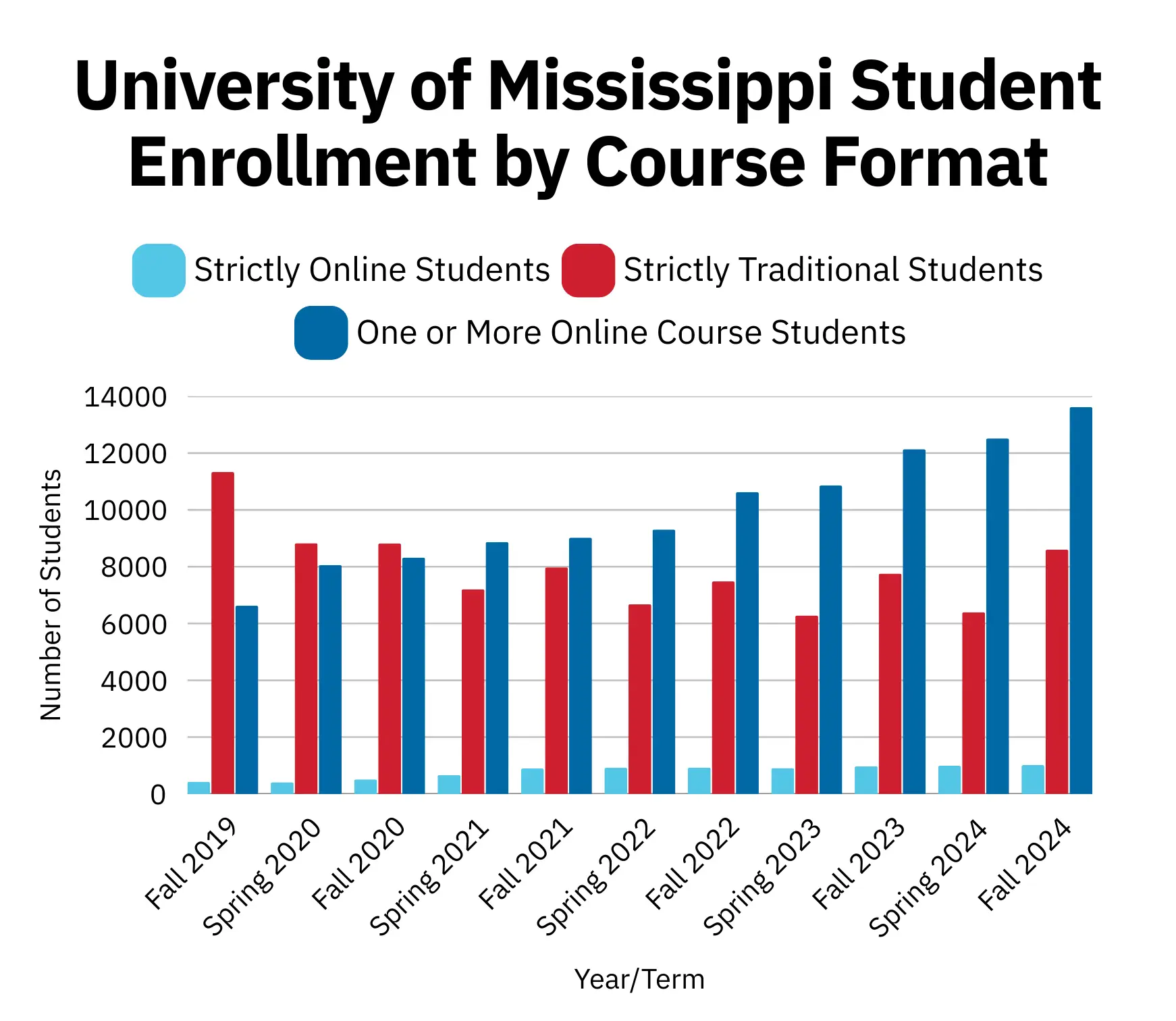
Student course preferences at the University of Mississippi have shifted since the fall of 2019. More students now favor hybrid schedules — a combination of in-person and online courses — over strictly traditional, in-person only formats.
The COVID-19 Pandemic served as a major turning point in this shift. In March 2020, the university transitioned to remote learning in response to campus closures. While hybrid forms of learning resumed at the university in Fall 2020, full in-person learning resumed in Fall 2021.
Adjunct Instructional Assistant Professor of Integrated Marketing Communications Robin Street said the transition revealed the potential of online coursework.
“We were all forced to go online because the university essentially canceled all on-campus classes for public safety reasons. I think that was when many students and professors understood that teaching and learning are possible in an online format,” Street said.
Data from UM’s Office of Institutional Research, Effectiveness, and Planning (IREP) supports this potential. In the 2020-2021 academic year, more students enrolled in hybrid schedules that include a mix of online and in-person courses than traditional all in-person schedules.
“I prefer a schedule with a mixture of both because it makes my academic and social schedule more manageable and allows me to create my own schedule for the online courses,” Jennifer Nieberlein, a junior law studies major, said.
Sociology and Anthropology Professor Scott Barretta, who teaches exclusively online, said that while his online classes have always been full, he has progressively had more to teach.
“As someone who has been teaching online for nearly 20 years, I certainly have seen how the number of online courses has increased,” Barretta said.
Professors enjoy the format as well.
“Like the students, I enjoy the flexibility of the schedule. I’m someone who doesn’t mind working at night or on the weekends if it means that I can have a loose schedule during the weekdays, and I’ve never been a 9-to-5 person,” Barretta said.
A 2022 Statista survey found that 47% of students in higher education believed online courses were equal to in-person courses, while 43% disagreed, saying they found them to be worse.
“Online learning can be a challenge for students who get busy and forget deadlines in a course they don’t physically attend. I think it’s important as an instructor to find ways to encourage regular participation,” Summer Hill-Vinson, a journalism professor, said.
Street said that students taking online classes have to focus on discipline.
“In terms of success in an online class, a student has to be disciplined enough to watch or read the lectures and complete the assignments without the guidance of a scheduled class date and time,” Street said.
Not all students embrace hybrid or online learning formats. Sophomore professional sales major Charlie McClorey said he prefers the structure of in-person classes.
“I prefer in-person classes because it gives me better discipline to focus on what’s going on in class, and I would prefer an all-in-person schedule,” McClorey said.
However, registration challenges have limited his options. McClorey said late registration times have left him with only online options for his required courses. According to the university’s website, registration windows are determined by several factors including priority status, classification, credit hours and completion of teacher evaluations.
“I am only in a couple of online classes because it was the only option that I had. I pay to go to school here, and if I knew that the outcome of coming here would be having no choice but to take some online classes, then I would have gone somewhere else,” McClorey said.
Other students have found a balance between formats that works for them. Senior multidisciplinary studies major Shannon Glancy tailors her schedule to the difficulty of her courses.
“My schedule depends on the difficulty of my classes that semester,” Glancy said. “I prefer harder classes taken in person and easier classes taken online.”
Senior accounting major Talley Bryan said online courses allow her to focus better and learn at her own pace.
“I prefer online classes because I can get more done at home,” Bryan said, “I learn best by teaching myself in a way that isn’t rushed. When I’m not overwhelmed with tons of work and having to attend class on top of it, I think I learn the materials better.”
Though Bryan prefers online classes, she said limited availability has kept her in a mixed format.
Barretta also mentioned how online courses, or a combined course schedule, can be beneficial to people with different priorities and responsibilities.
“Students who have a lot going on in their lives, such as a full-time job, small children, an active sports training and traveling schedule, and older students who are returning to school enjoy the flexibility of not having their life revolve around being on campus,” Barretta said.