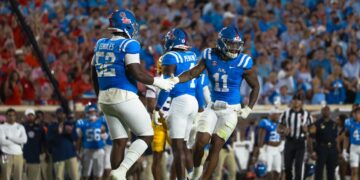























Though Ole Miss Football does not have quite as many highly touted NFL prospects ahead of the 2026 NFL Draft as it did in 2025, there is still plenty of talent in this year’s batch of soon-to-be professional Rebels.
Five Ole Miss players were invited to participate in the 2026 NFL Combine in Indianapolis, Ind., from Feb. 27-March 2: defensive tackle Zxavian Harris, offensive tackle Diego Pounds, tight end Dae’Quan Wright and wide receivers De’Zhaun Stribling and Harrison Wallace III.
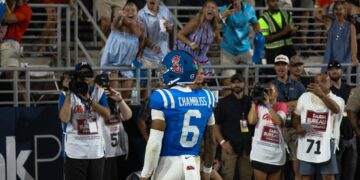
Pounds’ immense frame assists him in muscling defenders, but it also hinders him against speedy edge rushers. Though Pounds did not allow a single sack this past season — which points to NFL-caliber protection — Ole Miss quarterback Trinidad Chambliss escaped some sticky situations thanks to his wizardry in the pocket.
Stribling wowed scouts with his 40-yard dash time of 4.36 seconds, which ranked No. 8 among receivers at the combine. Additionally, when taking into account his performances on the vertical and broad jumps, he ranked as the No. 5 receiver in terms of athleticism score.
Stribling’s production was inconsistent in 2025-26. Against Arkansas and Kentucky, he combined for three catches for 15 yards. However, he found his stride late in the season; across three playoff games, he caught 17 passes for 278 yards and a touchdown.
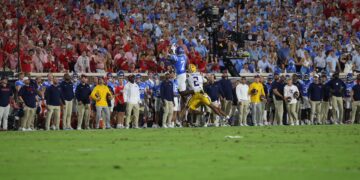
Stribling’s ability to outrun defensive backs on vertical routes, his body contortion and strong hands shined in the Sugar Bowl, when he caught seven passes for 122 yards, including the game-sealing 40-yard reception in the final minute. Stribling’s combine performance could vault him into Day 2 NFL Draft conversations. His ceiling probably hovers around the late second round or early third round.
While Wallace was the more productive receiver in college, his athleticism knocks him down a few notches in comparison to Stribling and other receivers. At 6-feet-1-inch, 192 pounds, he does not possess the length or reach that lankier receivers offer. He also does not look to be fast enough to make his mark as a deep threat and speedster, with his 40-yard dash time being 4.54 seconds.
Though Wallace’s production at Ole Miss speaks for itself — he caught 61 passes for 934 yards and four touchdowns — and he was an excellent jump ball receiver, whether his abilities will translate to the NFL remains to be seen.
While there are less athletically gifted receivers in the league, Wallace would be extremely fortunate to blossom into a top-producing receiver — comparable to Puka Nacua or Cooper Kupp, who were both selected in the mid to late rounds.
Wright made several crucial plays this season, but the tight end suffered from playing in an offense that did not utilize a tight end as much as some other teams. Wright’s highest yardage in a single game this season was 80, which is solid for his position, but his most receptions in a game was four.
While he is a skilled pass-catcher, he is not an exceptional blocker. Despite Wright standing at 6-feet-4-inches and 255 pounds, NFL analyst Lance Zierlein pointed out some glaring weaknesses in Wright’s draft profile on NFL.com.
“Run-blocking technique at the point is below average. … Needs to become more consistently competitive as a blocker,” Zierlein wrote.
Since he lacks the upside to be a pronounced difference maker in the league, Wright projects as a Day 3 selection (rounds four-seven) — especially in an era when tight end is becoming an increasingly important position in the NFL. George Kittle and Brock Bowers, for example, are two of the best tight ends in the league thanks to excellence in both run blocking and pass catching.
Harris is a physical specimen, but that carries both strengths and weaknesses. At 6-feet-8-inches and 330 pounds, he generates plenty of power with his size. However, he often plays too high; players are often instructed to keep a low pad level. Harris’ potential to serve as a heavy, stalwart pillar plugging up the line of scrimmage strength will mean nothing if he cannot play low to the ground.
Scouts increasingly seem to favor nimble pass rushers. The Philadelphia Eagles’ Jordan Davis is a prime example of this. Davis is 6-feet-6-inches, 336 pounds, yet his 40-yard dash time was 4.78 seconds. Harris is two inches taller and only a few pounds lighter, but his projected 40-yard dash time is 5.40 seconds.
Though Harris will be able to soak up running lanes just from his size and power alone, getting to the quarterback may be difficult for him. His production raised some red flags in college. This past season, he logged a career-high in sacks, but still only finished with three.
Harris may not be immediately available to play due to injury. At Pro Day, he was on a manual medical scooter with his right foot in a cast. He also did not compete at the combine.
Harris may appeal to his NFL teams thanks to his size and strength, but he does not project as more than a rotational or depth piece with special teams value. He will probably be a Day 3 selection — not quite as complete as former Rebel defensive linemen Walter Nolen and JJ Pegues.