



























The Lafayette County Board of Supervisors voted 3–1 at its meeting on Monday, May 4, to not rezone parcels of the Lafayette County Max D. Hipp Industrial Park from I-2 heavy industrial to I-1 light industrial, permitting the Magnolia Materials asphalt plant to begin construction there pending approval from the Mississippi Department of Environmental Quality (MDEQ). Lafayette County residents who requested the rezoning in January 2026 to prevent the plant’s construction are considering legal action.
Residents have until May 14 to file an appeal of the board’s decision to be heard by the Lafayette County Circuit Court. Residents opposing the plant’s construction will voice concerns to MDEQ at the agency’s public hearing on June 10 from 6 to 8 p.m. at the Oxford Conference Center.
The Lafayette County Board of Supervisors accepted the Lafayette County Planning Commission’s recommendation on March 23 to decline the rezoning application filed by county residents Ronnie McGinness, Meg Faulkner Duchaine and John Duchaine.
Brent Larson, president of the board of supervisors, was absent from the May 4 meeting due to medical reasons. District 5 Supervisor Greg Bynum, vice president of the board, led the meeting.
“The applicant must prove there has been a change in the character of the neighborhood that has created a public need for the rezoning and the proposed rezoning is consistent with the comprehensive plan,” Joel Hollowell, Lafayette County Director of Developmental Services, said at the meeting.
Walt Davis, the attorney representing the rezoning applicants, said Hollowell failed to mention that rezoning could occur if there was a mistake in the zoning.
Davis argued that the board incorrectly zoned parcels of the industrial park as (I-2) heavy industrial, as there is no transitional zoning and too many residential neighborhoods in proximity to the heavy industrial zoning.
“We are asking for the board to fix the mistake that was made when the original ordinance was enacted,” Davis said. “When the ordinance did not match the map, because the ordinance calls for the establishment of a transitional zoning around every heavy industrial proportion to be C-3 (commercial high density) or I-1 (light industrial), we are asking for it to be rezoned I-1.”
The Lafayette County Zoning Ordinance Davis referred to was enacted in 2018 following the adoption of the Lafayette County Comprehensive Plan. The zoning ordinance categorizes areas in the county as agricultural, residential, commercial, light-industrial and heavy-industrial.
“It is the intent of this Ordinance that such ‘heavy’ industrial districts be located insofar as possible adjacent only to C-3 (commercial high density) or I-1 (light industrial) districts, which shall serve as transitional zones between I-2 (heavy industrial) districts and residential uses and lower intensity commercial uses,” the Lafayette County Zoning Ordinance says.
C-3 commercial high-density zoning or I-1 light industrial zoning would have to be implemented around the industrial park for the required transitional zones to be present.
“Industrial uses should be located away from, or well-buffered from, residential uses,” the Lafayette County Comprehensive Plan says.
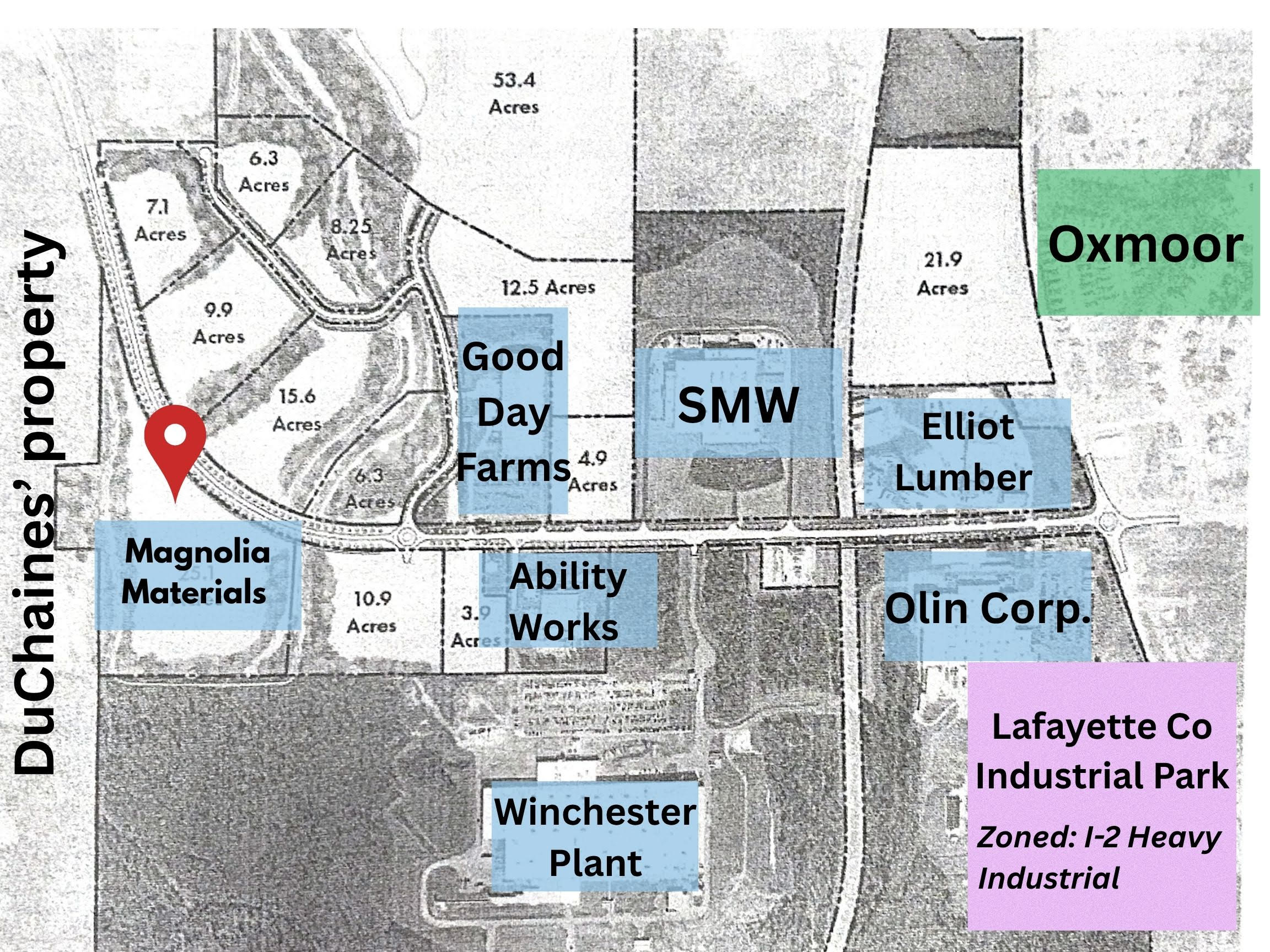
Meg Faulkner and John Duchaine live on a 165-acre property 150 feet away from the proposed asphalt plant site. The Duchaines’ property is zoned A-1 rural agricultural.
In the Lafayette County Planning Commission meeting on March 23, Hollowell said that Duchaine’s property would serve as the buffer between the I-2 heavy-industrial-zoned asphalt plant and the residential-zoned neighborhoods.
“The way this is supposed to work is that if you have a heavy-industrial use, you put it in the center, put light industrial around it, small commercial around that, so that you separate heavy industrial use from where people live and keep their horses,” Davis said. “No one has been able to give me a good answer as to why it was not done here. It appears that there was a mistake as to whether or not it was.”
Hollowell said in the board of supervisors meeting that he does not believe the zoning was a mistake or that buffering plays a role in the zoning case. He stated the requirements for a buffer between (I-2) heavy industrial and other zones, not transitional zoning, is a 40 inch buffer and a six-foot fence, as defined in the Lafayette County Zoning Ordinance Section XVII Article 1703.06.
The Lafayette County Master Plan was adopted in 2022 and describes the industrial park as a techno-industrial campus with walking trails, water features and vegetative berming.
“We’re doing the best that we can with that type of situation,” Hollowell said in the meeting. “The zoning ordinance does not say that you shall put a buffer of C-3 or I-1 between an I-2. It says, ‘Insofar as possible.’”
The board of supervisors agreed with Hollowell that it would not be possible to provide transitional zones.
In an email to The Daily Mississippian, Hollowell explained that it was impossible to provide transitional zoning for the industrial park.
“With no zoning in Lafayette County until January 18, 2018, it was impossible to create ideal transitions because of existing uses,” Hollowell said. “The industrial park is the perfect example. Section 1703.06 of the Lafayette County Zoning Ordinance takes into account that there are no perfect scenarios and that when an I-2 district or use abuts any district other than an I-1 district and a use is developed, a 40-foot buffer and a six-foot screen are required.”
Supporters of the rezoning to prevent the proposed asphalt plant’s construction spoke during the public hearing portion of the supervisors’ meeting.
No one spoke against rezoning the industrial park parcel in the public hearing.
“In 1985, Lafayette County purchased land north of town for industry,” Summer Hill-Vinson, a resident who lives 0.25 miles from the industrial park, said. “It is now 2026, and the industrial park is an island surrounded by homes, farms, schools and parks. Thousands of people live within a mile-radius of the industrial park, with thousands more planned by your own votes. The rezoning is critical for the people in your community: their homes, their health, their safety, and today you have the opportunity to rezone the industrial park to a type of development compatible with the thousands of people living in its shadow.”
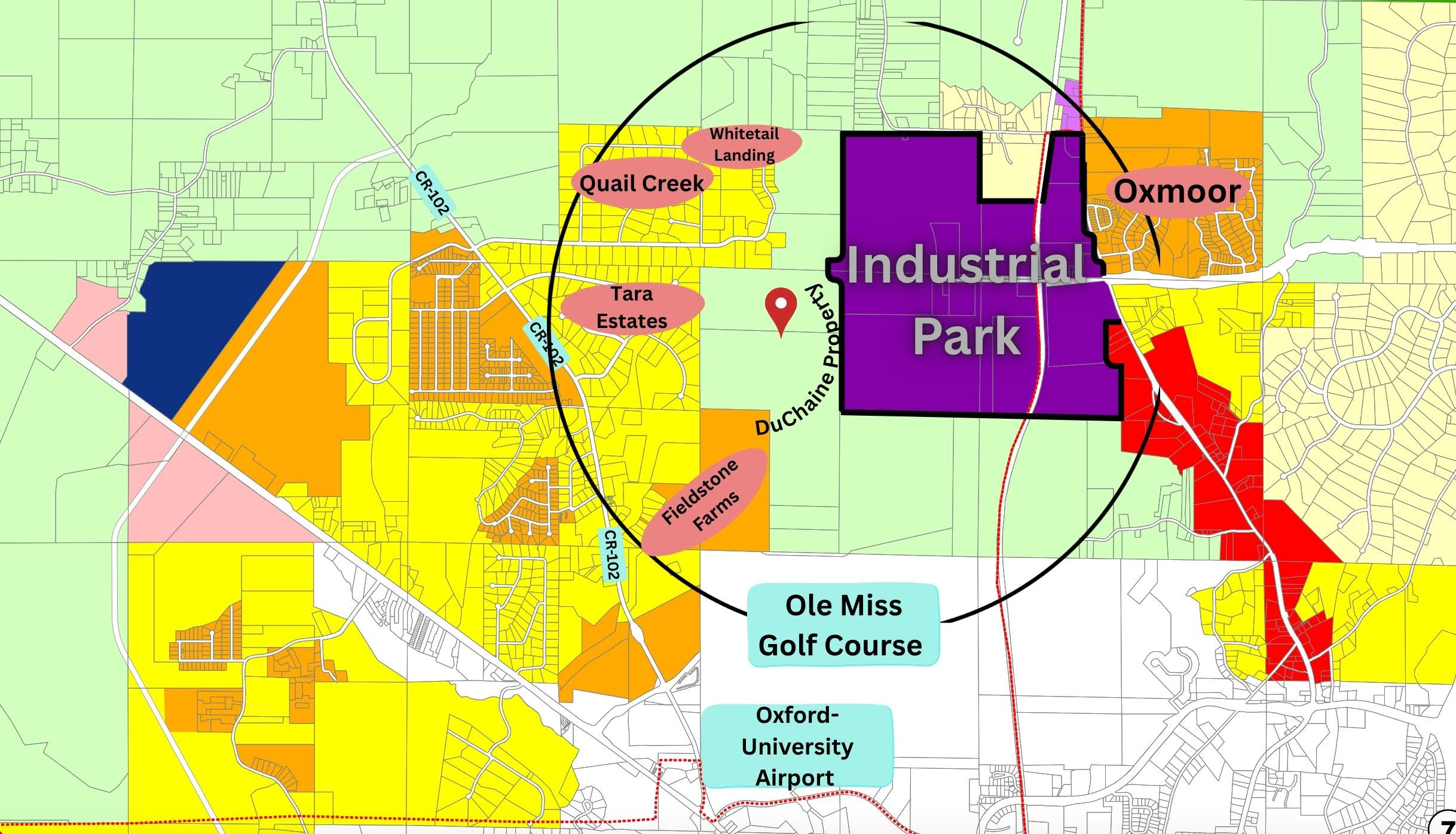
Neighborhoods Tara Estates, Whitetail Landing, Quail Creek, Oxmoor, The Ranch, and Fieldstone Farms are located within one mile of the proposed asphalt plant site. Just outside the mile-radius are Twelve Oaks, Northpointe, the new Lamar Lakes development, Magnolia Montessori School and Regents School of Oxford.
The industrial park is located approximately 1.57 miles from the Oxford-University airport.
Lafayette County resident Wen Wu raised concerns over the distance between the Magnolia Materials asphalt plant and the airport, citing potential aviation problems due to the asphalt plant’s emissions.
“In aviation terms, that is within the area where aircraft may turn, descend and maneuver at low altitude before landing,” Wu said. “At this time, I simply request that any applicable (Federal Aviation Administration) notice, review or coordination be confirmed and documented as part of the planning process.”
At this time, it is unclear whether proper notification has been submitted to the Federal Aviation Administration (FAA) by completing a federal “Notice of Proposed Construction or Alteration,” or FAA Form 7460-1. The board of supervisors has not responded to a request for comment on the status of the notice at the time of publication.
“These aircraft follow curved flight paths, and at low altitude, their turning radius can be on the order of one to two nautical miles, meaning aircraft may be operating over this same area,” Wu said. “Some industrial activities may involve emissions, heat sources, plumes, lighting or other operational factors that, in certain cases, could affect visibility or pilot awareness. I am not saying that such impacts will occur, only that they are reasonable factors to evaluate.”
Jacob Pind, manager of the Oxford-University Airport, said in an email to The Daily Mississippian that a Form 7460-I would have to be submitted to the FAA before construction of Magnolia Materials.
“This would prompt the FAA to do an airspace study in order to identify any construction or final plan obstructions and to see if any airspace and/or navigational amendments are necessary,” Pind said. “There are several towers/antennas that stand within a few-mile radius of the airport, some in the area of the industrial park, that stand between 200 (feet) and 462 (feet) above ground in elevation, all depicted on aeronautical charts. If the towers are similar to these and standard plant towers, I do not foresee an issue.”
Davis explained that rezoning the parcels from (I-2) heavy industrial to (I-1) light industrial would allow existing industry in the park to operate. The rezoning, however, would prohibit the heavy-industrial Magnolia Materials plant from operating there unless a conditional use permit is obtained.
“It’s still going to be the industrial park,” Davis said. “You’ll still have jobs, but what you can do is have the transitional zoning that the ordinance calls for and that is required. I was brought up to believe that when you make a mistake, you fix it, and that is what we are asking for you to do.”
Davis asked the board to rezone the property to provide consistency with the zoning ordinance and Lafayette County Master Plan. By requiring transitional zoning, the zoning ordinance requires the (I-2) heavy industrial zoned parcels of the industrial park to have transitional zones if possible. If the board were to rezone the property to (I-1) light industrial, according to Davis, the property would not need transitional zoning.
To comply with the Lafayette County Zoning Ordinance, the parcels of land abutting Meg Faulkner Duchaine and John Duchaine’s A-1 rural agricultural property must be used as transitional zones, which would require rezoning these parcels to (C-3) commercial high-density zoning or the (I-1) light industrial zoning.
Oxford-Lafayette, Inc., formally known as the Economic Development Foundation, is a non-profit organization that works to recruit industry for Oxford and Lafayette County. Oxford-Lafayette, Inc. owns parcels in the industrial park and recruits industry for the park.
Allen Kurr, vice president of Oxford-Lafayette, Inc., read a statement from Ryan Miller, CEO of Oxford-Lafayette, Inc., to the board. Miller was absent from the meeting.
“This reclassification could limit or narrow our scope of possible expansion and potentially reduce the number of industry sectors from which new projects might emerge,” Miller’s statement said. “We prefer the opportunity to thoughtfully consider as many projects as we can that might achieve our goals for the community.”
JWM Development, LLC — owned by Magnolia Materials owner JW McCurdy — is a member of Oxford-Lafayette, Inc., according to the organization’s website.
McCurdy was not present at the May 4 board of supervisors meeting.
Roy Liddell, an attorney with Wells Marble representing Magnolia Materials, presented the board with a brief and documents related to the plant’s position on the rezoning.
“There’s no public need for the zoning change,” Liddell said. “But on the other hand, there is a public need for the development of Magnolia Materials … The application also lacks a sufficient description of the property being rezoned that legally precludes the rezoning.”
Davis argued that the public need was to follow the master plan of the industrial park that the Lafayette County Board of Supervisors adopted in 2022, which was supported and signed by Oxford-Lafayette, Inc.
“As far as public need, we already have an asphalt plant that operates at fifty percent capacity and has for many years,” Davis said.
Lehman Roberts Co. operates a hot-mix asphalt plant approximately 2.1 miles from the site of Magnolia Materials on County Road 101.
“Asphalt production demand can vary based on project timing, seasonal conditions and the needs of public and commercial work,” a spokesperson for Lehman Roberts said. “We scale production output as project needs change while maintaining a consistent focus on safety and reliability.”
Davis argued that Lafayette County owning the parcels that were asked to be rezoned, as well as being the lessor over the property to Magnolia Materials, puts the board in a conflict of interest.
The Lafayette County Board of Supervisors signed a 35-year lease with Magnolia Materials on December 15, 2025. On December 22, 2025, the Lafayette County Planning Commission approved the site plan for the Magnolia Materials plant.
Mississippi Code § 57-3-9 indicates a site plan has to be approved by the county board of supervisors following a public hearing before a lease can be signed.
“The reason industrial parks are traditionally put off in the middle of nowhere is so they don’t expose residents to these sorts of things anymore than they have to,” Davis said. “This industrial park is basically in the middle of town.”
The industrial park is approximately 2.94 miles from the Square.
Residents who live near the industrial park said they will continue fighting Magnolia Materials’ construction. Several community members plan to pursue legal action. No further details on the pending litigation are known at this time.