



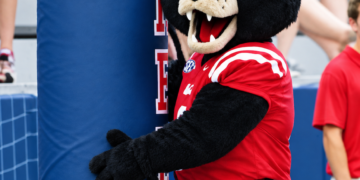
















The history of the Ole Miss mascot is a long and tumultuous one. The University of Mississippi’s current semi-official mascot is Tony the Landshark, whose vibrant aquatic energy has been absent from any sporting event in years.
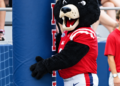
In 2017, the Landshark dethroned the university’s previous mascot, Rebel the Black Bear, who had shouldered the mantle of schoolwide patriotism since 2010. The Landshark honored Tony Fein, a former Ole Miss linebacker who passed away from a drug overdose in 2009, who popularized the “fins up” gesture.
The black bear was chosen as the mascot to replace the long standing Colonel Reb, whose history is equally fraught with confusion.
Some historians say Colonel Reb was modeled after a caricature of an elderly, Southern gentleman with Confederate roots; others argue he was inspired by a Black man named James “Blind Jim” Ivy. Ivy, the son of a former slave, came to the university in 1896 and worked as a peanut vendor, quickly becoming a symbol of school spirit after his boisterous cheers helped turn the tide of enthusiasm in a baseball game against the University of Texas.
Whether or not Colonel Reb was inspired by a peanut vendor or a Southern gentleman, there is no doubt his image is tainted by a history of oppression, as his image was modeled after a Confederate colonel.
After his introduction to campus in the 1930s, Colonel Reb became a figure synonymous with Ole Miss athletics. A male student dressed as the colonel cheered on the sidelines of Ole Miss football games and other sporting events for several decades.
For many people, it is hard to think about Ole Miss and not think of the image of Colonel Reb. However, there is someone else, especially for frequent Grove-goers, who could also be seen as a symbol of Ole Miss: the Grove squirrels.
If you’ve ever picnicked in the Grove on a sunny day or tailgated amongst the hustle and bustle of game-ready fans, you certainly have encountered the animal perhaps most ubiquitous on campus. These four-legged, vividly uncaring rodents are more than a common sight; in many ways, they are just as much a part of campus as we are.
Pay close attention to the paraphernalia that dots the water bottles, laptops and various accessories of students and faculty, and you will often notice a Grove squirrel, sometimes even boasting a pale blue bowtie.
We even had national TV coverage of a brave squirrel who scored his own touchdown at the Oklahoma football game last year, appearing yet again against Georgia weeks later. Why not commemorate his bravery and make some shirts while we’re at it? Not to mention the adopt-a-squirrel program that helps raise money for various charities.
There is no doubt the Grove squirrels represent a cultural cornerstone on our campus. Colonel Reb’s history is rocky, Rebel the Black Bear is unexciting at best, and the Landshark connects little with the current student body.
How amazing would it be to have a lively squirrel on the sidelines cheering on Ole Miss athletes?
Envision the endless photo opportunities — the wonderfully squirrel-inspired costumes eager parents would dress their toddlers in. Perhaps other rival mascot photos could be taken. Grove Squirrel pictures could come to rival the stereotypical Walk of Champions pictures taken by freshmen and graduates. The blue bow-tie and bushy tails could become as synonymous with game day as the powder blue.
The Grove Squirrel could compete with Mississippi State University’s rival mascot, Bully, in terms of sheer cuteness and likability. How hilarious would it be to see MSU’s bulldog get taken down by the Ole Miss Grove Squirrel? The next Egg-Bowl champion shirt would have the best graphic in years.
The Grove squirrel is a beloved part of our campus. Why not make him (or her) the mascot?
I propose a new symbol for our school, untainted by controversy and unmatched in likability.
Name him Greg, Garry or even Georgina, it quite simply does not matter — fundamentally, the Grove Squirrel represents an opportunity for an era of school spirit unmatched by all else.
The Grove squirrel is a symbol of Ole Miss that everyone can get behind.
Cedar Bowers is a junior creative writing major from Tupelo, Miss.