




























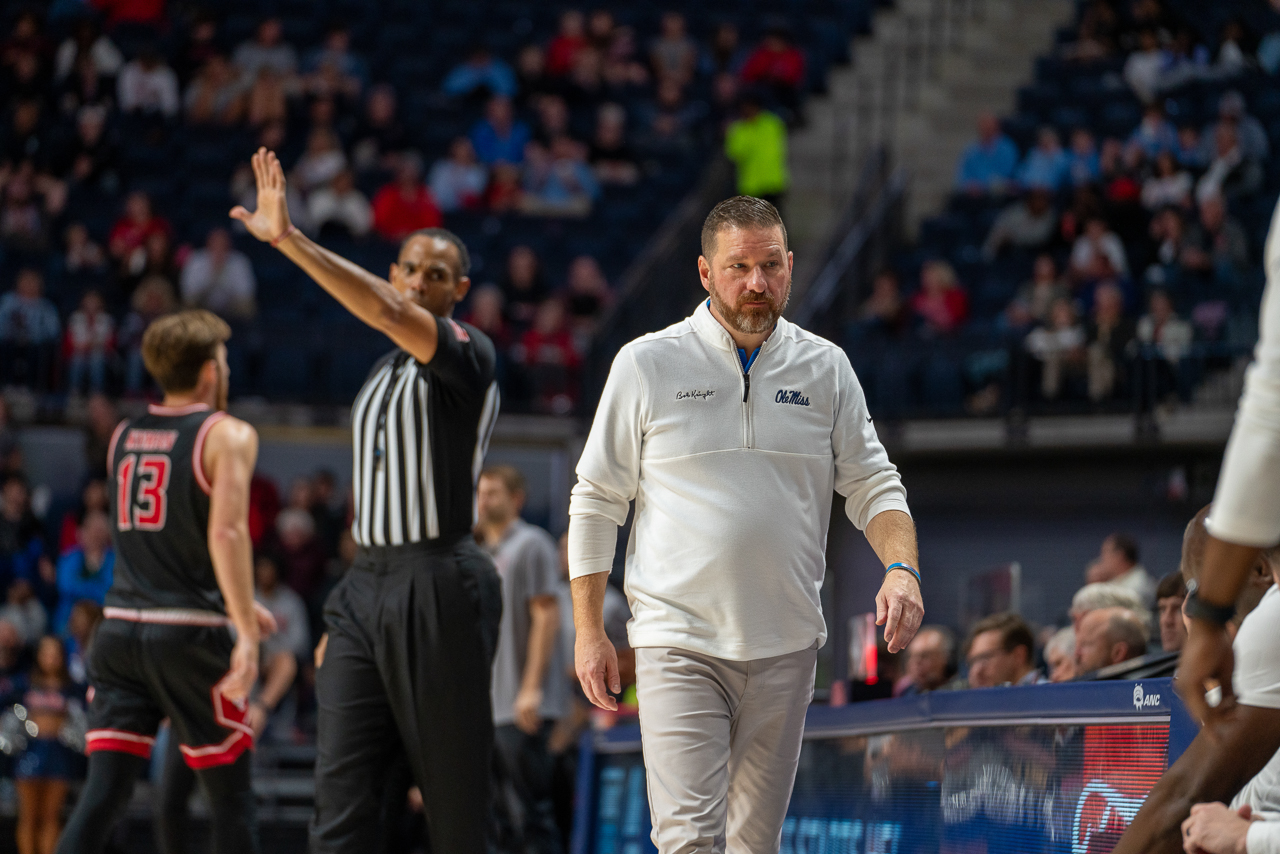
For most college basketball coaches, a second-to-last finish in conference play would mean a possible firing or at least a shorter leash. Ole Miss Men’s Basketball head coach Chris Beard, though, is not yet on the hot seat — he is not even close. Last year, in only his second season as head coach, he led the Rebels to the Sweet 16 for the first time since 2001, so his job should be secure for at least a few more years.
The question for Beard is whether he would depart Ole Miss in favor of a more storied program.
The logic runs that if he were to coach a program with better facilities, an esteemed national identity and a larger pool of funding through NIL, revenue share and alumni boosters— think of “blue blood” schools such as Duke, North Carolina, Kansas and Louisville — he would likely have an easier job bringing in top high school recruits and transfers. Better recruits lead to postseason success, which is, after all, what cements legacies in college basketball.
So, would Beard leave?
Other coaches might. Beard, though, would probably view upgrading to a more established program as taking the easy way out. On the Reb Talk podcast on Feb. 27, Beard appeared to dispel any rumors about a possible imminent departure.
“My promise is, there’s greater days ahead,” Beard said. “This too shall pass. We’re committed to being here at Ole Miss and building a program that’s nationally competitive.”
Consider his tenure at Texas Tech: In the six seasons before Beard took over in 2016, the Red Raiders had only one winning season. However, in his second season at the helm, Beard steered the Red Raiders to their first Elite Eight appearance in program history.
The next season, the Red Raiders won a share of the Big 12 regular season title and, as a No. 3 seed in March Madness, advanced to the National Championship, where they lost in overtime to No. 1 seed Virginia.
In 2022, Beard left Texas Tech and took the head coaching position at Texas. Could he jump ship from Ole Miss in a similar fashion? Maybe — but probably not.
Beard grew up in Irving, Texas. He served as a student assistant for the men’s basketball team at the University of Texas while he was an undergraduate, and he graduated in 1995. His taking the Texas job was not as much an abandonment of Texas Tech as it was a return to a program that helped build his foundation as a coach.
Also, Beard might have viewed his work at Texas Tech as complete. In the five seasons since he left, the Red Raiders have qualified for the NCAA Tournament four times. Last season, they advanced to the Elite Eight.
Beard could undoubtedly still achieve legendary coaching status if he took a job at a school with a stronger program — but he would miss out on the sort of cultural turnaround and community-wide adoration that would come with making a national contender out of a program that is historically weak.
Take Scott Drew, the head coach of Baylor Men’s Basketball, for example. Drew took over the Baylor program in 2003 following former head coach Dave Bliss’ dismissal amidst a scandal involving a murdered player.
At the time of Drew’s hiring, Baylor’s most recent postseason appearance came in 1950. In 2007, Drew’s fifth season as head coach, the Bears qualified for the NCAA Tournament. In 2009 and 2011, they advanced to the Elite Eight, and in 2020, they won the National Championship.
Drew’s effect on Baylor was so profound that in December 2021, Baylor and the city of Waco agreed to partner in the construction of the Paul and Alejandra Foster Pavilion, a new basketball arena for the men’s and women’s teams, on the bank of the Brazos River bank.
The entire facility, which opened in 2024, cost $212.6 million and covers 223,547 square feet. The Jay and Jenny Allison Development Center, which is connected to the Foster Pavilion, includes “separate practice courts, dedicated locker rooms, team lounges, office facilities and elite sports performance spaces, including strength and conditioning, athletic training, hydrotherapy and nutrition,” per the Baylor Magazine.
The success of the Baylor Women’s Basketball program undoubtedly factored into the construction of this facility. Kim Mulkey led the program to championships in 2004-05, 2011-12 and 2018-19. From 2009-18, the team’s worst postseason finish was the Sweet 16; every other season, the team advanced to the Sweet Sixteen or further. Still, Drew’s turnaround of the men’s program was remarkable.
To be fair, though, the most glamorous head coaching positions are also the most cutthroat. Fans and alumni are greedy and impatient. When blue blood programs hire someone new, athletic departments and fans do not expect results soon — they expect results now.
For example, former North Carolina head coach Hubert Davis was fired on March 24 following the Tar Heels’ loss to No. 11 seed VCU in the Round of 64 of March Madness. He coached the Tar Heels for six seasons. In 2021-22, Davis’ first season, No. 8 seed North Carolina was the runner-up in March Madness, losing 72-69 to the No. 1 seed Kansas Jayhawks.
Two seasons later, the Tar Heels won the ACC and advanced to the Sweet 16, and in the past two seasons, the Tar Heels have made the NCAA Tournament, though they lost in the Round of 64 both years.
For most programs, these results would be enough. For North Carolina — and for Davis — that was not the case. If Beard stepped into a head coaching role at a bigger school, the timer would start ticking before he even set foot on campus. Even considering the money and talent Beard would be working with at a bigger program, Davis’ situation shows that nothing is handed to a new coach.
Regardless, if Beard only intended to use Ole Miss as a stepping stone to a job at a bigger school, last offseason would have been the time to go. His stock as a coach was at an all-time high after turning Ole Miss into a Sweet Sixteen team in only his second season as head coach.
Beard demonstrated his loyalty in the offseason when Texas A&M reportedly pursued him following former head coach Buzz Williams’ departure for Maryland. Yet, despite this offer from a bigger school with better facilities and more money to work with, Beard opted to stay in Mississippi.
Beard’s name was also mentioned in connection with the Indiana head coach position. An offer from such a storied program is nothing to sneeze at; former Louisville head coach and current Saint John’s head coach Rick Pitino said that Beard would be the “perfect” candidate for Indiana’s coaching vacancy. But, again, Beard chose to remain in Oxford.
Since the SEC has become one of the premier conferences for college basketball — 14 teams made the postseason tournament last season, and 10 qualified this season — Beard’s future with the program should be secure.