
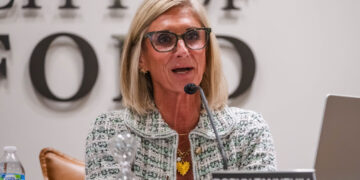



















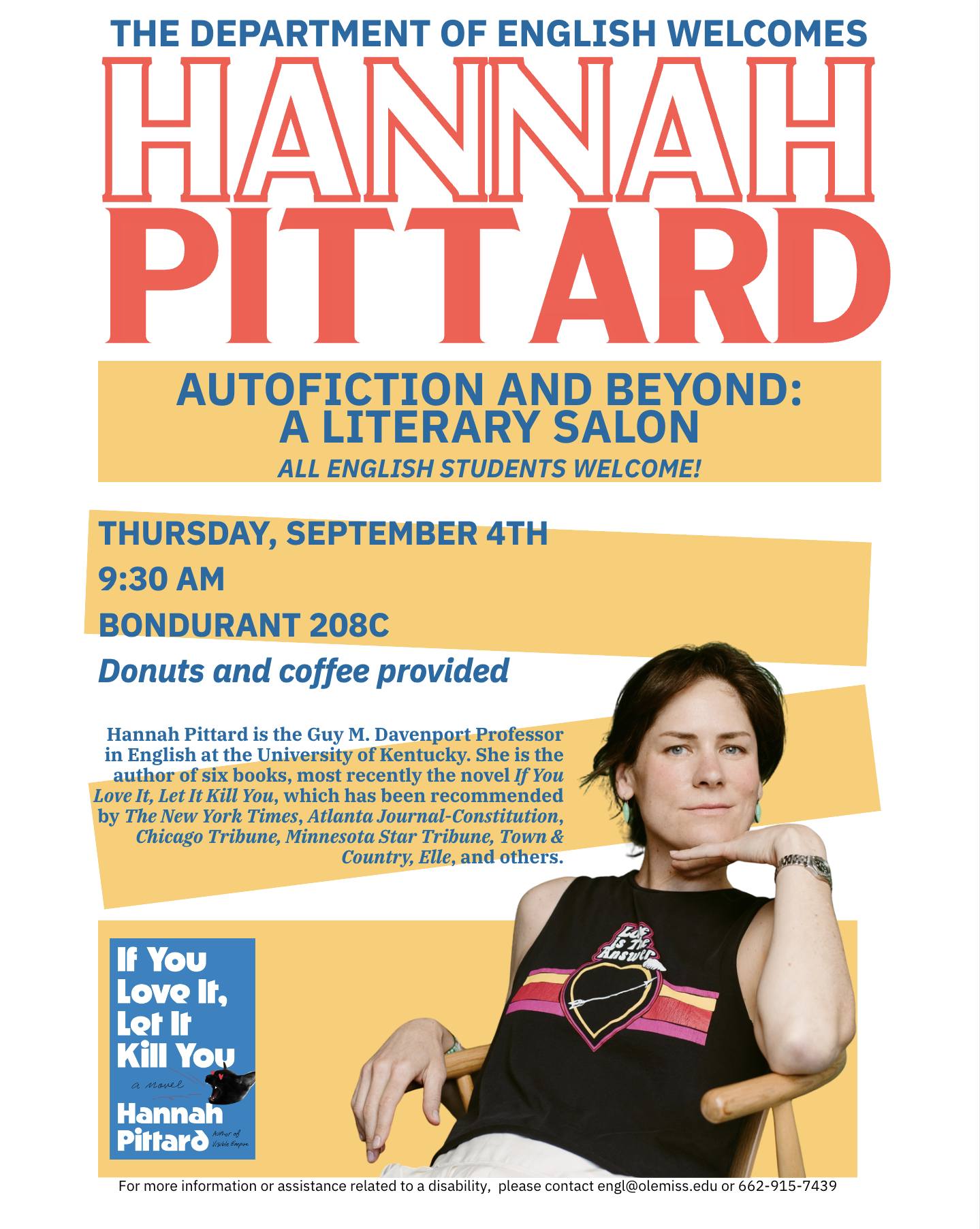
On Thursday morning, Hannah Pittard, acclaimed author and Guy M. Davenport-endowed professor of English at the University of Kentucky, spoke to an audience of English students at the University of Mississippi to promote her new book “If You Love It, Let it Kill You.”
Akin to a comedian, her advice contained punchlines and her presence was self-assured, even in the midst of unmasking personal doubt and dissatisfaction.
Pittard’s conversation was driven by questions from the crowd and mostly pertained to the merits of autofiction. She finds the genre comforting because it “resists a binary” and rests at the intersection between fiction and biography.
Autofiction is a genre where an author might share the same name or circumstances with characters but with certain fictional elements. This is usually meant to capture truths that transcend reality. For instance, a writer might be describing their husband and include a story of a fight they never had.
Pittard said she enjoys that autofiction “must deviate to get to the truth.” She noted the strangeness of feeling like a character is impersonating her in her writing.
Pittard also called attention to authors she finds particularly fascinating such as Tim O’Brien, Steven Dunn, Stephen King and Phillip Roth. Hailing from Georgia, she grew up with Southern influences William Faulkner and Flannery O’Conner.
Students of Tom Franklin, author of “Crooked Letter, Crooked Letter” and associate professor of fiction writing at UM, attended the lecture in place of their regular class to pick the brain of the celebrated writer. Their consensus was positive.
“I thought Hannah Pittard was a free spirit who didn’t care what anyone thought,” Griffin Ray, a senior creative writing major, said. “She clearly channels that positively into her writing, unafraid to use herself as the subject of a story.”
“She had a very good bit of advice for an aspiring author such as myself to use, saying, if you are struggling with making your characters different from one another, insert a small aspect of yourself in to make them more relatable both to you and the readers,” Ray said.
Junior psychology major Marin Wark, reflected on a piece she read for the talk, “Always Kill the Dog,” mostly thinking about the last line of the story in relation to the embarrassment Pittard alluded to in her talk about self-honesty.
“It is a comfort to know that the mistakes I make or embarrassing moments I have are almost never memorable for others the same way they are for myself,” Wark said.
Commenting on her writing process, the crowd laughed when she compared her computer to a wild bull that knows its fate. Acting it out, she said she will come into a room, avoid eye contact with the computer and suddenly pounce, furiously typing a memorized paragraph.
Additionally, when she is driving in the car, she will have conversations with people in her life, like her boyfriend and sister in order to fuel a story. She joked that when she gets home to her boyfriend he will ask if they were just fighting and remind her that the conversation was imaginary.
The ease and humor Pittard brought to her talk made for a masterclass in itself. She reminds writers that even as they bring real life to the imaginary, it is also acceptable to bring imagination to daily life.
“I have always been interested in the stories that we tell ourselves — the lies we tell, the truths we tell, the information that we leave out,” Pittard said in an interview with Los Angeles Review of Books.