





























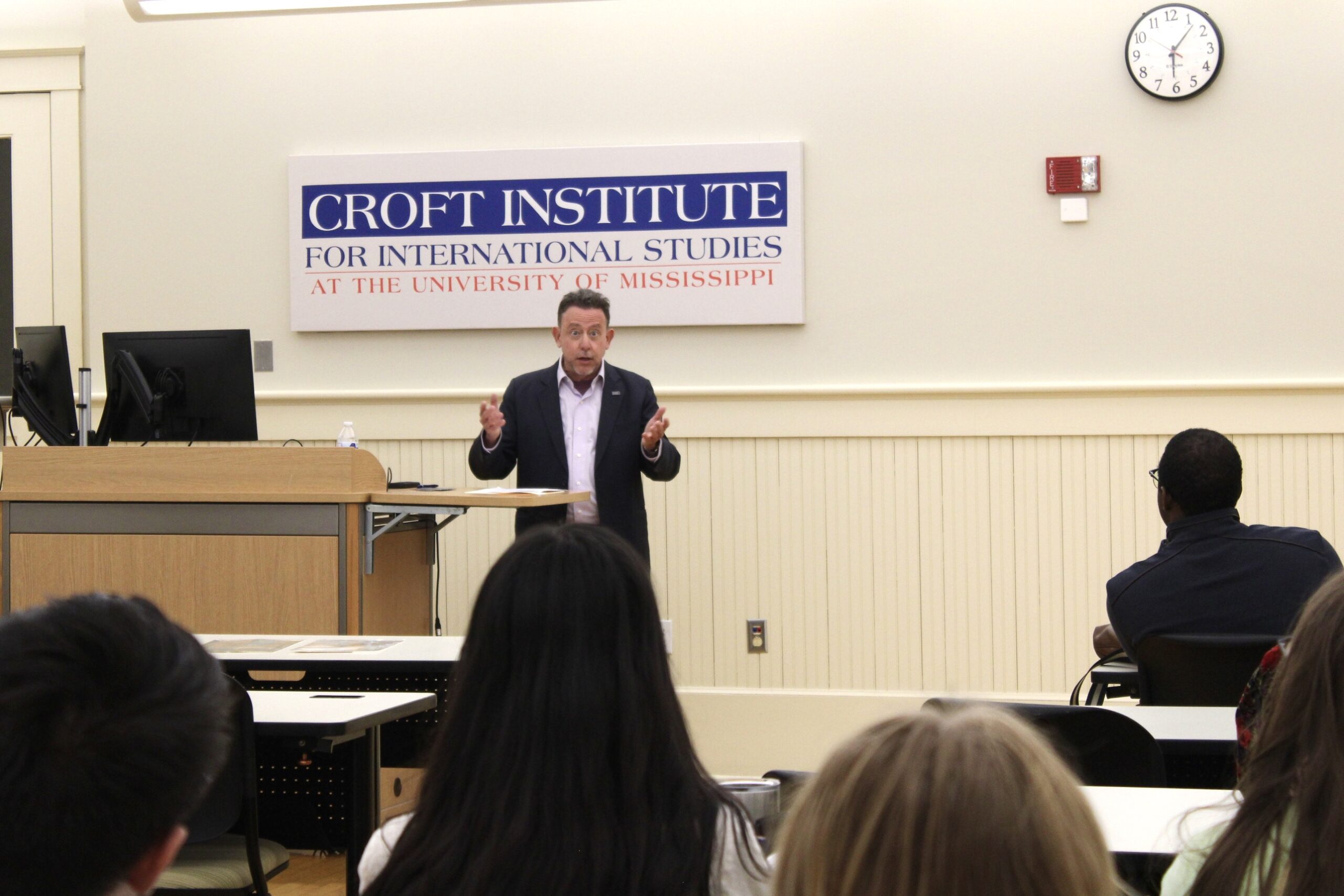
The Croft Institute for International Studies hosted Executive Director of the Jordan Center for Journalism Advocacy Steven L. Herman on Oct. 20 at 6 p.m. to discuss state-funded media, including Russia’s Radio Moscow and Qatar’s Al Jazeera.
“I have been fortunate to witness our words, ideas and narratives in shaping how nations see themselves and each other,” Herman said. “But perhaps nowhere has that power been traditionally more consequential or more contested than in the realm of state-funded media.”
Prior to serving as the executive director, Herman has served as a White House bureau chief and as chief national correspondent for Voice of America (VOA). He authored “Behind the White House Curtain: A Senior Journalist’s Story of Covering the President – and Why It Matters” in 2024, detailing his experience as working in the press for the government.
Herman also served as the VOA correspondent and bureau chief in India, South Korea and Thailand. He spent over 25 years reporting from Asia and 5 years as part of the White House press.
“There is probably no single more formative experience for whatever you decide to do in life than experiencing other cultures firsthand,” Herman said.
During World War II, Nazi Germany weaponized international broadcasting, using the radio to conquer Germans and influence opinions abroad. Imperial Japan’s Radio Tokyo was infamous for using their broadcasts to demoralize Allied troops in the Pacific.
“Radio could be a potent weapon of war without firing a shot,” Herman said.
During the Cold War, The Iron Curtain refers to the political and physical barrier that separated Europe and Western Europe from the end of World War II in 1945 until the fall of the Soviet Union in 1991.
“The Iron Curtain was not just a geopolitical divide — it was an information barrier,” Herman said. “But the truth, especially when incredible and consistent, has a way of moving through in places like Poland, Hungary and Czechoslovakia.”
President Franklin D. Roosevelt’s administration recognized the strategic value of state-owned media and created Voice of America in 1942 to broadcast news internationally in a variety of languages.
“In the United States in the early days of the Cold War, the Voice of America expanded dramatically, not just reporting on U.S. policies, but airing relatively uncensored views and analysis that Soviet citizens would not find (in) their homes,” Herman said.
Moscow responded by jamming Western signals and building massive transmitter rates to try to block Soviet citizens from hearing English programming such as Radio Free Europe and Radio Liberty.
The Chernobyl disaster of 1986 in modern-day Ukraine left massive amounts of radiation. Herman stated Soviet authorities sought to initially suppress the information.
“State media was silent for days,” Herman said. “It was foreign broadcast, notably BBC, (VOA) and Radio Sweden that broke the story in places like Kyiv and Minsk. Citizens tuned in secretly to learn whether it was safe to go outside, whether their food and water might be contaminated.”
Al Jazeera, the first independent Arab news channel that launched in 1996 by Qatar’s emir Hamad bin Khalifa Al Thani, is another example of a state-funded media platform.
“While Al Jazeera branded itself as independent and often offered perspectives absent from Western media, its scaling and geopolitical context made it a strategic act in regional politics and was highly critical of Israeli policies from the start,” Herman said. “While the network claims editorial independence, it does continue to rely heavily on sovereign funding.”
International broadcasting often provides awareness on stories that were repressed or have had details omitted.
“In many parts of the world, these are the only sources of reliable information that people can access,” Herman said. “We all take our unfettered access to the internet for granted. It is not like that for much of the world. For people living under authoritarian regimes where news is censored, Journalists are jailed and the internet is firewalled, international broadcasting remains a lifeline. It provides not just facts but context, not just (headlines) but hope.”
To Herman, international broadcasting matters in democracies around the world.
“The disinformation landscape is more fragmented and sophisticated than ever,” Herman said. “Deepfakes, troll farms, state-backed narratives. They are the new front lines of global information … In this fight, credibility is still our greatest weapon. State-funded media when it is transparent, editorially independent and rooted in fact serves as a boulder against manipulation. It reminds the world that democracy is not about perfection it is about openness, accountability and truth telling.”
“If history teaches us anything, it is that when we speak clearly, truthfully and persistently, our words can outlast laws, outshine propaganda and outlive tyranny,” Herman said.
In March of this year, President Trump passed an executive order to strip funding for Voice of America, calling it “anti-Trump” and “radical,” adding that the order would “ensure taxpayers are no longer on the hook for radical propaganda.”
Herman, having worked for VOA, expressed his displeasure with the decision.
“If it is not dead, it is in a deep coma,” Herman said.