











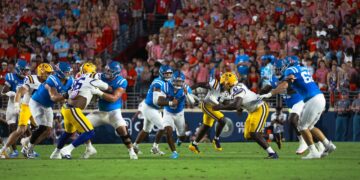

















SEC Commissioner Greg Sankey announced that member schools will now play nine conference games per football season instead of eight — the latter of which has been the norm since 1992. Additionally, SEC schools must play a non-conference Power Four opponent every year.
“It’s been a discussion for quite a while,” Ole Miss Vice Chancellor of Intercollegiate Athletics Keith Carter said in an interview with The Daily Mississippian. “I think that it was inevitable that we were going to go to nine games at some point, whether it was this coming season or the season after. I think there’s a lot of pros to doing it, obviously we give an opportunity for more quality games, give our fans an opportunity to see those games and I think that’s a win.”
While this change has many positive effects for both programs and fans, the schedule change also carries downsides. With the extra conference and Power Four game, average ticket prices will likely rise because those games are generally more expensive than non-conference games or non-power 4 games.
Also, lower-tier SEC schools will hurt the most; these teams set their sights for bowl games, not the College Football Playoff. For these teams, more difficult schedules will make the necessary .500 win percentage threshold to qualify for bowl games harder to achieve.
Kentucky head coach Mark Stoops discussed bowl qualification worries at his weekly press conference.
“Look at our schedule this year,” Stoops said. “It’s pretty hard to get more difficult than that. We have a top-five, top-six-most-difficult schedule. Next year, it’ll be about the same.”
This change in scheduling policies aims to promote conference prestige, storied rivalries and postseason success. Additionally, the nine-game SEC schedule prevents teams from artificially creating easier schedules, which often leads to better overall records and puts teams in good positions for College Football Playoff bids.
Recently, Indiana is one of the most noticeable offenders. The Hoosiers manipulated their schedule by cancelling a series against Virginia Tech and cancelling a game against Louisville. As a result, Indiana will not face a non-conference Power Four caliber opponent until 2030.
Big 10 commissioner Tony Petitti drew upon Big 10 success in the postseason as justification for scheduling weaker opponents.
“We just stand by what we do in the Big 10,” Petitti said at Big 10 media days. “I think the national results have shown that the last couple of seasons … I’ll stand by how much tougher our league has gotten.”
In contrast, SEC schools are now required to schedule at least one Power Four non-conference game per season, drawing from teams in the ACC, Big 10 and Big 12. Non-conference power Notre Dame also counts among this number.
This condition intends to make SEC teams more competitive in postseason talks by improving each team’s strength of schedule. Ole Miss Athletics is working on finding a Power Four non-conference game for 2026.
“We have to add a Power Four opponent for ‘26,” Carter said. “I think we’re really close on that, and hopefully we can announce that here in the coming days.”
The nine game conference schedule is also meant to maintain program traditions by preserving rivalries, allowing schools to play three rivalry games each season. This requirement also ensures that all SEC schools will have head-to-head matchups every two years, and each team will have home field advantage against every other team at least once every four years.
Until now, SEC schools have been sporadically scheduled to play each other. For instance, Georgia has not played Texas A&M in College Station, Texas, since Texas A&M joined the SEC back in 2012. In fact, the teams have only played once since then, in 2019. The schedule change addresses this by making matchups more consistent.
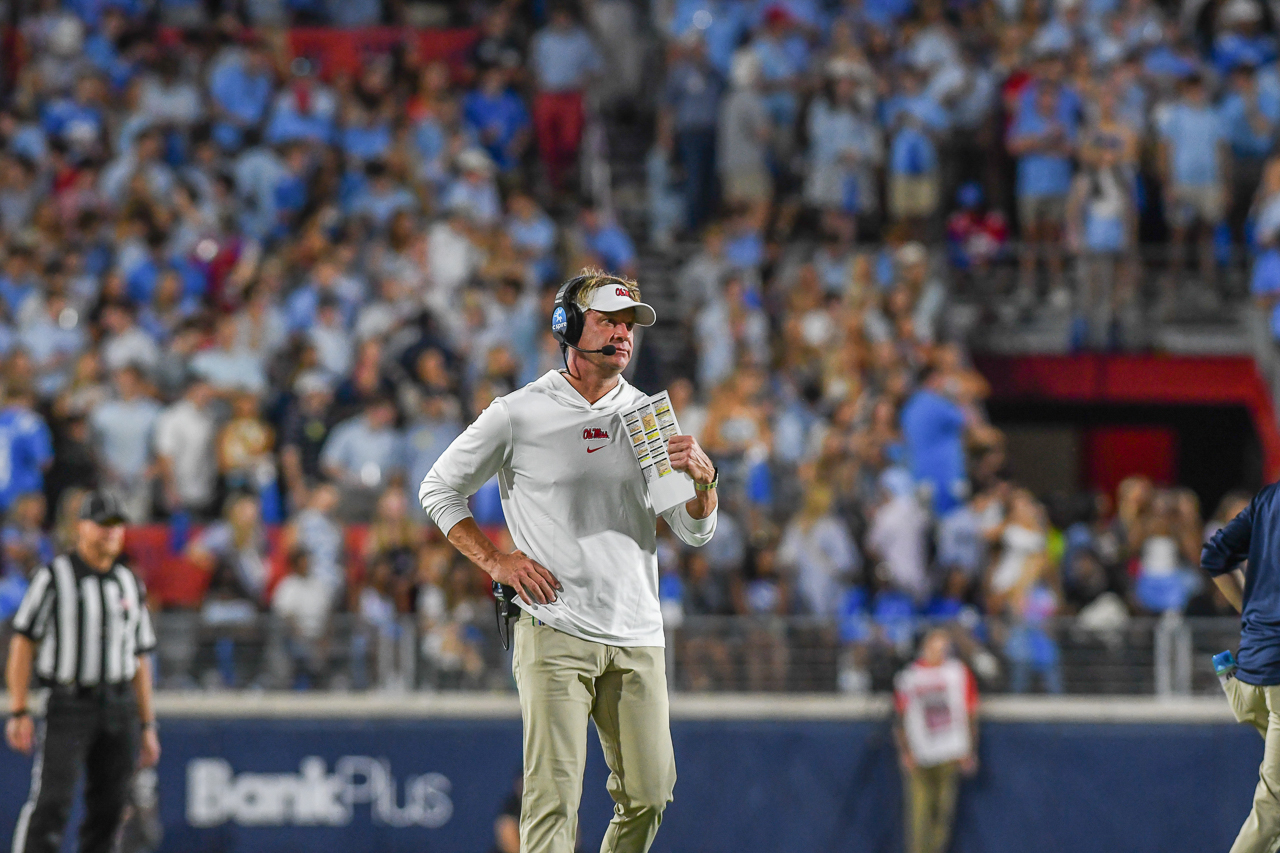
During his press conference on Aug. 25, Ole Miss Football head coach Lane Kiffin was mainly focused on the upcoming game against Georgia State and did not comment further regarding the new rule.
“That’s completely out of our control as coaches, so it really doesn’t matter,” Kiffin said.