
























A growing trend in graduation photos has created new challenges for the University of Mississippi Department of Facilities Management. When champagne bottles have stopped spraying, they leave behind damage that the department must repair.
Graduates can be spotted across campus taking photos with friends, family, confetti and champagne during graduation season. Mike Dunnavant, the director of facilities services, has concerns about staining on campus signs and popular locations caused by popping champagne bottles for photoshoots.
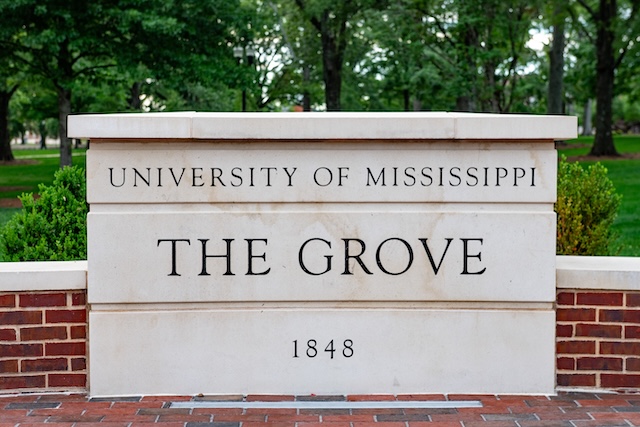
“They go to the Lyceum, and they go to the Grove sign and they’re … popping champagne bottles,” Dunnavant said. “The champagne is staining the concrete, and we can’t get it clean.”
The problem is chemical as much as it is behavioral, according to Dunnavant.
“The champagne is acidic, and it reacts with the lime in the concrete,” Dunnavant said. “The sugar in the champagne also stains that porous limestone.”
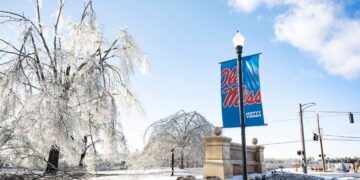
The damage is especially concerning at newer campus features, such as the Grove Plaza completed in 2024 at the intersection of University Avenue and Grove Loop.
“That Grove sign is brand new,” Dunnavant said. “It was quite an expensive project, and we can’t get that stain out of that concrete right now.”
The issue extends beyond the University of Mississippi campus. Dunnavant said facilities leaders across the Southeastern Conference have raised similar concerns.
“That topic came up from three or four other campuses … asking each other if they were having that same problem,” Dunnavant said. “None of the other schools had a solution for it either.”
Other universities have also reported issues with non-biodegradable celebration materials like polyester (mylar) confetti.
“They mentioned a mylar confetti, and it doesn’t biodegrade down into the grass like the paper confetti does,” Dunnavant said.
Despite the issues created from graduation photograph trends, compared to other large-scale campus events, commencement generates relatively little waste. Most of the cleanup consists of small, scattered items.
“Mostly it’s water bottles and stuff people leave around campus,” Dunnavant said.
Facilities crews focus heavily on preparation in the weeks leading up to graduation. Sidewalks are pressure washed, landscaping is refreshed and venues like The Sandy and John Black Pavilion are cleaned and reset between ceremonies.
“We take commencement as really one of the most important events on campus every year,” Dunnavant said. “We really try to make the spring commencement each year a very special event for everybody coming.”
Another major factor during graduation week is student move-out, which generates far more waste than the ceremonies themselves.
“That trash cleanup is a lot more intense than the commencement activities themselves,” Dunnavant said.
Even with these challenges, commencement cleanup is much smaller in scale than athletic events. Football game weekends require extensive labor and resources.
“It’s like night and day,” Dunnavant said. “For football games, it’s a massive cleanup.”
Facilities and landscape services crews involve around 100 workers. Trash collected in the Grove after a home football game fills 25 to 30 large construction dumpsters, Dunnavant said. By contrast, commencement cleanup between ceremonies is limited.
“We have about an hour between each of the sessions,” Dunnavant said. “ It’s mostly just straightening up chairs and picking up a program.”
While commencement remains one of the most important and carefully prepared events of the year, facilities management staff said small changes in how students celebrate could help preserve the beauty of campus for future classes.
“Just take care of the university,” Dunnavant said. “Try to treat it like it is your home.”