



























SEC Media Days were eventful for the Rebels. This week, the SEC announced rules changes for the upcoming season, and Pete Golding showed the rest of the SEC his unabashedly authentic self. Golding has always been candid in press conferences, but he shined compared to many of his head coach counterparts.
New Florida head coach Jon Sumrall has known Golding for a long time and applauded him for his honesty and skill as a head coach.
“Pete is going to be himself,” Sumrall said. “He’s not going to change. I have an appreciation for that. You have to be authentic. I think he’s going to do a phenomenal job. (I) really do. (I’m) happy for his opportunity there.”
In an interview with SEC Network, Golding explained how he’s able to avoid the so-called bland, unoriginal “coach speak” that many coaches use during press conferences. He also talked about the impact former Alabama head coach Nick Saban had on his career. Golding worked as a defensive coordinator at Alabama before becoming a Rebel.
“This is my ninth year in this league, and I’ve been fortunate to be learning (from) a lot of really good guys that do it the right way and that I have a lot of respect for,” Golding said. “I also think things become easy based on your intentions. For me, getting into and having been in the league for nine years and seeing guys do it on a consistent basis, being around coach Saban and, as professional as he is, he did it his way, but it was still him.”
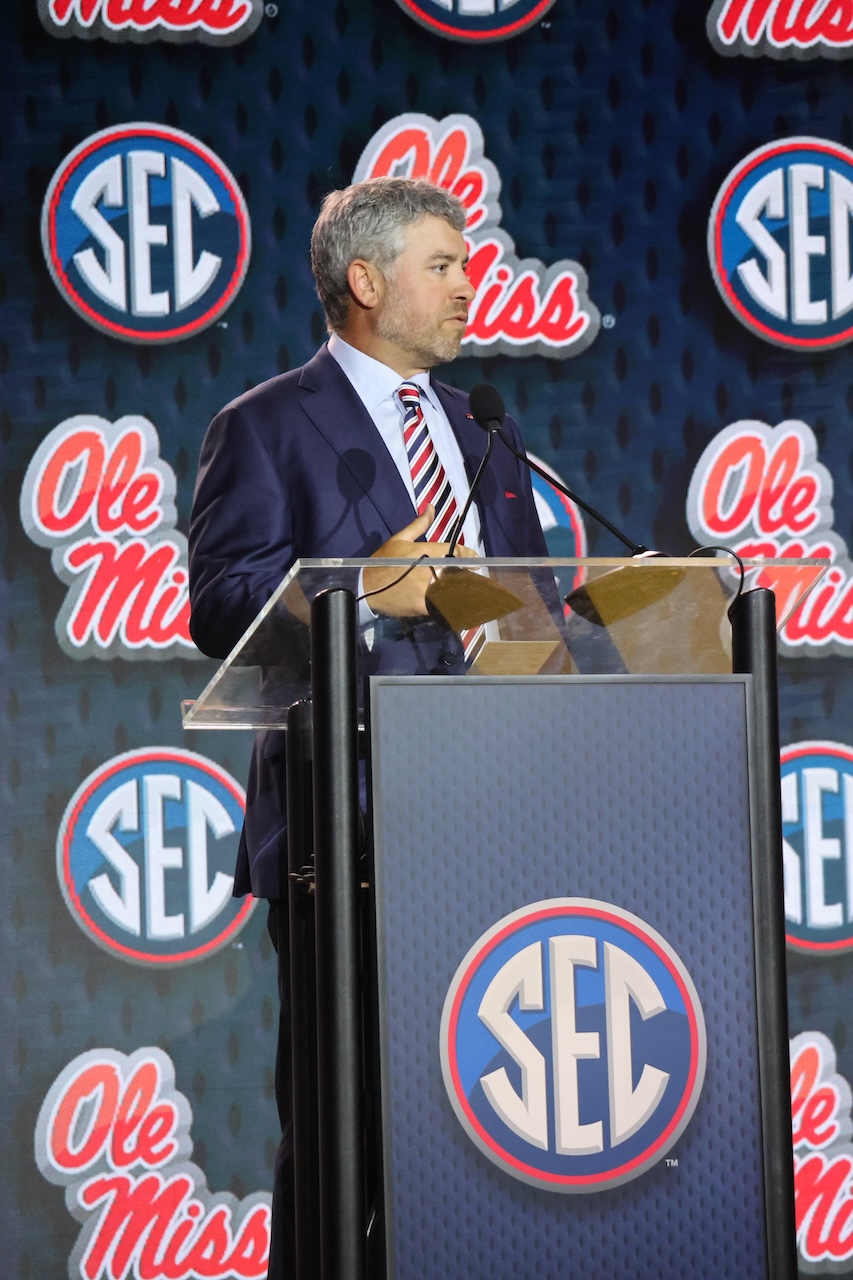
Despite Golding’s authenticity, there is still discourse surrounding how good of a head coach he actually is. Golding has yet to coach a regular season game as head coach of the Rebels, but he brought the Rebels to the semifinals of the College Football Playoffs following Lane Kiffin’s abrupt departure to LSU.
While people will continue to argue about whether Golding is worthy, Sumrall brought a different perspective about a coach’s worth. He stressed the importance of the players rather than the program’s head coach with a few choice words about facing the Rebels twice during the 2025 season.
“We played them the first time at Tulane (when Kiffin was the Ole Miss head coach) and they beat the s–t out of us,” Sumrall said. “We played them the second time, different head coach (Golding), still beat the s–t out of us, so it didn’t matter who the head coach was. They were still pretty good, so I think sometimes people forget it’s a player-driven game. Pete will do a great job with his team and (I have) a lot of respect for Pete.”
The structure of college football is a highly contentious topic currently, and a lot of coaches arrived at similar conclusions about college football and its increasing connection to the NFL. Golding highlighted the absurdity of the current structure of college football recruiting and the transfer portal.
Golding also addressed tampering allegations related to his structural beliefs for college football.
Kiffin echoed other coaches’ thoughts and proposed a sort of solution that was based upon his time in the NFL as head coach of the Oakland Raiders when they drafted Jamarcus Russell first overall. Russell was making more money than many veteran players without ever actually taking a snap, and Kiffin does not believe that is an equitable strategy.
“Our system is a little bit screwed up, in my opinion. The kids that haven’t played at all coming out of high school should be making less, and there should be a freshman, like a rookie cap,” Kiffin said on Thursday. “Then they’re signed to multi-year contracts, so now you really do get into (building) through high school because that guy can stay longer.”
Golding was asked about his relationship with Kiffin. Golding noted everything worked out after Kiffin left Ole Miss for LSU after the regular season concluded but before the Rebels began play in the College Football Playoff, giving Golding the opportunity to become the head coach.
“I have no ill will towards coach Kiffin. He texts me on a regular basis and there are certain things we’ll talk about and certain things we don’t talk about,” Golding said. “Everybody won from it. … I’ll be the first one to tell you I told him I would think he was dumb if he was to leave. I wanted him to stay. It was a selfish decision because I loved being the DC (defensive coordinator) where I was at.”
Looking past the politics of college football, multiple rule changes were explained by John McDaid, the SEC Coordinator of Football Officials, during media days. The most impactful rule update was a change to the penalty for targeting.
While players flagged for targeting still have to sit out a game, McDaid explained that if a first-time offending player was ejected in the second half of a game, he would not have to serve another half’s suspension during the ensuing game.
“First-time offenders of targeting within a single season no longer have the possibility of a first-half carry-over game disqualification for their next game,” McDaid said. “For the second-time offender, no matter when the targeting foul occurred, you need to sit out the first half of your next game.”
Third-time offenders still have to sit out at least one full game in addition to exiting the game where the penalty occurred. Over the past five seasons, there have only been six two-time offending players and no players that have three or more targeting penalties.
McDaid affirmed that, while this rule is in place for the upcoming season, officials will continue to rework the rule as they see fit and as they receive more data regarding targeting.
Another rule revision concerns the offensive pass interference penalty.
“We now have a 10-yard penalty instead of 15 for offensive pass interference,” McDaid said. “For what it’s worth, this matches what’s done in the National Football League. That’s not why the rule change was made. The rule change was made because we were looking for a higher rate of success gaining a first down after incurring an offensive pass interference. If you are penalized only 10 yards instead of 15, it stands to reason that conversion rate will go up.”
Finally, the last rule change is a somewhat complicated numbering change during punts. The original rule was a numbering exception meant to provide teams with the option of not having to send out four offensive lineman, since many teams want to use faster, lighter players that have more experience tackling during punt returns rather than bigger, slower offensive linemen.
“That rule was that if you came into the game and lined up in an interior lineman position and you were not wearing 50 through 79, you became a numbering exception,” McDaid said. “You became an ineligible player through that numbering exception.”
However, this created a system where teams manipulated the line of scrimmage to disguise which players were eligible receivers and which players were satisfying the numbering exception as artificial offensive linemen.
Essentially, teams would line up in odd formations and motion multiple players at a time all to confuse defenses and officials alike and create busted coverages, allowing for big plays.
McDaid explained that players lined up inside the tackle box — on either side of the center like a normal formation — are now ineligible players. The other players may motion however they would like, but the four players around the center are automatically ineligible. This means that if teams want to use players whose jerseys are not 50 through 79, then they cannot have different formations.
Coaches can still swap their players in-game jerseys numbered 50 through 79. While it is more difficult, it gives coaches the option to line up players in a different formation without the need for the traditional two players on either side of the center.
McDaid showed several examples of different formations teams can do by having players wear different jersey numbers.
“You can do this to get to or use a non-two-by-two punt formation,” McDaid said. “There’s no tackle box requirements when they do this. (When) the snapper is on the end of the line, he can be eligible.”