


























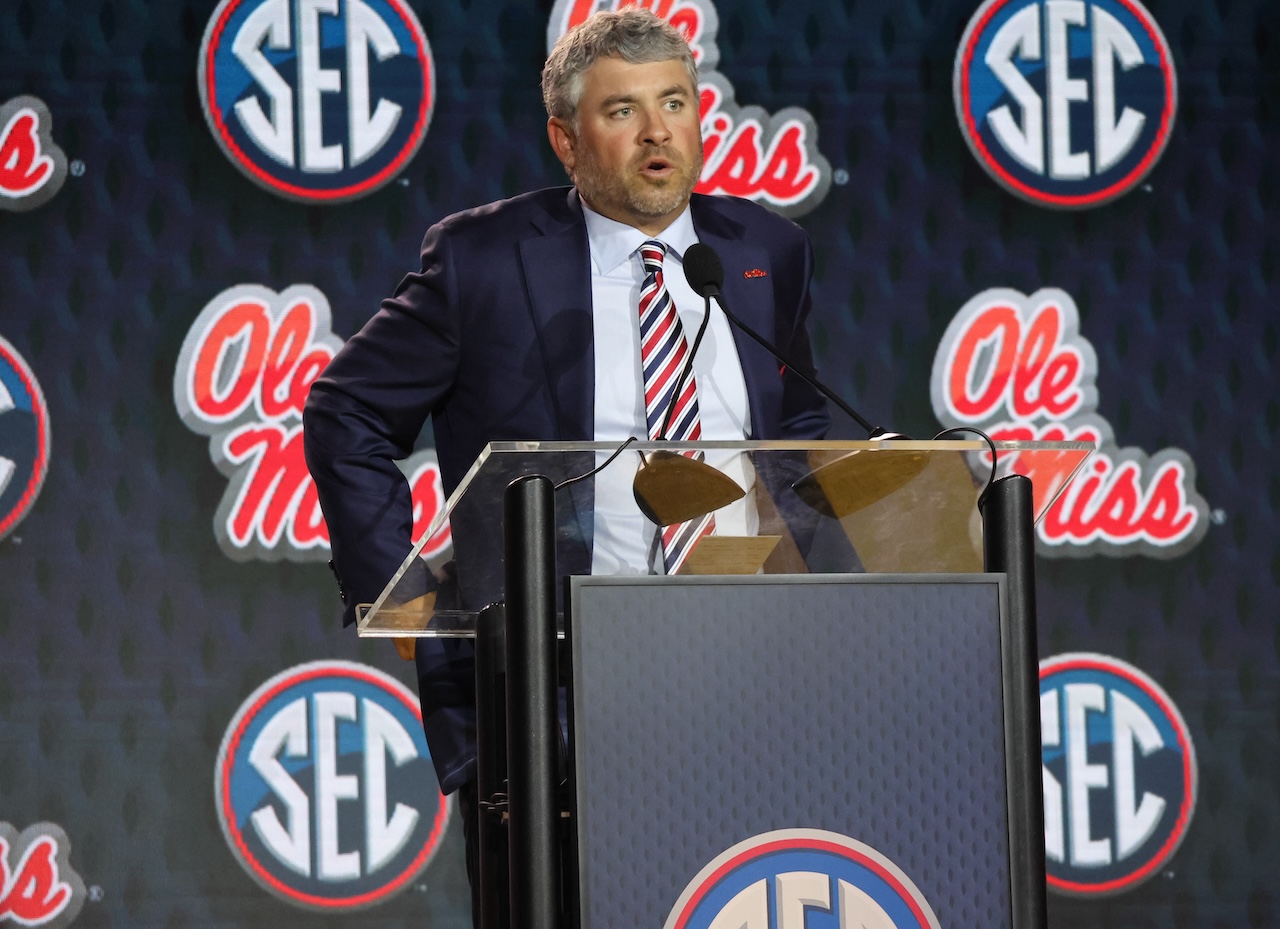
Ole Miss Football head coach Pete Golding spoke to the media on July 22 in Tampa, Fla., for SEC Media Days. The first-year full-time coach spoke about preparation for the upcoming season, the mentality of the program and how things have changed since he took the helm as head coach.
Golding came to Oxford from Alabama in 2023 as the defensive coordinator. Since then, Oxford has treated the Golding family well.
“It was a unique decision for us to leave Tuscaloosa (Ala.) to go to Oxford. (It was) not strictly a family decision, … but the people there have embraced us,” Golding said. “The people and the quality of the people within that place, the community and how they embrace the school and our students, the way they impact the environments not only at home games, but also on a day-to-day basis is something really, really remarkable.”
Golding spoke about his relationship with former Ole Miss head coach Lane Kiffin, who exited the program dramatically in November 2025 to fill the head coach vacancy at LSU. The pair coached at Alabama, but they did not cross paths until Golding joined Kiffin’s coaching staff at Ole Miss. Importantly, Golding noted he did not come to Ole Miss for Kiffin.
“Lane (Kiffin) and I are good. I did not know coach Kiffin prior to taking the Ole Miss job,” Golding said. “I didn’t come to Ole Miss because of coach Kiffin. I came to Ole Miss to be at Ole Miss to raise three kids.”
The Rebels last played on Jan. 8 in a four-point loss to Miami in the Fiesta Bowl, a College Football Playoff semifinal game. Since Jan. 9, Golding and the team have been focused on improving and doing better this year.
“We still know there’s a lot of work to be done. We know every season is independent of their own,” Golding said. “The legacy from last year’s team is over. We can learn from that moving forward, which we have all spring.”
The Rebels have put the memorable 2025 campaign in the rearview mirror and are moving on to 2026, but Golding acknowledged the recent success of the program. He thanked Chancellor Glenn Boyce and Vice Chancellor for Athletics Keith Carter for their roles in getting Ole Miss to where it is today.
“We definitely would not be where we’re at as a university right now, as an athletic program at Ole Miss, without Glenn (Boyce) and Keith (Carter) working side-by-side. They embody everything Ole Miss is about,” Golding said.
With the Rebel 2026 season set to begin on Sunday, Sept. 6, against Louisville in Nashville, Ole Miss will begin fall camp soon. Players will have a week off next week, then official team activities will get underway just before fall camp.
“A little different structure than they’re used to, but I am just really, really big on the why,” Golding said. “I think they’ve seen the results throughout the spring in their bodies and speed and jumps from a weight room standpoint. It’s allowed us as coaches to slow down the install to really teach these 50 new guys that we’ve got coming in … You’re investing a lot into these guys in order to play in the fall. We have to make sure that we’re teaching it the right way and the right progression.”
After several assistant coaches joined Kiffin at LSU at the end of last season, Golding had to upgrade the 2026 coaching staff. He spoke about the success in retaining many coaches and acquiring new ones.
“I was really … glad that I was able to retain … good staff on both sides of the ball — really, on all three phases,” Golding said. “When you look at offense and keeping (quarterbacks coach) Joe Judge, who has done an unbelievable job; bringing (offensive coordinator) John David Baker back, who was the co-offensive coordinator in 2023 that had been in the system, went off, got his teeth cut (and) called really good offenses at East Carolina. (We) did a really good job to get him back.”
Defensively, Golding was able to retain staffers whom he is familiar with, such as defensive coordinator Bryan Brown and defensive line coach Randall Joyner. Special teams coordinator Jake Schoonover will continue in his role, as well.
Another change in the staff is the hiring of strength and conditioning coach Paul Constantine. Golding subscribes to a different approach to training than many college coaches. His team schedule is divided into phases and blocks, which is more of an NFL style. Constantine furthers Golding’s NFL-style approach.
“He (Constantine) was the No. 2 (strength coach) with the Falcons, so he came to us from Atlanta and switched that model in the weight room to a velocity-based training model,” Golding said.
Several former Ole Miss Football players joined the staff. These new additions will help in a variety of ways, but Golding highlighted where they are most valuable.
“We’ve been really fortunate to add a lot of really … good human beings into both sides of the ball, and it just so happened to be a very unique year to where a lot of these guys were Ole Miss alums,” Golding said. “The Terrence Metcalfs of the world and the Michael Spurlocks of the world, and the Moncriefs of the world and the Marcus Woodsons of the world — they’ve created so much value for our players, not only from a relationship standpoint, but the investment into them and making them better human beings.”
All teams bring three players to media days. Ole Miss brought quarterback Trinidad Chambliss, running back Kewan Lacy and defensive tackle Will Echoles. Golding was confident everyone already knew the talent of those players, so he instead talked about their character and what Ole Miss looks for in recruiting beyond the physical side of the things.
“Rule No. 1 in our program is to be a good dude, and that ain’t too hard,” Golding said. “They’re (Chambliss, Lacy and Echoles) tough. They’re competitive. They love football. That’s who we look for, from a recruiting standpoint, but more importantly they’re good people.”
The Rebels have had a successful three-year stretch. They have won at least 10 games each season in that time, but for Golding, elite programs are made for more than just winning.
“Having been a part of, in my opinion, one of the best coaches to ever do it (Nick Saban), the one thing that stuck with me, elite programs aren’t designed for when they (players) have cleats on,” Golding said. “Elite programs are designed for when they take them off. Are they a better dude, better husband, better father? Do they have a job making a certain amount of money that they wouldn’t have had and wouldn’t have made if he didn’t go to Ole Miss?”
Golding is focused on keeping good stability and schemes and recruiting good players. He believes when you do that, winning follows.