

























Reenva Evers-Everette, the daughter of Medgar Evers; R.J. Morgan; a University of Mississippi School of Journalism and New Media associate professor and instructor of JOUR 350: “Bob Dylan and the South and Jerry Mitchell, a Mississippi Today investigative reporter, discussed the legacy of Evers, Dylan’s songwriting and the connection between the two on Oct. 8 at the Overby Center at the University of Mississippi.
Evers was a Jim Crow-era Civil Rights Movement activist and the NAACP’s first field officer in Mississippi. He was killed by an opponent of integration, who shot him in the back outside his home on June 12, 1963. Evers died at the hospital 50 minutes later, according to Medgar Evers College – CUNY.
Evers-Everette was eight years old when her father was murdered, but she remembers the day leading up to his death. She shared her memory of that night from the stage.
“It got close to midnight, and we heard dad’s car come,” Evers-Everette said. “As soon as (my brother) and I were saying, ‘Daddy’s home,’ we heard the pow. We knew exactly what that was. My brother Darryll and I were already on the floor watching TV, but we dropped into the position.”
Evers-Everette recounted seeing her mother race outside and hearing her scream. Evers-Everette and her brother ran outside soon after.
“We found dad stretched out in this big pool of blood, holding the ‘Jim Crow Must Go’ t-shirts,” Evers-Everette said. “He was close to our porch. He had pulled himself from his car, all the way around his and my mom’s cars, and halfway to the carport. When you think about what his body went through because there was a big hole in his back, you think about the strength of a person who’s determined to get to their family.”
Less than a month following Evers’ murder, a relatively unknown Bob Dylan wrote the song “Only a Pawn in Their Game” about the events that transpired. Dylan performed the song at political rallies and folk festivals across the country, recording it on Aug. 7 of that year.
Dylan performed the song at the March on Washington for Jobs and Freedom on Aug. 28, 1963, the same event where Martin Luther King, Jr. gave his “I Have a Dream Speech.”
Morgan talked about Dylan’s songwriting, particularly in his song about Evers’ assassination.
“Bob Dylan was still kind of this guy in the background, but he had written songs about Emmett Till and wrote a song about James Meredith and the integration of Ole Miss,” Morgan said. “‘Only a Pawn in Their Game’ was a leap forward in his songwriting. It was far more literary and far more specific.”
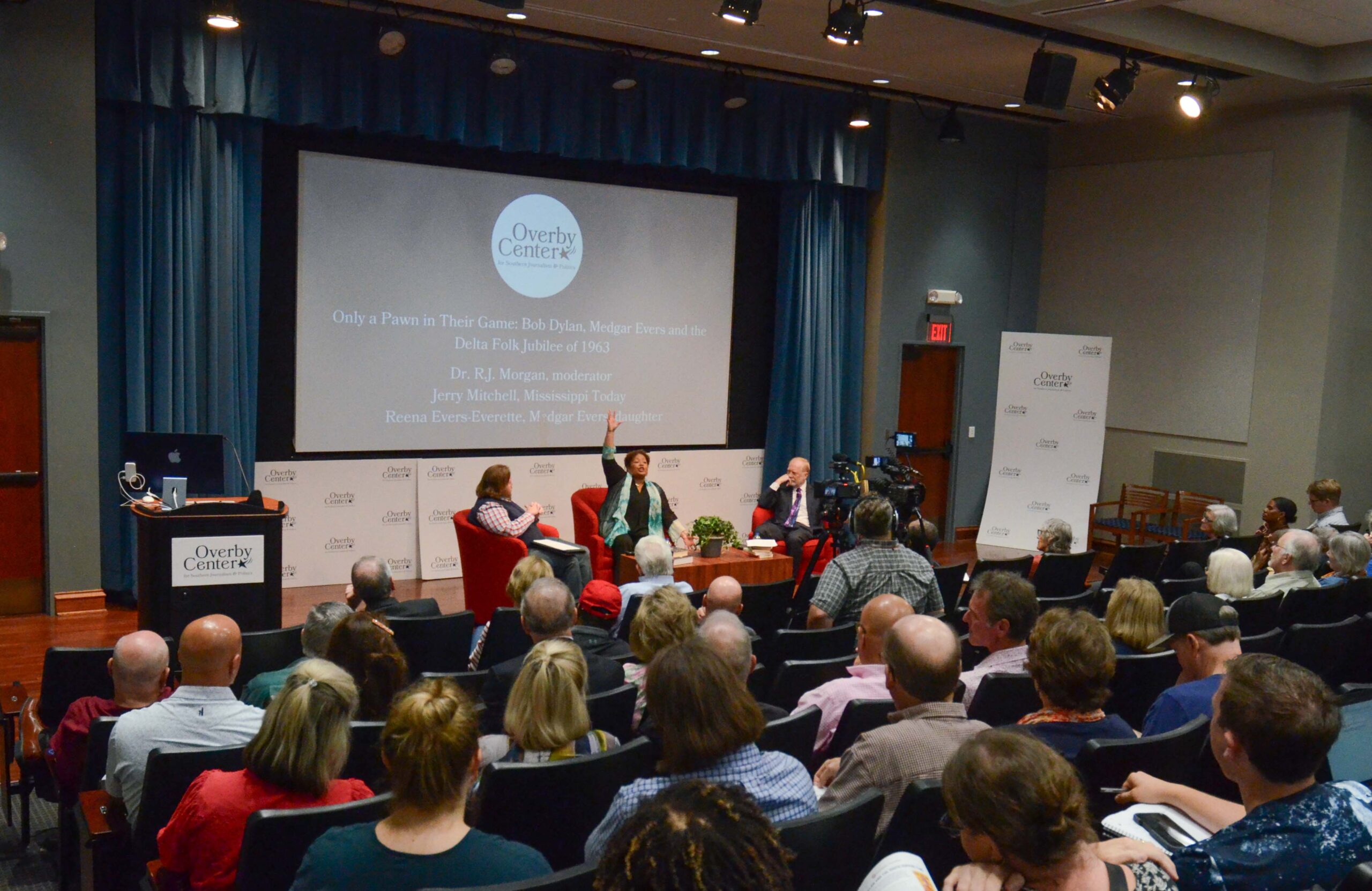
“Only a Pawn in Their Game,” which Dylan performed at the Delta Folk Jubilee of 1963 when he was 22 years old, explored the idea of ordinary people being pawns in the hands of politicians. The first verse focused on Evers’ death: “A bullet from the back of a bush / Took Medgar Evers’ blood / A finger fired the trigger to his name / A handle hid out in the dark / A hand set the spark / Two eyes took the aim / Behind a man’s brain / But he can’t be blamed / He’s only a pawn in their game.”
As Mitchell investigated Evers’ case, he became fascinated with the song and its lyricism.
“I did not hear this song until I was working on (Evers’) case,” Mitchell said. “I had never heard this song and then I found out about it and kind of started my Bob Dylan period. I kind of became obsessed, to be honest. It’s so fascinating, and it’s so prescient in terms of people being used, and the poor being used as a pawn for politicians.”
Evers-Everette talked about the relevance of Dylan’s song today.
“It’s still prevalent now,” Evers-Everette said. “It’s a wake up call again of what are we doing to each other, and how are we helping and uplifting each other.”
Oxford local Rachel Humphries attended the event and talked about the importance of discussing topics like this today.
“I was alive when Medgar Evers died, and I’m also a huge Bob Dylan fan,” Humphries said. “I think it’s important to talk about it so that we remember what it was like then, and the kind of pain things like this cause, and that maybe we need to change. We need to try to do better. We don’t have to be so xenophobic. Our history is very important to remember, so that we don’t repeat it again.”
Steven Humphries, Rachel’s husband, attended the event with her and expanded on the importance of remembering history.
“After the end of World War II, when we realized just how bad the genocide had been, this phrase, ‘Never Forget,’ became part of common speak,” Steven Humphries said. “That’s where we need to be right now regarding civil rights, ‘never forget.’ I lived through this. We’re not that far away from it, but we’re very close to it again.”
Oxonian Amanda Bagwell also attended the event because of its relevance in today’s culture.
“I feel like this event is very poignant with the things that we’re going through today,” Bagwell said. “It was something that I knew a little bit about, but wanted to learn more about. It was a great opportunity just to come and learn more about this topic.”
Evers-Everette highlighted the similarities between the era of her father’s death and current times.
“It’s been over 60 years since my father was assassinated, and it seems almost like it’s the same time with certain things,” Evers-Everette said. “So many things have been elevated, and the thing that has been elevated that we have to stop is hate for one another. We need to have a clear understanding that no matter what religion you are, you were created. We all were.”
Evers-Everette emphasized pushing back against political violence, referencing Dylan’s song.
“A lot of the thoughts that are in politics now at a high level were in politics in the 1950s,” Evers-Everette said. “Murders have happened recently that should never have happened. Why do we think taking a person’s life is going to change things? I go back to what my father taught me: to remember there’s good and bad in every race. We need to make sure that we’re not a pawn in the game.”