


























When every Black lawmaker in the Mississippi state Senate walked out in January in protest of a bill prohibiting the teaching of critical race theory in the state’s public schools and universities, all eyes were on Mississippi, yet again. Their seats sat empty — a loud gesture in the quiet Senate chamber — as their white counterparts passed the controversial legislation.
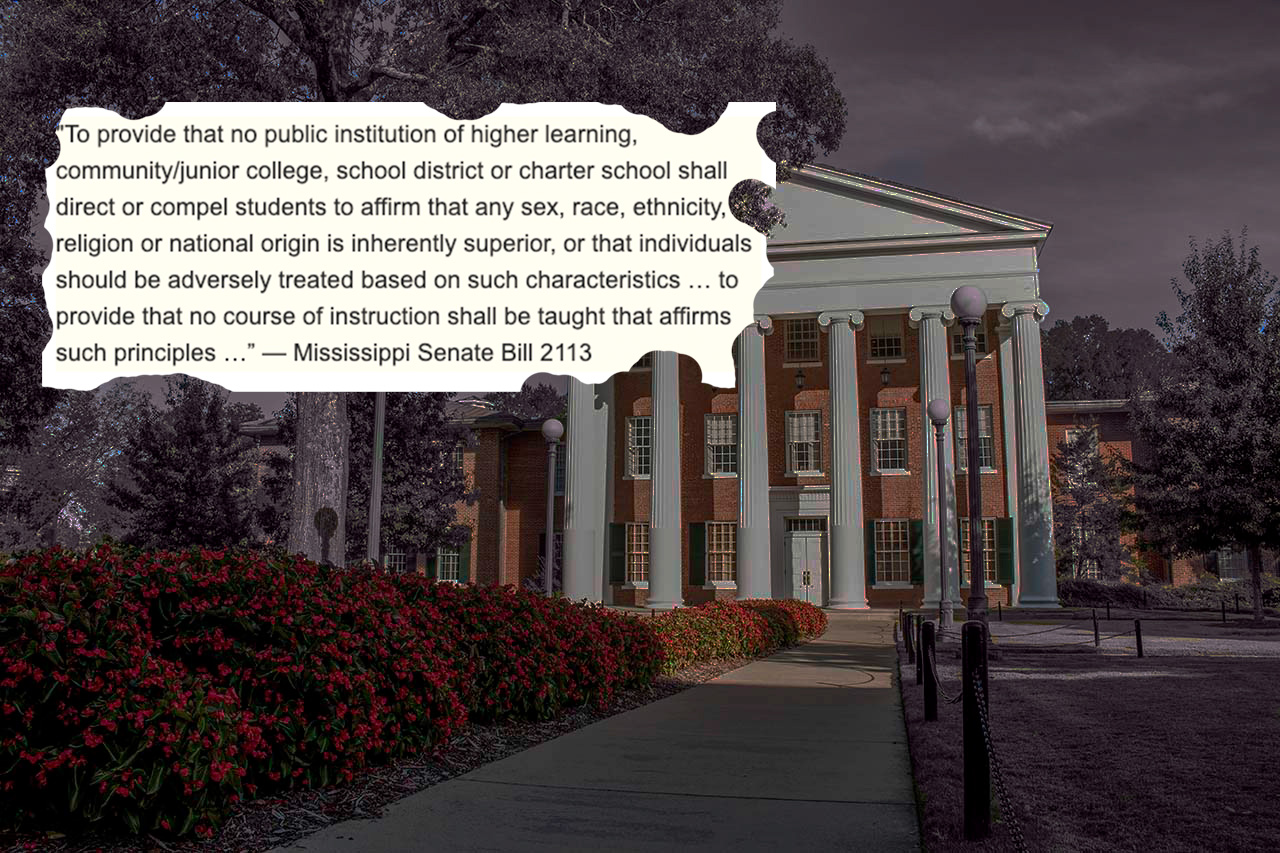
Weeks later, as Senate Bill 2113 has moved to the House of Representatives for consideration, many students who fill classroom seats and the professors who teach them at the University of Mississippi are worried that passage of the anti-critical race theory legislation into law will be devastating to their freedom to teach and learn fair and accurate information about the history and current circumstances in Mississippi and the United States.
What is (and what isn’t) critical race theory?
Before moving into the national spotlight over the past two years, critical race theory had a robust history stretching back to the 1980s. Spanning multiple intellectual disciplines and primarily studied by post-undergraduate scholars, critical race theory is — simply put — a way of examining and understanding the intersections of race and law in America.
Yvette Butler, an assistant professor of law at the University of Mississippi, teaches Law 743: Critical Race Theory. Despite extensive legislative pushback against critical race theory in Mississippi classrooms, hers is the only class in the state that deals with the topic.
“Critical race theory is, essentially, a post-Civil Rights Era way of asking why the law hasn’t fixed racial inequality,” she said. “The Civil Rights Act of 1964 is one of our main statutes that basically says in employment, in public accommodations you can’t discriminate against people on the basis of race, sex, national origin, etc.”
The Civil Rights Act marked a turn in the fight for equality in the United States.
“And despite that, obviously, we still have a variety of racial inequities, gender inequities — critical race theorists are like, ‘Let’s investigate the reasons behind that,’” Butler said. “Which is why they don’t focus on the single bad apple person who meant to discriminate, but on people who are generally well-meaning, who ended up essentially perpetuating systems of inequality.”
Like many who are familiar with critical race theory, Butler sees the legislation likely being advanced beyond its face value as a bill promoting equality. Rather, she sees it as a product of widespread politicization, of pushback against advancements made after George Floyd’s death in 2020 and of a lack of understanding as to what critical race theory even is.
“I do not think my definitions match (theirs), because their definition is wrong,” Butler said. “Because I don’t think they’ve taken the time to learn what it is and I don’t think they care what it is.”
For example, people opposed to the teaching of critical race theory often claim CRT seeks to label all white students as inherently bad people and all non-white students as oppressed, with nothing that can be done about either situation. According to Butler, a core tenet of critical race theory is that there are no inherent differences between races.
“Critical race theory rejects any sort of inherent differences between races because it was often founded in pseudoscience that was just like, black people are inferior,” she said. “So why would critical race theorists buy into any sort of inherent differences? That wouldn’t make sense.”
Keyona Sutton, a biochemistry major at the University of Mississippi, is concerned about the legislation, even though she doesn’t think it will greatly impact her education in the sciences at the university.
“I just don’t think it’s going to push Mississippi in the right direction at all education-wise. I just don’t see its purpose. And I don’t understand who it’s to protect either,” she said. “My roommates — they’re political science majors and education majors and they’re really upset about it. I have conversations about it over dinner all the time. And they tell me that their professors are already talking about how it’s gonna affect the way that they teach. That’s crazy.”
James M. Thomas, an associate professor of sociology at the University of Mississippi, has researched critical race theory extensively. He, too, sees a disconnect between anti-CRT advocates’ definition of critical race theory and what critical race theory actually is.
“They’ve taken the concept of critical race theory and they’ve turned it into what in academics we would call an empty signifier. What that means is it’s now a concept devoid of its original meaning, and you can shove any meaning you want into it,” he said. “So now critical race theory is Marxism. It’s civil rights history, it’s post-reconstruction history, all these things that don’t have anything to do with the critical legal framework.”
Thomas further explains that critical race theory, which used to be found only in graduate studies, legal studies and among certain academics, has become a standard for everything conservative lawmakers see as a threat to their way of life.
“That tradition that you really only find in graduate studies and in the law school and among certain groups of academics, now has become a standard for everything that I would argue the right and far-right feels is a threat to the way of life they want to create — which is a very conservative, very pro-capitalist, very colorblind kind of society. And Christian, I would say, very Christian society as well,” Thomas said.
Both Butler and Thomas see the legislation as being unnecessary.
What is the legislation?
Described as “Critical Race Theory; prohibit” on the Mississippi Legislature website, SB 2113 caused Mississippi’s 14 Black senators to walk out. Authored by 21 Republican senators, the term “critical race theory” is never coined in the bill’s text. The bill is also short and non-specific — at just over 500 words, the bill proposes a withholding of state funds for public institutions of learning that affirm, adopt or adhere to the following tenets:
(a) That any sex, race, ethnicity, religion or national origin is inherently superior or inferior; or
(b) That individuals should be adversely treated on the basis of their sex, race, ethnicity, religion or national origin.
House leaders have until March 1 to pass the legislation out of committee or the bill will die.
“This bill is not changing anything about our past,” Sen. Micheal McLendon said as he presented the bill in January. “All this bill says is no child shall be told they’re superior or inferior to another. That’s all this bill does.”
McLendon and most lawmakers in the Senate support the passage of the legislation. Gov. Tate Reeves, too, has voiced his support for the removal of critical race theory from schools. In his 2022 State of the State address, Reeves called on the State Board of Education to “combat critical race theory” despite the board’s insistence that CRT is not being taught in any public primary or secondary school.
“I am calling on the State Board of Education to adopt the values that combat critical race theory in their educational efforts. To affirm that Mississippi’s public educators will not indoctrinate students in ideology that insists this country, or this state, are inherently racist. We will not teach that your race determines your status as a victim or oppressor,” Reeves said.
Because of the bill’s brevity and non-specific language, many people have written off the bill as harmless. It seeks to prevent things that are already outlawed by the Civil Rights Act of 1964 and subsequent legislation. However, some like Thomas see the bill’s vagueness — which poses opportunities for variance — as its threat.
“Policymakers pass policy, but then people on the ground have to put it into action. When a law is unclear, what often happens is that the interpretation of that law will be kind of all over the place,” he said.
Thomas described the bill as a “blank check — some school districts and school administrators will see its passage and change nothing. Others may see it and use it as an opportunity to alter the curriculum and remove certain standards under the guise of adhering to the law. Some teachers may be hesitant to teach as they did before the bill’s passage, altering their lesson plans out of fear.” This, says Thomas, is SB 2113’s threat.
“When a law is unclear, the interpretation of how it should be practiced is going to be varied, and that variance is itself a threat. It’s going to create uneven educational opportunities, uneven educational practices,” he said. “In some cases, you are going to have bad actors acting in bad faith, using this as an opportunity to do everything from keeping certain kinds of things outside of their classes to targeting specific teachers that they don’t like because of what they’re teaching.”
Conversely, the authors of the bill see it as necessary — despite SB 2113’s principal author, McLendon, saying as he presented the legislation on Jan. 21 that he is “not aware” of critical race theory being taught at any school in the state.
There have also been concerns raised that if passed, SB 2113 would violate the constitution, specifically with regards to its attempts to codify what is taught at Mississippi’s higher learning institutions. If passed, the bill could violate the academic freedom of professors.
“We would, of course, have to see the final form of any legislation, but I think any state law that seeks to limit topics for scholarly inquiry, especially ones such as CRT that have a strong academic legacy, could certainly raise concerns over constitutionality, such as in relation to freedom of speech and academic freedom rights,” said Neal Hutchens, a professor and associate chair in the Department of Higher Education and affiliated faculty in the UM School of Law.
The Institutions of Higher Learning, the governing body for all of Mississippi’s public universities, declined to comment, as the bill has yet to become law.
House Bill 437
Another anti-critical race theory bill introduced in the Mississippi House of Representatives earlier this legislative session was much more prohibitive in its restrictions. The Teaching Racial and Universal Equality, or TRUE, Act was proposed by eight representatives. Unlike SB 2113, TRUE, a nine-page bill, aimed to prohibit a number of things from being taught in school, such as “race or sex scapegoating,” criticism of certain capitalistic themes, and “that either the United States of America or the State of Mississippi is fundamentally, institutionally, or systemically racist or sexist.”
Broadly, the bill sought to ban what it refers to as “divisive concepts,” but to Butler, critical race theory is not divisive and shouldn’t be seen as such.
“Critical race theory, while often pushing against some principles that we take for granted (and being seen as controversial in that way), is actually not divisive if divisiveness is about separating people into categories and making them enemies with one another,” Butler said. “CRT theorists often argue that we should look at the world in a way where we can create as much intergroup solidarity as possible. It was not just Black people marching for equality during the civil rights movement. It was done with people of all races. Identifying and critiquing harmful systems makes space for everyone, regardless of race, sex or other identities, to play a role in making the law and society fairer for all.”
Thomas likened this bill to the wave of book bannings the U.S. has seen recently, also adding that fundamental, institutional and systemic racism are, factually, ingrained into the United States and the State of Mississippi.
“There’s no debate about that. It’s not a debatable thing. That is an agreed-upon set of facts. Right. And so what they are doing is banning facts,” Thomas said.
The House bill is no longer active, having died in committee on Feb. 1, but its subject matter is evergreen.
Rep. Brady Williamson of Lafayette County, an author on House Bill 437 and a University of Mississippi alumnus, could not be reached for comment, despite multiple attempts.
Where does UM stand?
Meghan Curry is one of the students on the UM campus who finds anti-critical race theory legislation concerning. A freshman from Indianola, Mississippi, Curry passionately denounced lawmakers’ efforts to codify the way we learn.

“This legislation is in no way justified at all. I kind of find it bizarre that this is coming about given recent events, with the Black Lives Matter movement,” she said. “This bill basically states that they’re going to make the white demographic, their kids and their people comfortable at the expense of knowledge to other children.”
Curry, an African-American studies and public health double-major, believes that the legislation, if passed, has the potential to impact the quality of education she and other Mississippi students receive at public institutions.
“I do think those bills greatly impact the quality of education that I receive as I am an African American studies major along with public health,” she said. “I feel like it’ll definitely impact the material that the teachers or professors are allowed to deliver to me but it won’t impact information that I’m allowed to access outside of the classroom, which I am fortunate to be able to say because others don’t have the same access, and with this bill, others won’t get the opportunity.”
Morgan Atkins, a public policy leadership major and the Associated Student Body president, is worried about the direction this legislation takes Mississippi’s public education.

“I think a lot of people were worried in the same way I am, that this starts out by saying, ‘Oh, we just don’t want to teach people that everybody’s biased.’ And it turns into, ‘We’re gonna stop letting kids learn about things that we don’t think is okay,’” she said. “And so then we start cutting out things that already aren’t super talked about, like the Black Panthers, like the Black Lives Matter movement — 20 years from now, it might not be talked about in classrooms, because they’re allowed to cut out things that could have anything to do with critical race theory.”
Neal Hutchens is an expert in higher education law and policy. He worries that legislation like SB 2113 could lessen the likelihood that the teachers Mississippi needs will join and stay in the profession.
“I think there are many topics involving education — such as helping to find ways to incentivize more people to become teachers and to provide better support to teachers to make it a more enriching profession — that are deserving of the legislature’s time and attention,” he said. “I worry that bills like these may actually make talented individuals less likely to enter into or to remain in education as a career.”
Both Atkins and Curry received their K-12 education in Mississippi’s public school system. Neither of them were at any point taught critical race theory.
Atkins attended public school in DeSoto County for 13 years. She said she was lucky to receive her upper-level history education from a good history teacher who taught her, among many things, the importance of objectivity, neutrality and truth.
“He talked a lot about it being like, there is truth and there is objectivity and they can exist together. But sometimes objectivity works against the truth,” she said. “Sometimes neutrality is a good thing. But sometimes neutrality also doesn’t paint the full picture of what’s happening in these events.”
James M. Thomas said he will not change how and what he teaches, no matter what the legislature passes.
“I’m not changing how I teach. But I’m tenured. And I’m white. And I’m a dude. I’m not contingent faculty. I’m not a man or a woman of color who has to go up there and talk about a contentious issue and potentially be viewed as having an ax to grind because of the color of their skin or their gender,” he said.
He worries that for university professors, the passing of such legislation will cause some professors to shy away from teaching as they would otherwise.
“Our recent history at this university shows that the administration often does not support faculty who, through academic freedom, teach and write and talk about very contentious issues and then experience blowback from external actors. Our university doesn’t have a good track record of protecting us,” Thomas said. “So I don’t give a —- if these bills pass. I’m not changing anything. I can’t say the same for a lot of my colleagues. I know a lot of them are deeply worried.”
University of Mississippi Communications did not respond to inquiries about the teaching of critical race theory from The Daily Mississippian.