






















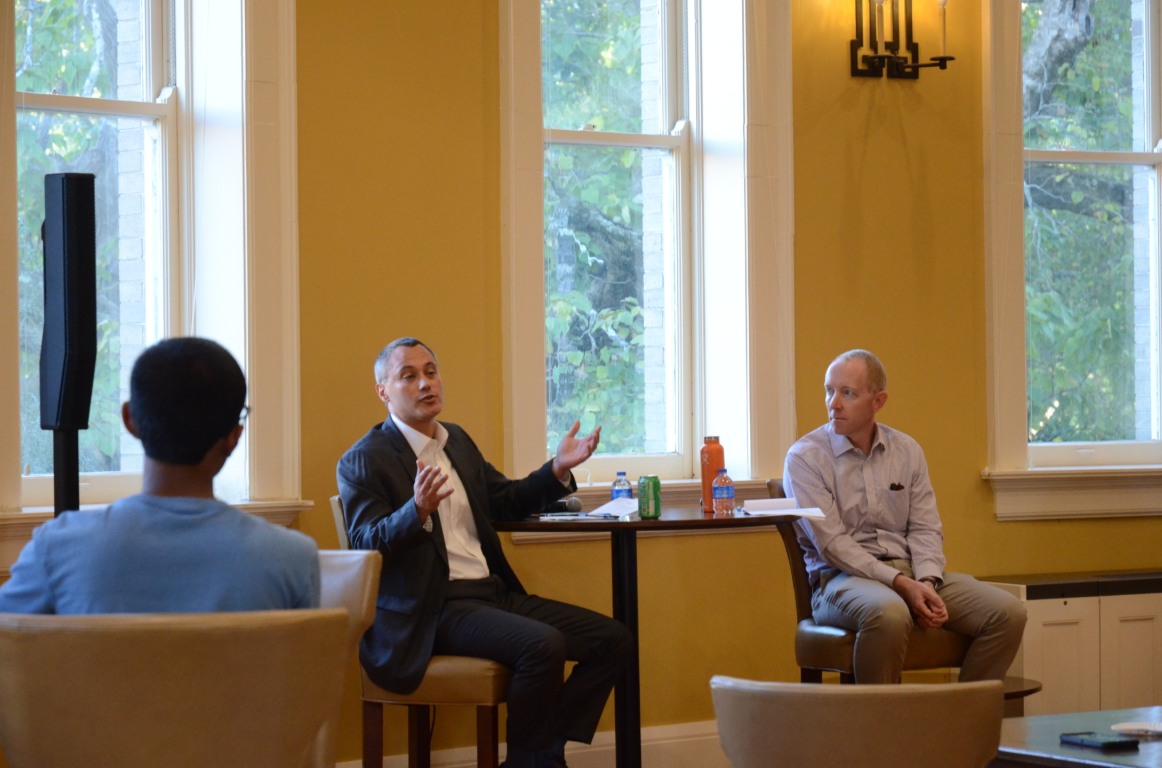
The Center for Practical Ethics hosted a discussion regarding Christopher Columbus on Monday, Oct. 13, at the Jan and Lawrence Farrington Gallery in Bryant Hall.
Associate Professor of Anthropology Marcos Mendoza and Associate Professor of Colonial Latin American History Jesse Cromwell shared their perspectives on the debate, while students gathered to hear and discuss whether Columbus’ legacy should be commemorated.
Columbus is historically significant for being credited as the man who discovered the Americas in the 1400s; however, many take issue with how he treated the Indigenous people of the time.
The event was hosted by Nathan Oakes, director of education and student programs at the Center for Practical Ethics, who guided a question-and-answer session between the two professors.
Oakes started the discussion by asking about the professors’ background and how that may shape their perspective.
For Cromwell, the idea of commemoration is a dicey one, especially given his background as a historian.
“I think historians in general are very wary of commemoration, in that commemoration is rarely history,” Cromwell said. “History is the evidence-based interpretation of tasks.”
Cromwell added that commemoration often simplifies a person’s legacy.
“Commemoration tends to sand down the intricacies of a person, people or even an event,” Cromwell said. “This generation, in many ways, tends to sort of sanitize, sanctify or villainize. There is a lot about Columbus that is deeply problematic by our standards.”
Mendoza responded by adding his perspective, emphasizing that his expertise is quite different from Cromwell’s.
“I believe the act of commemoration involves the process of conflicts, friction and multi-interpretations,” Mendoza said. “But what we really need to understand is the slight demonic roots and urge to contest state merit about certain people or events.”
For Mendoza, the association Columbus has with systematic enslavement and killings is too big to ignore.
“I want to take a more corporate perspective on Columbus, thinking about some of the historical associations he has with the Caribbean, slavery, forced labor and genocide,” Mendoza said.
Oakes followed their responses by asking a more fundamental and topical question — whether the two believe the celebration of Columbus day is “okay.”
Mendoza believes that the day could be better spent honoring someone else.
“My personal opinion is that I think we can recognize people that are more worthy,” Mendoza said.
Cromwell added that Columbus’ past is one that makes his legacy difficult to honor.
“We don’t need this kind of name on one of our holidays,” Cromwell said. “In addition to genocide, kidnapping, murder of the Indigenous people, violence and even rape, it is not a traditional thing we would want to celebrate.”
The discussion encouraged students to reflect on what our society chooses to celebrate and honor. Both speakers recognized and stated that our society needs to “do better” when it comes to situations and circumstances like these.
This message struck many viewers, as they left considering different points of view on the Columbus Day debate.
“I chose to attend the event because I wanted to gather a different point of view on Columbus Day,” Sadie Rosengrant, a sophomore journalism major, said. “I did learn a lot from the speakers, and I think there is a lot more to this day than what is perceived.”
Following the discussion, Mendoza shared his reflection of it in a broader sense.
“I have some very definite thoughts about Columbus Day,” Mendoza said. “I was happy to discuss history, knowledge and small commemorations.”
The event came after President Donald Trump announced via official proclamation on Oct. 9 that Columbus Day would be reinstated as a federal holiday, following a shift by cities, states and educational institutions to celebrate “Indigenous Peoples’ Day.”
“Today our (n)ation honors the legendary Christopher Columbus — the original American hero, a giant of Western civilization, and one of the most gallant and visionary men to ever walk the face of the earth,” Trump said. “This Columbus Day, we honor his life with reverence and gratitude, and we pledge to reclaim his extraordinary legacy of faith, courage, perseverance and virtue from the left-wing arsonists who have sought to destroy his name and dishonor his memory.”
Oakes also reflected on his motivation for planning the event and what he gained from it.
“I planned the event because I wanted to learn about Columbus and his legacy on Columbus Day,” Oakes said. “I learned so many facts about Columbus and had no idea he was so detested and disliked even at his time.”
Oakes emphasized his purpose for planning the discussion.
“The goal was just to facilitate conversation on something that a lot of people feel strongly about with some faculty who have some context,” Oakes said.